How much does it cost to produce the Indian currency notes we use every day? While the face value of a note can be ₹10 to ₹500 and beyond, the cost of producing the physical note is only a small fraction of its value.
Indian currency notes are not paper. They are produced with specialised security materials, printing tools that are very advanced, and several anti-counterfeiting features in place. So, at each step of the production process, from paper or substrate to security threads, watermarks to colour changing and specialised inks, we have technology to make the currency difficult to counterfeit.
Who prints Indian currency notes?
Currency notes in India are issued by RBI, and the physical printing is carried out at specialised security printing facilities.
The two major organisations that are involved in currency production are Security Printing and Minting Corporation of India Limited (SPMCIL) and Bharatiya Reserve Bank Note Mudran Private Limited (BRBNMPL).
BRBNMPL operates currency printing presses in Mysuru in Karnataka and Salboni in West Bengal. SPMCIL also operates currency presses at Nashik in Maharashtra and Dewas in Madhya Pradesh.
Such facilities employ specialised equipment and security materials to make banknotes according to the RBI.
How much does it cost to make a note?
The production cost varies with the denomination, design, security features and quantity printed. Hence, there is no single manufacturing cost for every Indian banknote.
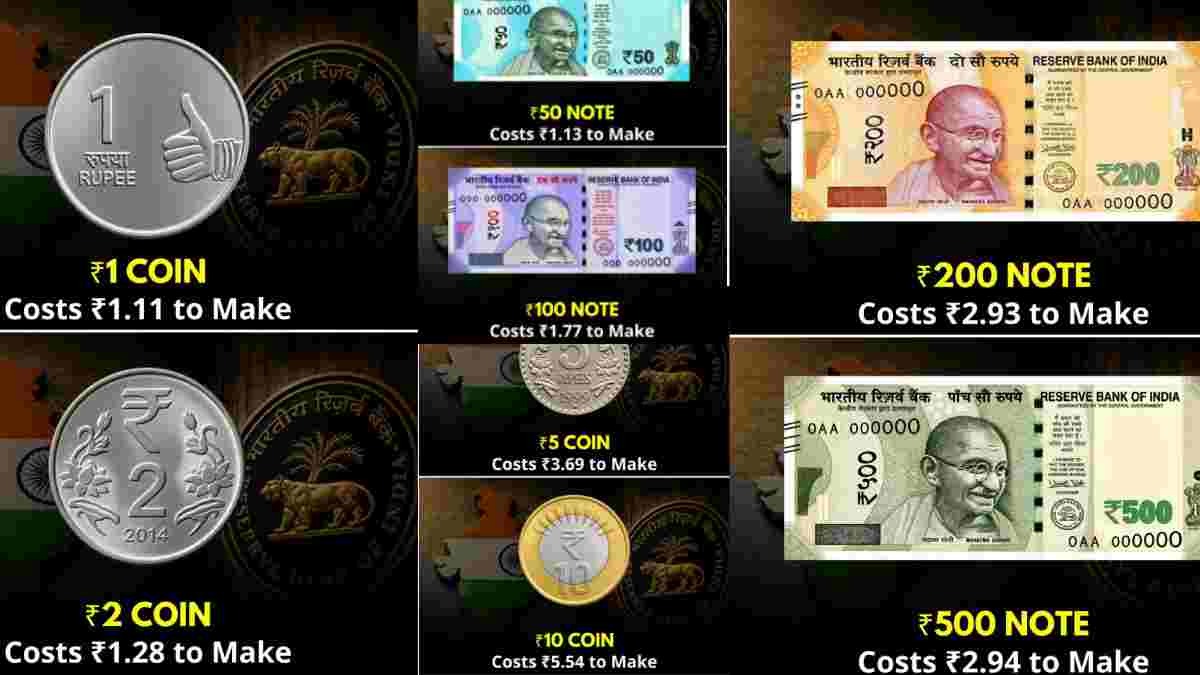
Previously reported figures have shown that lower denomination notes can cost a few rupees to produce, while higher denomination notes can also have production costs running into a few rupees per note.
For example, publicly reported RBI-related data in different years have shown varying costs for denominations such as ₹10, ₹20, ₹50, ₹100, ₹200 and ₹500. These figures can change because the cost of currency paper, security features, printing technology, transportation, and other inputs change over time.
This means that a ₹500 note does not cost anywhere close to ₹500 to produce. It is not because it’s in fact a legal tender, but because it is officially issued as legal tender.
Why is currency production expensive?
Several specialised processes are involved in making a banknote secure.
Currency paper or other approved substrates are manufactured to strict specifications. Notes also have security features that can be checked by the public, banks and currency-processing machines.
These can include watermarks, security threads, latent images, micro-lettering, colour-changing elements and other specialised features depending on the denomination and series.
Special inks and high-precision printing methods are also used. Some features are designed to be visible to the naked eye, while others are intended for machine-based authentication.
The notes are then checked for quality after printing. Defective notes are removed from circulation before the actual currency is distributed through the banking system.
What happens after printing?
Printing a currency note is only one part of the overall currency management process. Once notes are made, they must be securely transported to currency chests and then given to the banks.
The RBI also manages the circulation of banknotes and replaces notes that are worn out or damaged.
So, the total cost of currency management is more than printing one note. It can include materials, printing, quality control, security, transportation, storage, and processing.
Why doesn't India just print more money?
The cost of producing a currency note is much lower than its face value, but that does not mean a government or central bank can print unlimited amounts of money.
The quantity of currency in circulation is part of monetary and economic management. Too much money supply growth can lead to inflationary pressures depending on the economy and other factors.
This is why currency production is closely linked to demand for cash, replacement requirements, economic activity, and monetary policy.
The Real Value is More Than the Paper
A banknote may be made of a special substrate and many security features, but its purchasing power comes from its status as legal tender and the monetary system that is supporting it.
So, next time you hold a ₹100 or ₹500 note, please remember that the manufacturing cost is not even a fraction of the value printed on it. And behind that seemingly simple piece of currency is a sophisticated process involving security printing, specialised materials, quality checks, and secure distribution.