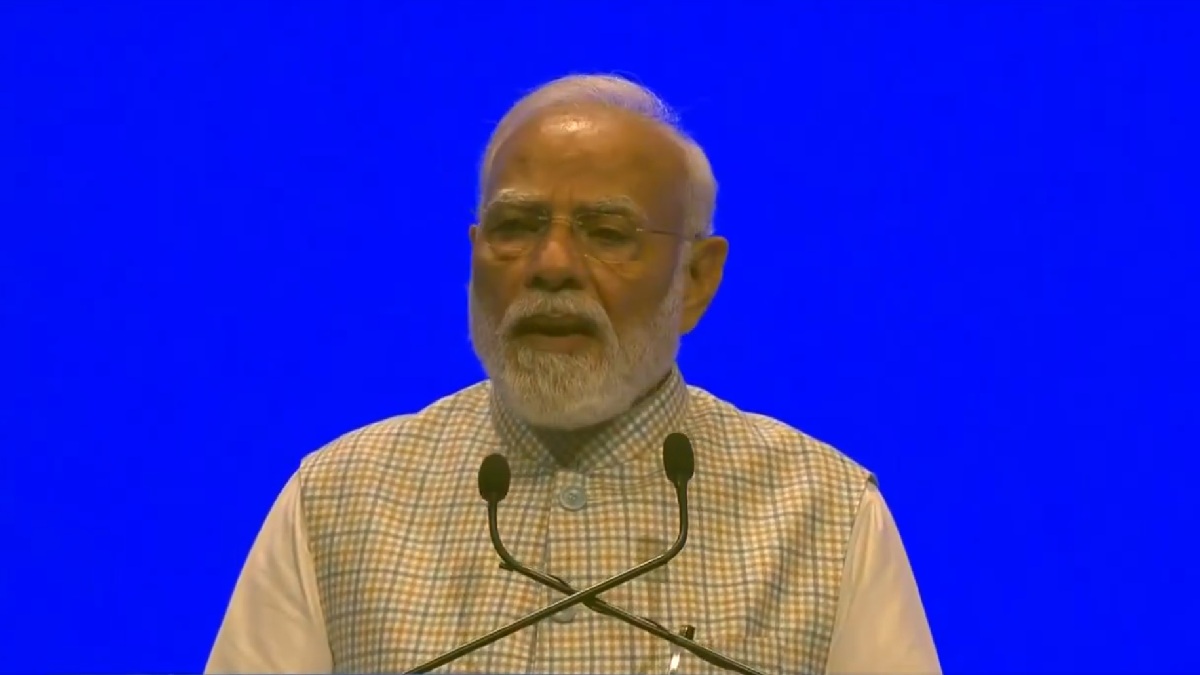
Narendra Modi inaugurated the 10th edition of the India Mobile Congress (IMC) 2026 at Yashobhoomi in New Delhi on October 8, and brought the country's telecom, technology and startup ecosystem into focus. It has brought together tech companies, telecom operators, startups, policymakers and global industry leaders to discuss the theme “Scale Without Boundaries” from 7-10 Oct.
The 2026 edition will focus on the next stage of India’s digital transformation and will have discussions and demonstrations on artificial intelligence, next generation connectivity, 6G, smart mobility, industrial robotics, transport technologies and digital infrastructure. Organisers are expecting more than 1.5 lakh participants including some 100 countries, 500 partners and exhibitors and 600 startups.
PM Modi Highlights India’s Rapid 5G Expansion
Modi also told the IMC gathering that 5G services are rapidly expanding in India’s rapidly growing market share of 5G services and mobile connectivity has played a significant role in the country’s digital transformation.
The Prime Minister said 5G connectivity has reached every district in the country. Government data released earlier this year shows that 5G services were available in 99.9 per cent of India's districts, with 5.23 lakh 5G base transceiver stations installed as of February 28, 2026. In June, 5G base stations were added to 5.63 lakh according to government data.
The expansion of 5G is expected to be the basis for the next generation of digital services. And the government has also been promoting 5G applications in telemedicine, precision agriculture, smart manufacturing and education in addition to faster smartphone connectivity.
The overall telecom infrastructure is also going to support India's preparation for technologies such as 6G, and the government is going to continue to promote research and development in advanced connectivity, quantum communication, satellite networks and telecom security.
Mobile Phones At The Centre Of Digital India
PM Modi also pointed out how mobile phones have changed significantly during the past decade. Smartphones have become gateways towards digital payments, government services, online platforms and other forms of digital access.
The Digital India programme has put mobile connectivity at the heart of the push for access to technology. The transformation has gone beyond communication and smartphones are now vital to accessing financial services and public services.
Government data reveals the scale of this transformation. India’s internet subscriber base had reached 1.09 billion by March 2026 and telephone connections had grown to over 1.34 billion by June 2026. The government has also made the reduction in mobile data costs and broadband connectivity as a factor to encourage wider digital adoption.
The growth of India’s mobile manufacturing sector has been another part of this transformation. India is the world’s second largest mobile phone manufacturer, according to the government, and domestic mobile phone production reached Rs 6.27 lakh crore in FY2025-26.
IMC 2026 Expands Beyond Traditional Telecom
While telecom is still at the heart of the India Mobile Congress, the event has expanded to a much wider technology landscape of the future.
Smart mobility, stadium experiences, industrial robotics and transport technology were added to the agenda of IMC 2026. The event also addresses AI-native telecom networks, intelligent radio access networks, edge and cloud technologies, autonomous networks, semiconductors, AI chipsets and quantum communications.
Artificial intelligence is now one of the main themes of the event. The official IMC programme will look at AI-native telecom infrastructure and the use of AI agents in next-generation networks. It’s a matter of growing overlap between telecommunications and artificial intelligence because we are expecting networks to support more data-intensive applications.
The event’s programme also includes an International 6G Symposium, a Satcom Summit, a Cybersecurity Summit, a Smart Mobility Summit and talks with global telecom operators and technology companies.
Startups And Global Technology Companies Take Centre Stage
IMC 2026 is also a platform for startups and emerging technology companies. Over 600 startups are expected to take part as well as more than 500 partners and exhibitors. The official event platform has more than 2,000 technology use cases and over 900 thought leaders participating in the programme.
As India’s technology ecosystem is now moving beyond software services to areas such as deep technology, semiconductors, AI, telecommunications hardware and even advanced mobility, startups are important in the technology industry.
The event will also facilitate investment and international partnerships. The official program of the event lists hundreds of investor meetings and startups and technology companies will have the opportunity to meet with investors, industry participants and policymakers.
India’s Digital Push Moves Towards 6G
The expansion of 5G is also a stepping stone towards India’s longer-term 6G ambitions. In 2023 the government published the Bharat 6G Vision Document, which laid out its plans for developing and deploying next generation connectivity technologies and building India’s position in the global 6G ecosystem.
Research initiatives supported by the government are projects covering 6G, quantum communication, satellite and non-terrestrial networks, optical systems, indigenous 5G cores and telecom security.
That makes IMC 2026 as much more than just a display of existing mobile technology. Through the technology, research and commercial applications the event is also used to discuss the infrastructure, research and commercial applications that will shape India’s next phase of digital connectivity.
‘Scale Without Boundaries’ Defines IMC 2026
The theme “Scale Without Boundaries” aligns with the event’s broader goal of bringing Indian technology capabilities to a larger domestic and international audience. The official IMC programme is structured on four pillars: Srishti is to build the future; Samvardhan is to drive growth; Sashakt is to enlarge opportunities; Suraksha is to build trust.
Addressing the India Mobile Congress. It is encouraging to see India's telecom sector steadily moving towards greater self-reliance. https://t.co/tIuohkURIE
— Narendra Modi (@narendramodi) October 8, 2026
With over 1.5 lakh expected participants for 4 days, IMC 2026 is a large platform for discussions of India’s telecom growth and emerging technologies.
From the perspective of consumers, businesses and the technology industry, it is a show of how India's digital ecosystem is migrating from basic connectivity to AI-enabled services, smart infrastructure, robotics and advanced communications. The rapid rollout of 5G has laid a foundation for this transformation; and the increasing emphasis on AI and 6G indicates where the country’s technology agenda could move next.
As IMC 2026 continues at Yashobhoomi, the focus is not only on the extent to which India has expanded mobile connectivity, but how that infrastructure can be used to build the next generation of digital services and technologies.