Every year on July 22, India will celebrate the Chandrayaan-2 launch anniversary of Chandrayaan-2 and we will celebrate our second mission to the Moon and it is also the first mission of Indian Space Research Organisation (ISRO).
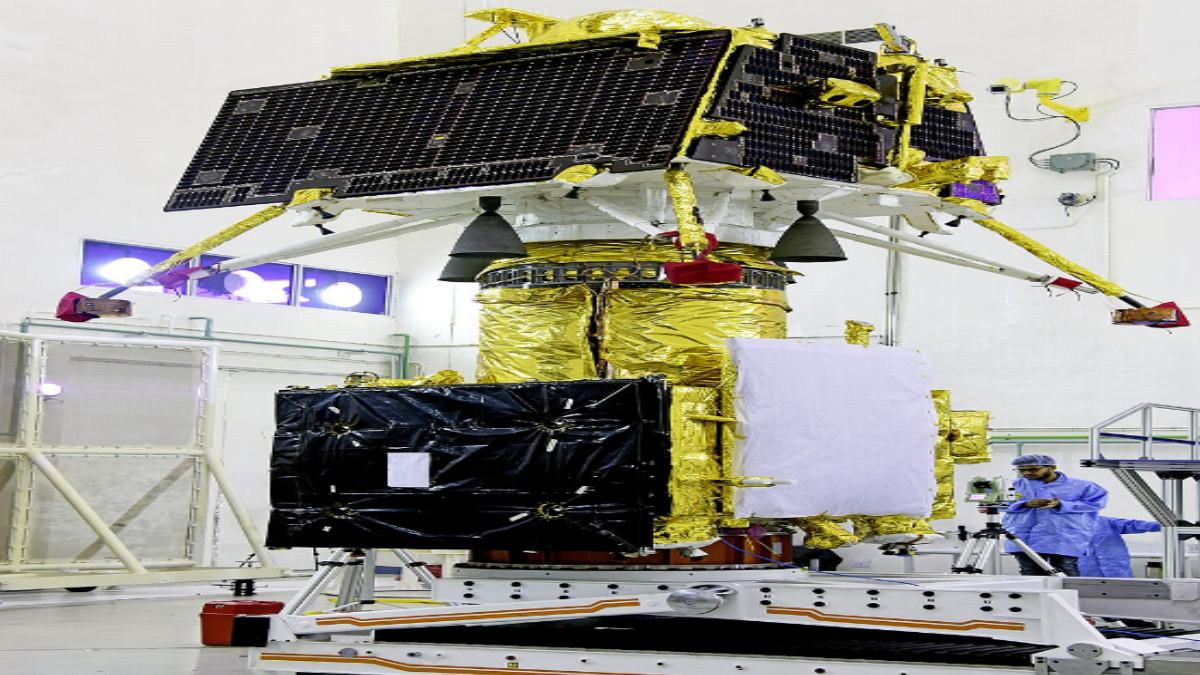
When it was launched from Satish Dhawan Space Centre in Sriharikota on the GSLV Mk III-M1 launch vehicle, Chandrayaan-2 was one of the most ambitious space exploration missions of India.
With the success in Chandrayaan-1 (which discovered water molecules on the moon in 2008), Chandrayaan-2 was designed to take India’s lunar ambitions to the next level. The mission was to allow for a soft landing on the Moon with a rover to carry out scientific experiments on the moon surface, so it was much more complex than its predecessor.
The Chandrayaan-2 mission consisted of three major elements: the Orbiter, Vikram Lander and Pragyan Rover. These systems were designed to study the geology, mineral composition, topography, exosphere, and water ice in the south polar region of the Moon, which is one of the most valuable places on the Moon scientifically.
Chandrayaan-2 successfully completed a series of carefully planned Earth-and lunar-bound orbital orbits before it entered lunar orbit in August 2019. The Orbiter performed extremely well, and still sails on even years after its mission life and is sending data back to Earth. Armed with state-of-the-art imaging and scientific instruments, it has helped scientists to understand the surface and the environment of the Moon so much better.
The mission reached its most anticipated stage on September 7, 2019, when the Vikram lander began its descent towards the lunar surface. The lander lost contact during the last moments of the landing sequence from which it was not successful in a soft landing, but the mission was far from a failure. The Orbiter was fully functional and has since provided us with a lot of data in the past few years and makes Chandrayaan-2 an important success in the history of lunar science with remarkable returns.
The failure in the landing process was of major interest to ISRO and had lessons for future lunar missions. Scientists examined the mission, identified technical improvements and incorporated these into the design of future moon landings. Such dedication to continuous improvement was the key to Chandrayaan-3’s great success as it had a soft landing on the Moon’s south pole on August 23, 2023.
Chandrayaan-2 not only made science discoveries but also demonstrated India's increasing skills in spacecraft design, autonomous navigation, deep-space communication, orbital mechanics and precision in mission planning. It showed ISRO's capacity to conduct high-tech interplanetary missions at a low cost and to the appreciation of the international space community.
Chandrayaan-2 inspired millions of students, researchers, and aspiring scientists in India. The mission created an enthusiasm for science, technology, engineering, and mathematics (STEM) and the young people are aspiring to work in space research and innovation. Schools, universities and scientific institutions continue to celebrate the mission as a symbol of determination, resilience, and scientific excellence.
India’s reputation around the world for spacefaring became better with Chandrayaan-2. The data collected on the Moon by the Orbiter is still used to support global studies and to better understand the Moon’s composition, surface evolution, and distribution of water that may be used in future human exploration.
Chandrayaan-2 is a great example of the way science is made and made by persistence and innovation and learning from challenges.
On its launch anniversary on July 22, Chandrayaan-2 is a reminder of the country's relentless quest for knowledge and technological progress. And not only did the mission expand India's scientific abilities and lay the groundwork for future achievements, like Chandrayaan-3. Chandrayaan-2 inspires confidence in India's position in space exploration and is a continuing symbol of our nation’s thirst to expand our horizons beyond Earth.