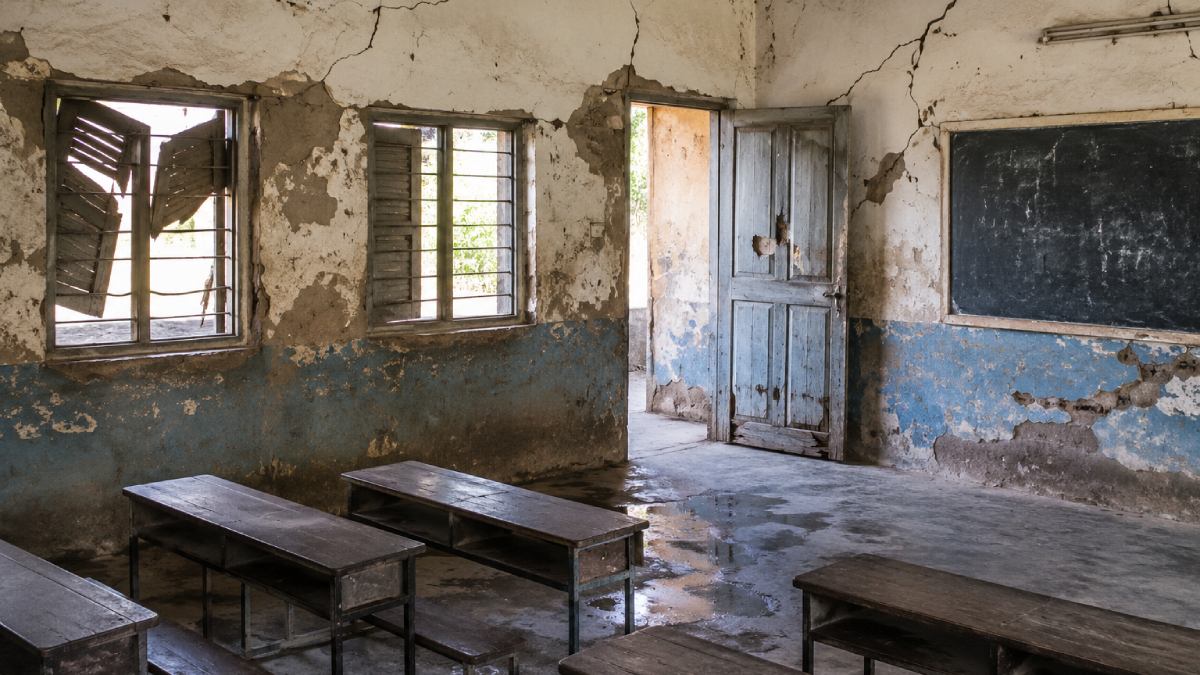
There are serious concerns regarding the condition of a government school in Kalaburagi, Karnataka, where students and teachers still have classes in a building that is alleged to be dangerously dilapidated. The school is situated at Old Jewargi Road in Jewargi Colony and has become a symbol of the infrastructure challenges still facing many government educational institutions in various parts of the country. It has cracked walls, broken doors and windows, damaged flooring, and visible structural damage in the building has led to the fear that it might collapse if necessary repairs are not made.
As long as there is no alternative facility for students, classes are held every day. Teachers and children are forced to continue to do their study in classrooms where safety is a concern. Not only is the physical building structure deteriorated to a point where students cannot concentrate on the subject, but the atmosphere is also affected, and in general, the students cannot be at a high level of learning.
The school building has been neglected for decades so much that portions of the building are in poor condition, as reported by the newspaper. The walls have been cracked, doors and windows have gone bad, and dampness has spread throughout classrooms, especially during monsoon time. Such conditions make structural damage worse and make life even worse for students and teachers.
Parents and local residents are worried about the safety of children in the school. A student’s safety could be jeopardized if the elderly building continues to be used in the rainy or windy weather conditions, one of the community’s voices has said.
The issue is emblematic of what government schools in many places of India are facing to improve education, and it is because of the infrastructure that a failure of those schools results not just in poor education but also in poor education. Education experts believe that in order to have a good education, not only do we have to get good teachers, but also we need good classrooms in which we can learn.
Poor infrastructure is very important for students to attend school, and in general, teachers say. Students with damaged roofing, leaking ceilings, broken furniture, poor ventilation, or unsafe electrical systems have negative effects on learning and are also very health and safety risks in school. Students studying in such situations may also have anxiety and distraction; they may not be able to focus during lessons.
Teachers working in aging school buildings also find it difficult to navigate those classes. Handling overcrowded and unsafe classrooms, inadequate facilities, and maintenance issues can put extra pressure on educators that are already committed to delivering good education. Teachers are also often in favor of better infrastructure and ask for repairs and upgrades in their local councils and schools.
Infrastructure development has been one of the central and state education priorities for public schools under various state and central governments. School construction, sanitation and drinking water, digital skills training, and school maintenance have been implemented all around the country. However, older school buildings need to undergo regular structural assessment and renovation to be safe for their continued use.
The Kalaburagi school’s poor condition has revived calls for a full structural audit and, if necessary, to temporarily relocate students from the school for repair or reconstruction work. Civil engineers suggest that buildings in serious structural distress, with visible cracks and water damage, should be thoroughly investigated for safety and should be inspected for structural problems before they can be declared habitable.
Parents too have been saying that all children deserve education in a safe and dignified environment. Infrastructure shouldn't be an obstacle to learning, and school building is part of the future of the students and the nation.
Education is still one of the most effective tools for social and economic growth, but only if we provide students with secure and functional learning facilities. The situation in Kalaburagi is a reminder that even if education reforms are so much about curriculum, technology, and teacher training, physical infrastructure is just as important for quality education.
As the safety risks grow, local residents, parents, and teachers hope the concerned authorities will act quickly. Structurally safe and supportive education should be the goal for every child, as the children should be able to learn without fear.