The legal battle over bike taxi services in Karnataka has now reached the Supreme Court, with the state government challenging a Karnataka High Court order that had opened the door for authorities to consider applications for operating motorcycles as transport vehicles and bike taxis.
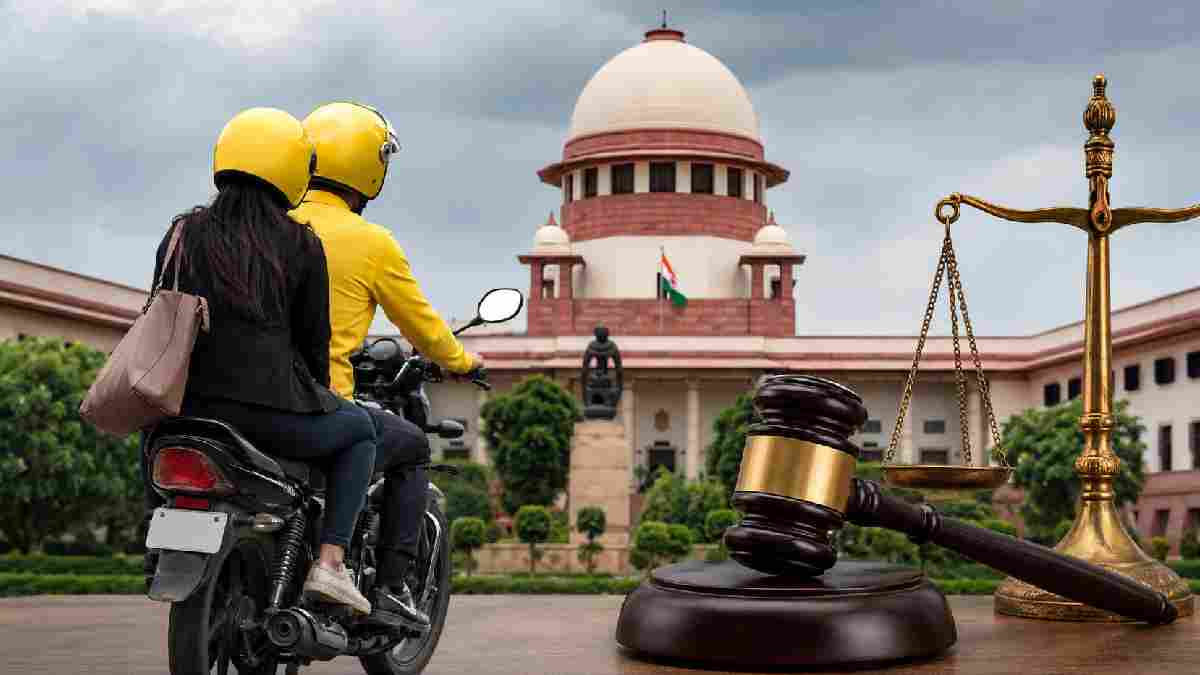
The Karnataka government has raised serious concerns over passenger safety, insurance coverage, women’s security, regulatory gaps and the legal status of motorcycles being used for commercial passenger transportation.
The state has also filed a Special Leave Petition (SLP) before the Supreme Court to question the High Court’s January 23, 2026 decision.
Karnataka Government Challenges High Court Order
Bike taxis in Karnataka have been in a long series of litigation.
Earlier, a single-judge bench of the Karnataka High Court ordered that bike taxi operations should be halted until the state government formed an appropriate policy for them.
The order was challenged by several parties, including Ola, Uber, Rapido, motorcycle owners and the Bike Taxi Welfare Association.
The appeals were then heard by a division bench of the High Court. In January 2026, the division bench passed an important order directing authorities to consider applications for registration of motorcycles as transport vehicles and permission to operate them as bike taxis.
The ruling paved the way for bike taxi services to resume or increase in the state. But the Karnataka government has now approached the Supreme Court, saying the High Court order poses several legal and practical problems.
Passenger Safety Is a Major Concern
One of the Karnataka government’s central arguments before the Supreme Court is passenger safety.
The state says motorcycles don't have several of the passenger protection features of autorickshaws and car taxis, and passengers on motorcycles are not supplied with them. If an accident occurs, passengers on motorcycles could be significantly more vulnerable to serious injury and death.
As such, the government has claimed that allowing motorcycles to carry passengers for commercial purposes requires a comprehensive regulatory framework covering safety standards, driver responsibility, insurance protection, vehicle inspection and passenger rights.
The state also has raised questions over compensation in cases where a bike taxi passenger is seriously injured or killed in an accident.
Women's Safety Also Under Scrutiny
Women’s safety is another important issue that the Karnataka government is focusing on.
Unlike conventional taxis, where passengers travel inside a vehicle, bike taxi passengers sit directly behind the rider on a two-wheeler. The state believes this means that safety considerations need to be ensured before large-scale commercial operation is allowed.
The government has said driver background verification, monitoring mechanisms, complaint-handling systems and emergency assistance are needed.
It has maintained that a clear regulatory framework should define the responsibilities of drivers and aggregators as well as offer passengers a mechanism to report safety issues.
State Says Motorcycle Commercial Use Is Not Completely Banned
The Karnataka government has also rejected the argument that it is trying to completely prevent motorcycles from being used for commercial purposes.
The state said motorcycles can continue to be used for delivery and logistics purposes.
The government has said that platforms such as Swiggy, Zomato, Amazon and Flipkart could still use motorcycles for food, goods and package deliveries.
The state has also referred to the Karnataka Platform Based Gig Workers (Social Security and Welfare) Act, 2025, under which platform-based workers are provided with social security and welfare-related protections.
Thus, Karnataka argues that restrictions on bike taxi passenger services should not be interpreted as a complete ban on earning a livelihood by motorcycles.
Motor Vehicles Act And Permit Dispute
The state government has argued that the Motor Vehicles Act, 1988, does not provide an absolute right to operate every category of vehicle as a taxi.
According to Karnataka, the authority to grant contract carriage permits is with the relevant transport authorities and remains subject to their discretion.
The state has maintained that transport authorities can reject applications when there are genuine public safety or regulatory issues.
Karnataka has also questioned the High Court's interpretation that motorcycles can fall within the definitions of a "motor cab" or "contract carriage" for commercial passenger transportation.
The state says motorcycles are primarily designed for personal transportation and shouldn’t necessarily be regarded as vehicles intended or suitable for commercial passenger carriage.
Existing Aggregator Rules May Not Cover Bike Taxis
Another important issue raised by Karnataka concerns the Karnataka On-Demand Transportation Technology Aggregator Rules, 2016.
The government has claimed that these rules were primarily framed around motor cabs and do not specifically provide a regulatory framework for motorcycles being used as taxis.
According to the state, this regulatory gap makes it necessary to establish a separate legal and policy framework for bike taxis.
Such a framework could address commercial registration, permits, insurance, driver verification, passenger safety, vehicle standards, pricing, complaints, and emergency response.
High Court Had Relied On Constitutional Right
In light of this, the Karnataka High Court had concluded that operating a taxi service is a legitimate profession protected under Article 19(1)(g) of the Constitution.
The High Court had also noted that there was no clear statutory provision, rule or notification explicitly banning bike taxi services in Karnataka.
So, the court had held that an unwritten restriction could not simply be treated as a reasonable restriction on the right to carry on a lawful occupation.
The Karnataka government has challenged this reasoning before the Supreme Court.
The state has referred to a March 18, 2026 response by the Union Ministry of Road Transport and Highways in the Rajya Sabha, which said that the Motor Vehicles Act does not specifically define the term "bike taxi".
Karnataka argues that the absence of an express prohibition should not automatically be interpreted as creating a positive legal right to operate bike taxis.
White Board And Yellow Board Issue
The state government has also highlighted practical problems related to vehicle registration.
Motorcycles registered for private use generally have white number plates, while commercial transport vehicles have yellow number plates.
According to Karnataka, the existing regulatory framework does not clearly establish how privately registered motorcycles should be converted into commercial transport vehicles for use as bike taxis.
The government also pointed out the lack of clarity around dual private and commercial registration or conversion of vehicles.
These issues, the state says, indicate why a regulatory framework should be in place for large-scale bike taxi operations.
Traffic And Environmental Concerns
Karnataka has also raised broader public-interest concerns of traffic congestion and the environment.
The state has said such bike taxi operations could affect urban traffic patterns and increase the number of commercial two-wheelers operating on already congested roads.
The government has also claimed that restricting widespread bike taxi operations could help avoid about 13.9 lakh tonnes of carbon dioxide emissions annually. It has also argued that better public transportation and urban mobility management via a structured system should be a priority.
What could the Supreme Court decide?
The decision of the Supreme Court could have implications for Karnataka as well as other Indian cities and states which are wrestling with the issue of app-based bike taxi services.
We can not just decide if bike taxis should be allowed or restricted.
The larger question is whether motorcycles can legally be used for commercial passenger transportation under the existing motor vehicle framework and, if they can, what safety, insurance, licensing and regulatory standards should apply?
Bike taxi operators and aggregators are most likely to concentrate on affordable transportation, convenience, reduced travel time and employment opportunities for the riders.
The state, meanwhile, is focused on passenger safety, insurance coverage, women’s security, driver accountability, vehicle classification and regulatory oversight.
The Supreme Court's final decision could therefore influence the future of bike taxi services in Karnataka and potentially how similar services are regulated across India.
For now, the future of Karnataka's bike taxi industry is uncertain, and the next phase of the legal fight will be closely looked at by passengers, riders, aggregators and policymakers.