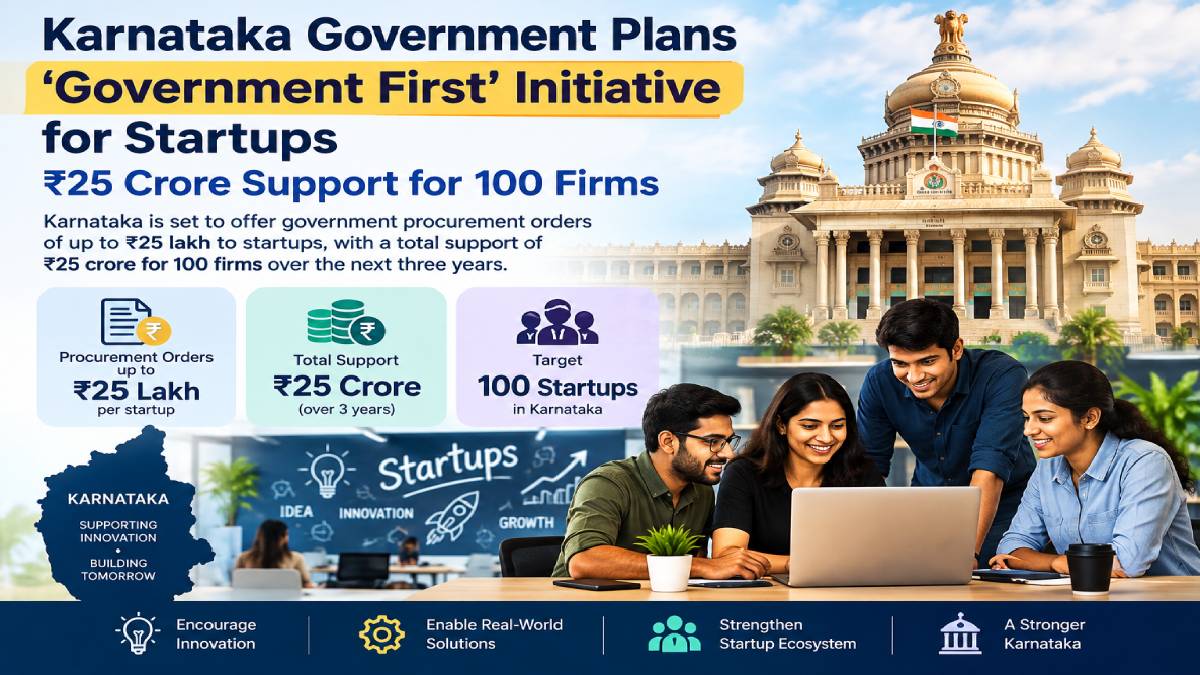
Karnataka is developing a new initiative to make the state government a customer for startups and could provide selected young startups with government procurement orders of up to ₹25 lakh for every startup. For the proposed programme, the state has decided to spend ₹25 crore to support around 100 startups in the next three years.
This kind of initiative is meant to solve one of the main challenges early companies encounter—finding their first significant customer and showing that their products or technology can scale. Unlike traditional vendors who have business records, government departments could give startups the ability to test and deploy new solutions in real-world public-sector environments.
According to recent reports, the proposal is going to be placed before the Karnataka Cabinet for consideration. It will be framed along the lines of a “Government First” model where the government will be the early adopter and customer of the startup solution.
Based on the framework, selected startups would receive work orders of up to ₹25 lakh. If the ₹25-crore allocation is divided equally among 100 startups, the average support would be ₹25 lakh per startup, and the actual allocation will depend on the solution, project requirements, and selection process.
This initiative would be particularly valuable for startups in technology, artificial intelligence, citizen services, governance, public administration, and other areas where innovative products can address government problems.
A big hurdle for young companies looking to get government contracts is the need to show previous experience, turnover, and financial capacity. Karnataka has already taken steps to reduce some of these barriers for startups in public procurement. The state startup framework has relaxed previous experience, turnover, and earnest money deposits, and previous government programs have encouraged startups to participate in public procurement.
The programme would build on that broader policy direction by providing startups a more direct route to government customers. It could enable companies to go beyond prototypes and pilot projects and demonstrate their products in actual government operations.
The Karnataka IT-BT Department has long advocated the idea of making the government the first customer of a startup. A previous initiative called for startups to be recruited in a Preferential Market Access framework so government departments and public sector units could buy products and services from innovative companies.
This new proposal is therefore a potential extension of Karnataka’s bid to connect its startup ecosystem with public procurement.
It might also be good for government departments. Startups often develop specialist technology that can solve challenges more quickly and effectively than traditional procurement models. Digital services, automation, artificial intelligence, data-driven governance, and other new solutions can be tackled with new technologies.
At the same time, a structured selection process would be necessary to make sure that public money is put towards startups with credible products and measurable results. A selection mechanism is being considered, and government departments could potentially provide datasets, facilities, and opportunities for testing solutions.
Karnataka already has a big startup ecosystem. As of July 30, 2026, Karnataka has 2,772 startups registered as sellers on the Government e-Marketplace, 1,951 in Bengaluru, according to data shared by the Union government.
If implemented and approved in the right way, the proposed ₹25-crore programme could provide a significant market access opportunity for early-stage companies. A government work order can help startups more than just make money; it can also be a vehicle for product validation, operational experience, credibility, and a reference customer that can help them get private sector customers and investors.
The proposal also aligns with Karnataka’s broader strategy to strengthen its position as India’s technology and innovation hub and encourage startups to come up with solutions to real-world governance issues.
However, the ₹25-crore allocation and the proposed ₹25-lakh work-order limit are still in the planned framework until the government formally approves and notifies the programme. The eligibility conditions, selection criteria, number of startups, and procurement mechanism are all to be determined by the government.
If implemented, the “Government First” approach could provide Karnataka startups with the kind of opportunities that are hard to obtain in their early years: not just funding or incubation, but a real opportunity to be part of a government technology partner and present their solutions at scale.