The United States and India are entering a new phase in their space relationship, with cooperation increasingly evolving into what US ambassador to India Sergio Gor called co-creation. Gor spoke at the 9th Bengaluru Space Expo (BSX), and said cooperation between the two countries was no longer limited only to knowledge sharing and technology sharing but more about developing the next generation of space capabilities.
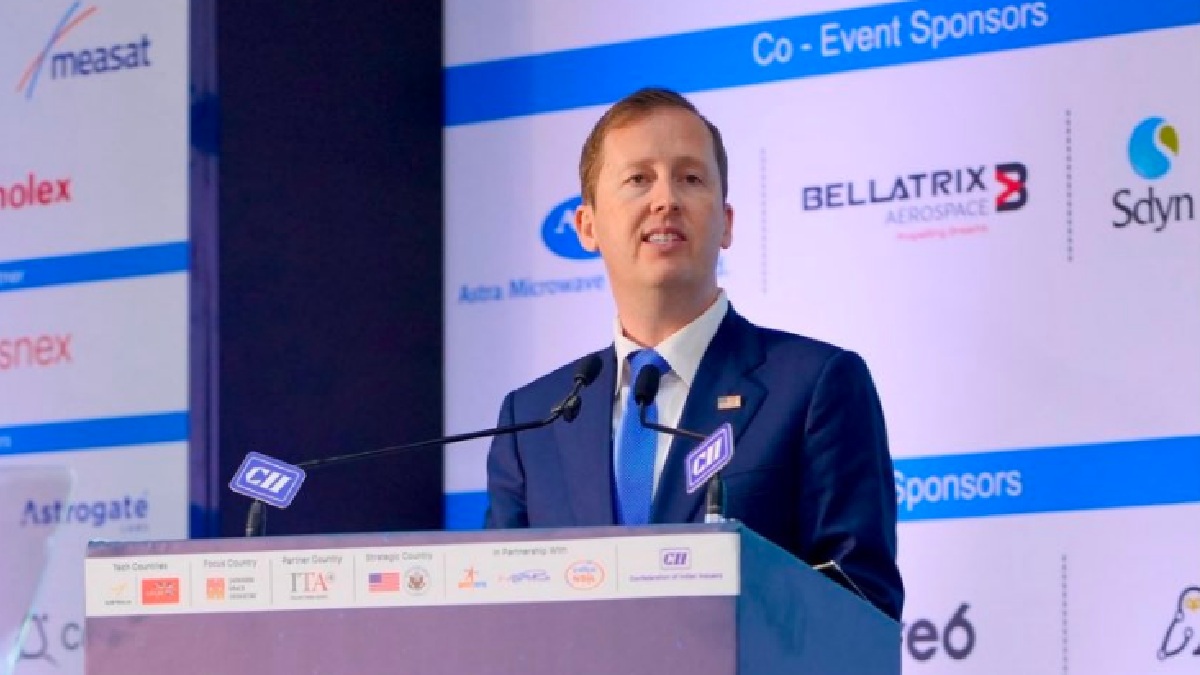
Gor said the discussion at the Bengaluru Space Expo showed how far the bilateral relationship in the space sector has come. “These countries are now and have been designing instruments, co-funding startups and co-authoring the future of human discovery,” he said. His comments underline Washington and Delhi’s growing aspirations to harness their abilities to develop technology, commercial opportunities and scientific missions for the expanding global space economy.
The ninth edition of BSX was organised by the Confederation of Indian Industry (CII) in partnership with the Indian Space Research Organisation (ISRO), the Indian National Space Promotion and Authorisation Centre (IN-SPACe) and NewSpace India Limited. The event brought together the space industry, government and private sector as India is expanding the role of commercial companies and startups in space ambitions.
Gor pointed to the complementary strengths of the two countries as one of the biggest advantages of their partnership. The United States has large private capital, established commercial ecosystems and a mature space industry while India offers advanced engineering capabilities, scientific expertise and a rapidly growing startup ecosystem. The ambassador described the combination as a “new dream team” that could potentially make major breakthroughs.
The US envoy also linked the growing space partnership with the broader strategic relationship between Washington and New Delhi. He said US President Donald Trump and Prime Minister Narendra Modi recognised the potential of the two countries’ technological strengths through the TRUST initiative, or Transforming the Relationship Utilising Strategic Technology. The initiative is aimed at strengthening collaboration in strategic and emerging technologies.
Gor said that the United States is also looking to expand the Commercial Service presence in Bengaluru to create a better commercial relationship between American companies and Indian innovators. He said the two countries were collaborating in so many different sectors and that the scale of the engagement was unprecedented. He cited bilateral trade (which he said has reached $240 billion) as well as collaboration in pharmaceuticals, technology and defence.
One of the best examples of the space partnership is the NASA-ISRO Synthetic Aperture Radar (NISAR) mission. Gor described the joint Earth-observation satellite as an example of that space technology delivering practical benefits on the ground. NISAR’s radar capabilities can provide valuable information even when cloud cover, dust or other conditions make conventional observation difficult, he said.
Referring to a devastating earthquake in Venezuela, Gor said NISAR’s radar data were used to help emergency responders locate affected areas despite dense cloud cover and dust. “[This mission] is more than just a scientific accomplishment,” he said, “but a life-saving application of jointly developed technology.”
The ambassador also highlighted India’s growing participation in human spaceflight. He recalled Group Captain Shubhanshu Shukla’s journey to the International Space Station on board the Axiom-4 mission last year as an accomplishment for India, which was secured through American cooperation. The mission also enhanced cooperation between the two countries in human spaceflight and scientific research.
After the Axiom-4 mission and five separate scientific studies, the two nations are now looking at docking standards, interoperability and astronaut training. Gor said this progress showed how technological cooperation can create new capabilities and, in turn, increase ambitions for future missions.
The next major frontier could be the Moon. Gor said India was a signatory to the Artemis Accords and that NASA had formally invited ISRO to participate in the Moon base programme. He said the United States is committed to returning to the lunar surface and wants India to partner with it.
“Make no mistake, we’re going back to the Moon, and we want India by our side on the lunar surface,” Gor said, and highlighted the strategic importance of India's participation in future lunar exploration.
His comments come as both countries are moving beyond their own missions to a more integrated space ecosystem. Greater cooperation between American companies, Indian startups and government-backed space programmes could open up a range of opportunities from satellite manufacturing and Earth observation to human spaceflight, lunar infrastructure and advanced research.
A call to India and the U.S. to build a global space economy ended Gor’s speech. He says the two countries should harness their technological capabilities and shared dreams to show how free nations can shape the future of space exploration.
The move from cooperation to co-creation signals an ever more ambitious phase in India-US space ties. With joint missions like NISAR, human-spaceflight cooperation after Axiom-4 and the possibility of the partnership to work together in future lunar missions, the partnership is moving towards a model in which both countries would be able to work together on technology, commercial ventures and scientific capabilities in the space exploration field.