In a landmark decision regarding matrimonial law, the Karnataka High Court has ruled that a financially independent and high-earning wife is not entitled to claim maintenance from her husband if she can provide for herself. Maintenance is not a substitute for a spouse who has no means of livelihood, but the other way around, to supplement a spouse’s income and support him, to keep him alive.
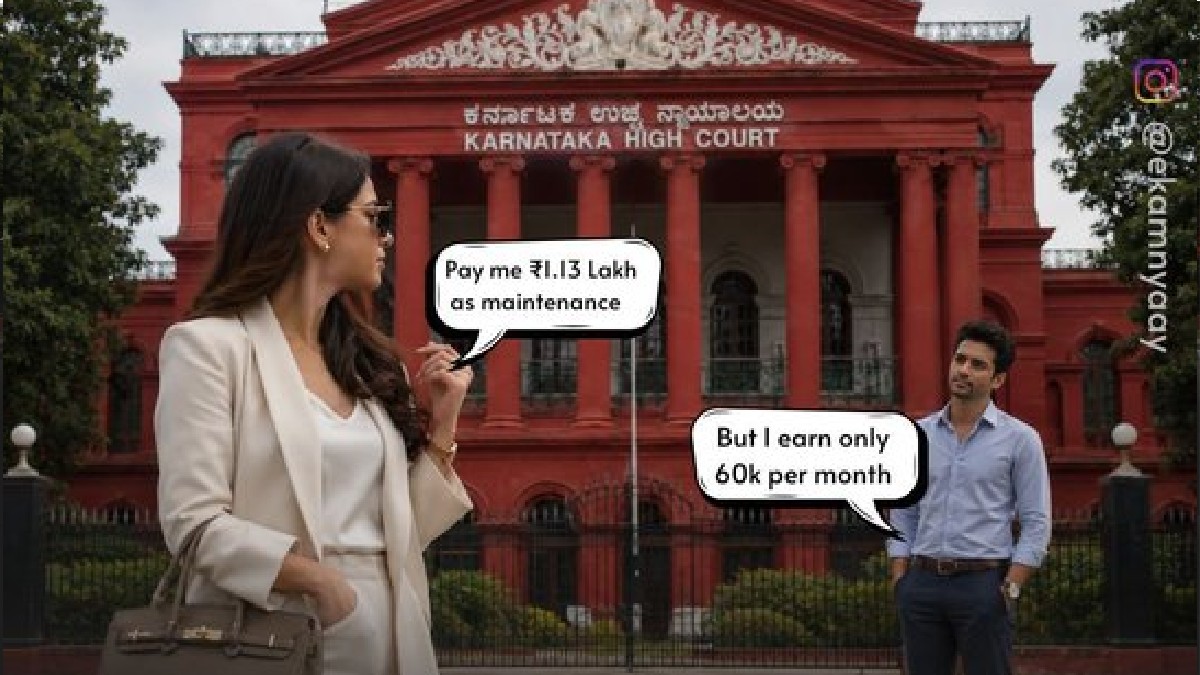
With respect to the financial status of both spouses when deciding maintenance claims, the decision has been of interest to legal experts and family law practitioners.
Court's Observations
While hearing the matrimonial dispute, the High Court examined the income, employment status, and financial capacity of both parties.
The court noted that the wife was in a good-paying job and was earning a substantial salary, which she could afford to pay her own bills. So this was not the case, and telling the husband to pay maintenance was not justified under the maintenance provisions of Indian law.
In a separate case, maintenance is designed so that the spouse who does not have enough money to support herself after separation or during the legal process can continue to do so.
Because each case has to be decided based on its own facts, and the financial condition and earning capacity of the parties involved.
Purpose of Maintenance Under Law
Indian matrimonial laws support maintenance to provide financial security to a spouse who lacks adequate resources to support themselves.
The maintenance may be claimed under any legal provisions, including the Hindu Marriage Act 1955, Protection of Women from Domestic Violence Act 2005, and Section 125 of the Bharatiya Nagarik Suraksha Sanhita (previously Section 125 of the Code of Criminal Procedure) on the basis of the case.
Most courts consider several factors before deciding maintenance (e.g.
The income and financial resources of both spouses.
The standard of living enjoyed during the marriage.
Employment status and earning capacity.
Dependents and financial obligations.
Health and age of the parties.
Other relevant circumstances affecting financial needs.
No single factor can be directly given the outcome, and courts will consider each matter.
Financial Independence Matters
The Karnataka High Court said that when a spouse can earn enough to sustain a reasonable life standard, the main objective behind awarding maintenance may no longer apply.
Legal experts say that the ruling is part of a trend towards judicial consideration of the actual economic status of both spouses, rather than the financial dependence on them only through gender.
But they note that being employed does not disqualify a person from receiving maintenance. Courts will still determine if the income is sufficient to meet reasonable living expenses and whether there is a significant disparity in the financial position of the spouses.
Case-Specific Decision
Lawyers say maintenance decisions are highly fact-specific.
Even if a wife is employed, courts may still grant maintenance if her earnings are significantly lower than her husband's or not enough to afford a living that is comparable to his.
Similarly, courts may refuse maintenance if evidence is shown that the claimant is financially secure and able to support themselves independently.
The present judgment, therefore, should not be taken to be a universal rule applicable to all working women.
Married : 2024
— Deepika Narayan Bhardwaj (@DeepikaBhardwaj) June 29, 2026
Separated : In 2 Months
Her salary : 1.6 Lac pm
His salary : 60K pm
Her demand : 1.1 Lac pm maintenance
Lower court granted : 20K pm
So Her salary : 1.8 Lac pm
His salary : 40K pm
Karnataka HC intervenes
Cancels entire amount given to her@ekamnyaay pic.twitter.com/OhIe5cdMAB
Legal Community Reacts
Family law practitioners have said that a ruling that confirmed existing legal principles rather than establishing a new legal standard is not new.
According to legal experts, courts have always maintained that maintenance is not only on account of entitlement but also of necessity.
The ruling also demonstrates the judiciary’s focus on fairness between both spouses and that the maintenance provisions must continue to serve the individuals who need financial support and to do so in a fair way.
Broader Significance
At a time when more women are entering professional careers and earning money, the courts are more necessary to assess maintenance claims based on actual economic reality.
The judgment is indicative of changing social and economic circumstances, but also that maintenance laws are welfare-oriented and are meant to alleviate financial hardship rather than provide an extra financial benefit where no real need exists.
But legal experts are reluctant to generalize the ruling, because every matrimonial dispute is at least as different as the evidence and financial situation.
Conclusion
The Karnataka High Court's decision is important in that maintenance under Indian law is based on fairness, financial need, and the individual facts of each case.
By refusing maintenance to a high-earning, financially independent wife, the court reaffirmed that maintenance is meant to support where the real financial need exists. The ruling will be cited in future matrimonial disputes on such questions of financial independence and entitlement, while leaving room for courts to see each case on its own.