Charles Freer Andrews was an Anglican priest, Christian missionary, educator, social reformer and supporter of the Indian independence movement. Although he was born in Britain, Andrews had a deep connection with India and its people.
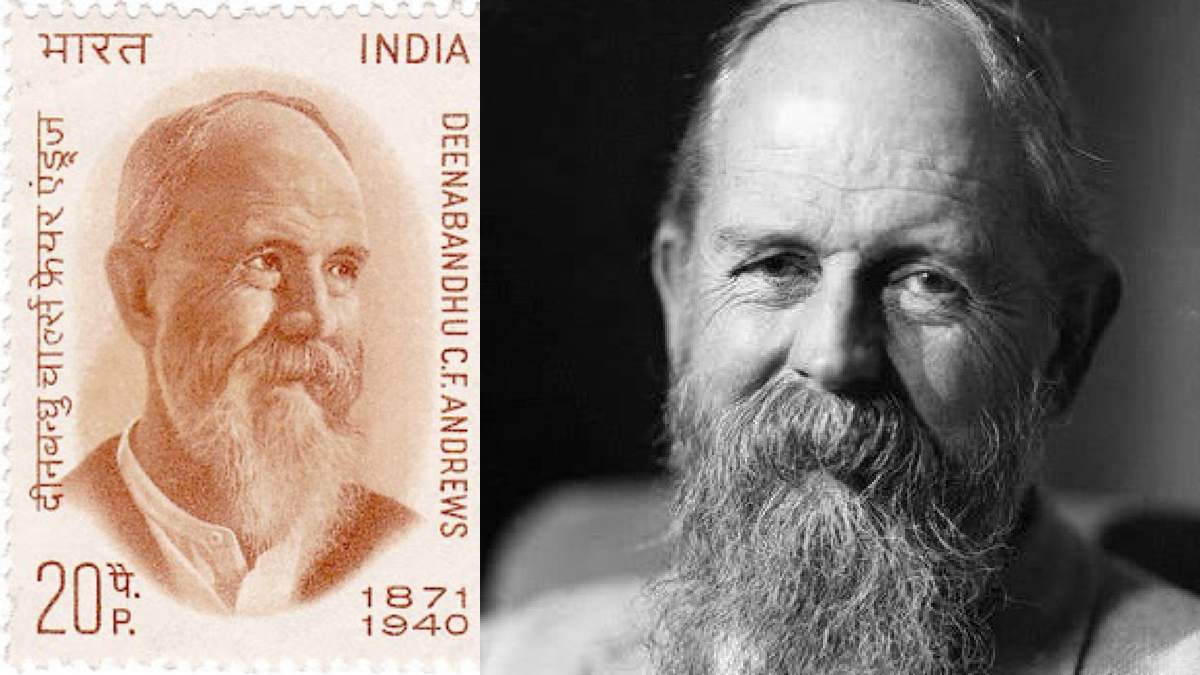
He was a close friend of Mahatma Gandhi and Rabindranath Tagore and played a key role in the defense of Indian rights.
Due to his dedication to India and his work for the poor and oppressed, Mahatma Gandhi and students of St. Stephen’s College in Delhi gave him the affectionate name “Deenabandhu” (friend of the poor).
Early Life
Charles Freer Andrews was born on 12 February 1871 at 14 Brunel Terrace in Newcastle upon Tyne, Northumberland, United Kingdom. His father, John Edwin Andrews, was an bishop at the Catholic Apostolic Church in Birmingham. He was one of 14 children in a big family.
He was educated at King Edward’s School in Birmingham and studied Classics at Pembroke College, Cambridge.
He was awarded the Carus Greek Testament Prize in 1895. During his time at Cambridge, Andrews gradually slipped away from the Church of England’s religious tradition and was eventually accepted for ordination.
His Journey to India
In 1904, Andrews joined the Cambridge Mission to Delhi and travelled to India. He began teaching philosophy at St. Stephen’s College in Delhi.
His experiences in India had a huge impact on his life. Andrews witnessed racial discrimination and the unequal treatment of Indians under British rule. His experiences deeply affected him and gradually brought him closer to India’s political and social struggles.
Rather than being a missionary and educator, Andrews began to support Indian labor and political leaders. Later in life, he became affiliated with the Indian National Congress and helped settle a cotton workers' strike in Madras in 1913.
His Friendship With Gandhi
Andrews’ ties to India’s freedom movement got stronger when Gopal Krishna Gokhale asked him to travel to South Africa to help the Indian community there in dealing with political disputes with the government.
Andrews met Mohandas Gandhi, then a 44-year-old Gujarati lawyer, during his visit. The meeting developed into a close and lasting friendship.
Andrews admired Gandhi’s commitment to nonviolence, or *ahimsa*, as well as his understanding of Christian teachings and values. Gandhi also respected Andrews for his sincerity, compassion and commitment to justice.
They remained friends for many years. Gandhi referred to Andrews affectionately as “Christ’s Faithful Apostle” with the initials of his name, C.F.A. Andrews was also one of Gandhi’s closest British friends and was known for addressing him by his first name, Mohan.
Work for Workers and Social Reform
Andrews was actively involved in workers’ rights and social reform. He was elected President of the All India Trade Union both in 1925 and 1927.
He also worked to promote greater understanding between different religious communities. Andrews encouraged dialogue between Christians and Hindus, and had a close intellectual friendship with Rabindranath Tagore.
He spent a lot of time in Santiniketan where he talked to Tagore about religion, education, society and human values. Andrews supported efforts to end untouchability and stood up against discrimination faced by oppressed communities.
His Later Years
As the Indian independence movement developed, Gandhi eventually felt that sympathetic British supporters such as Andrews should allow Indians themselves to lead the struggle for freedom.
Andrews spent much of the time in Britain from 1935 onwards. He visited and talked to young people about Christianity, social justice and the importance of living according to the teachings of Christ.
Andrews had a great emotional attachment to the country and people after leaving India. He kept in touch with Gandhi and Tagore, and was a key member of his legacy.
Death and Legacy
Charles Freer Andrews died on 5 April 1940 in Calcutta while he was visiting. He was buried at the Christian burial ground of Lower Circular Road Cemetery in Calcutta.
Andrews will be remembered as an exceptional British figure who stood with Indians in the face of injustice and colonial discrimination. He lived by his commitment to equality, social reform, workers’ rights and friendship across cultures.
His friendship with Gandhi and Tagore was also a great link between India and Britain. He was born in Britain but worked in India and had personal relationships in India, so India was very much a part of his life.
Deenabandhu (friend of the poor) was the affection and respect he earned for serving Indian society.