Since the Shakti scheme launched in June 2023, Karnataka’s Shakti programme on free bus transport for women and girls has helped to increase public transport usage throughout the state. Many millions of women are able to travel on government-run bus services without paying bus fares, and this is why people are using it so much more.
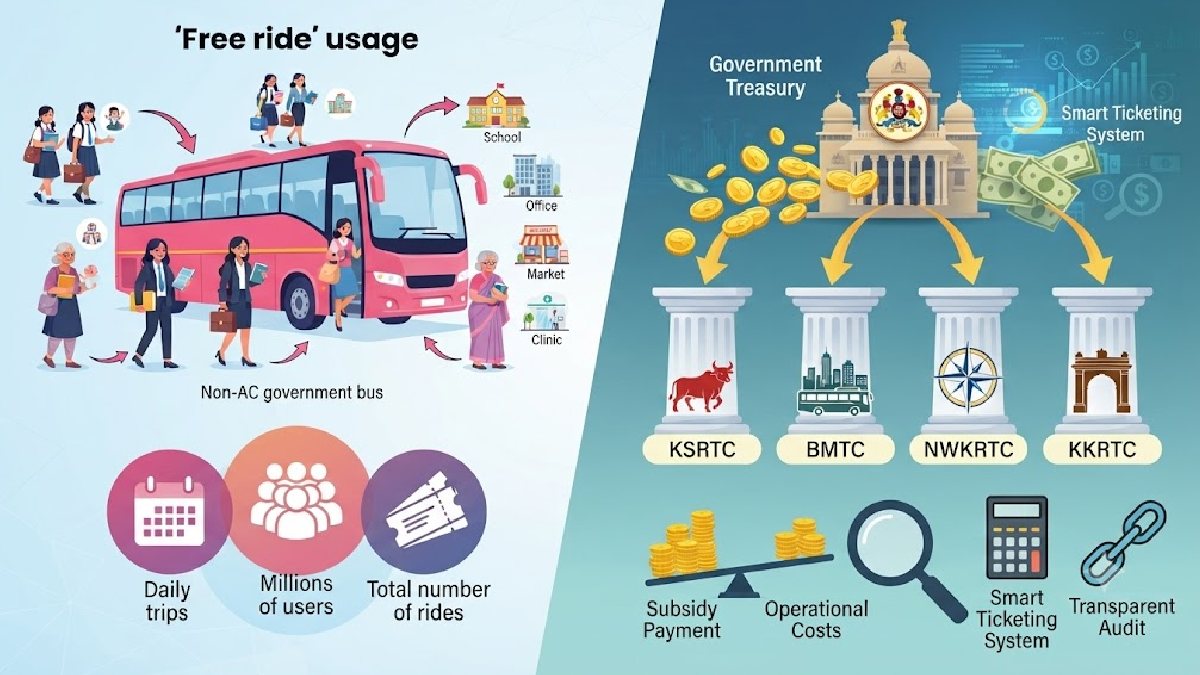
However, the financial mechanism of the scheme is under discussion as the state’s four transport corporations have around ₹5,650.95 crore in pending reimbursements from the government.
According to the information given by the Karnataka Legislative Council in the report, the four transport corporations spent about ₹20,955.96 crore on Shakti scheme travel between June 2023 and July 2026. The government has reimbursed ₹15,305.01 crore, leaving a balance of ₹5,650.95 crore.
How does Karnataka’s Shakti scheme work?
The Shakti scheme was introduced on June 11, 2023, with the aim of providing free travel for women who are residents of Karnataka on eligible government-operated bus services in the state.
The benefit is generally applicable to non-AC bus services, and luxury and some special services are excluded. The passengers who are eligible are required to carry a valid photo identity document while travelling.
The scheme has reduced the direct cost of public transportation for women and promoted bus use for employment, education, healthcare and other basic services.
But a free ticket for a passenger does not mean there is no cost in the journey. The transport corporation still has to operate the bus, pay workers, purchase fuel or electricity, maintain vehicles, and meet other operational costs. Under the scheme, the government is required to pay back the fare-per-service amount that the transport corporations would be required to pay.
Around 75.68 lakh free Shakti journeys every day
The scale of the programme can be seen from its passenger numbers. According to smart-ticketing tender documents related to the scheme, around 75.68 lakh free Shakti journeys were recorded per day in January 2026.
The number of annual Shakti trips has also increased steadily
During the 2025-26 financial year, around 275.70 crore Shakti journeys were recorded. This was higher than the 244.65 crore journeys recorded in 2024-25 and 183.06 crore journeys in 2023-24.
According to reports presented in the Legislative Council, the total number of free Shakti tickets issued between June 2023 and July 2026 was around 797.16 crore.
The increasing usage is a testament to the scale of the programme and also shows the need for a recurring reimbursement process between the government and transport corporations.
Four transport companies have the financial responsibility
The Shakti scheme is being implemented through Karnataka's four major state transport corporations:
Karnataka State Road Transport Corporation (KSRTC), Bengaluru Metropolitan Transport Corporation (BMTC), North Western Karnataka Road Transport Corporation (NWKRTC), Kalyana Karnataka Road Transport Corporation (KKRTC).
Together, these companies operate a huge public transportation network. Based on recent tender documents, the four corporations operate around 26,000 buses, with almost 1.2 crore boardings every day.
There are high recurring costs of running such a large network in terms of fuel, electricity, salaries, spare parts, vehicle maintenance, insurance, and other operational costs.
Hence, the delay in reimbursement is a cash-flow issue for transport companies, even though the amount is money that the government is expected to reimburse under the scheme.
Who pays for a ‘free’ bus ride?
The central financial problem with the Shakti scheme is how the cost of free travel is ultimately financed.
Women eligible under the scheme do not pay the fare when they take qualifying journeys. But the price of operating the service remains. Buses need fuel or electricity, drivers and conductors have to be paid, and the vehicles always need to be maintained.
Thus, the fare that would have been paid in the name of eligible passengers has to be compensated by the government’s reimbursement mechanism.
This means that “free travel” means that the passenger doesn’t pay the fare directly. The underlying cost is still borne by public finances and government payments to the transport corporations.
The transport department wants to receive the funds to complete the program
According to the information cited in the reports, the transport department requested the finance department to release pending funds in August 2026.
The finance department said there was no scope for further allocations at that point, according to the reports.
At the same time, a ministerial response reported that the government had provided around ₹18,459.37 crore in financial assistance to the four transport corporations for various purposes over the past three years.
The figures show the financial relationship between the state government and transport corporations, beyond the reimbursement for Shakti journeys.
The ₹5,650.95 crore pending is not the same as the total transport corporation loss.
An important distinction is needed when considering the ₹5,650.95 crore
The pending amount represents reimbursement from the government to the transport corporations under the Shakti scheme. It should not automatically be treated as the total loss suffered by the transport corporations due to the scheme.
The overall financial condition of a transport corporation is influenced by fuel and electricity costs, employee salaries, maintenance expenditure, debt obligations, revenue from other passengers, other concessions, and the corporation's overall operating income and expenses.
So in this case, the pending reimbursement figure indicates the amount still to be settled under the government-backed scheme.
I think the smart ticketing system will be better for tracking
We have also found that Karnataka is moving toward a smart-ticketing system to improve the recording and verification of Shakti journeys.
The proposed system will capture details including the transport corporation, route, service, trip, depot, vehicle, ticketing device, GPS location, and estimated ticket value associated with individual Shakti journeys.
A more detailed digital record could make it easier to determine the number of eligible free journeys, calculate the reimbursement due to each corporation and track travel across different routes.
Such a system could also provide a more transparent basis for calculating the government's financial liability under the programme.
What happens next?
Because the Shakti scheme is in use more and more, the social and financial impact has become the most important issue (e.g., the Shakti scheme is now a popular initiative).
For women passengers, the scheme removes the direct cost of eligible bus travel and can make public transport more accessible for work, education, healthcare and other daily needs. For transport corporations, however, the corresponding fare has to be accounted for through government reimbursement.
With the increase in usage, the amount that needs to be reimbursed can also increase. Delays in settling the dues can put even more pressure on the operating finances of the transport corporations.
The reported ₹5,650.95 crore pending reimbursement therefore puts the spotlight on the need for a predictable and transparent settlement mechanism. In the future, the main issue is not the fare paid by passengers, but how the government finances the cost of the journeys and ensures that transport corporations receive the eligible reimbursement on time. To do so at the scale of millions of journeys each month, it is important to have sustainable financial mechanisms to operate this scheme.