A startling development in Telangana’s postgraduate medical admissions has triggered widespread debate after a candidate who scored just 1 out of 800 marks in the National Eligibility-cum-Entrance Test for Postgraduate (NEET-PG) secured admission to the MS Orthopaedics programme at Kamineni Academy of Medical Sciences, Hyderabad.
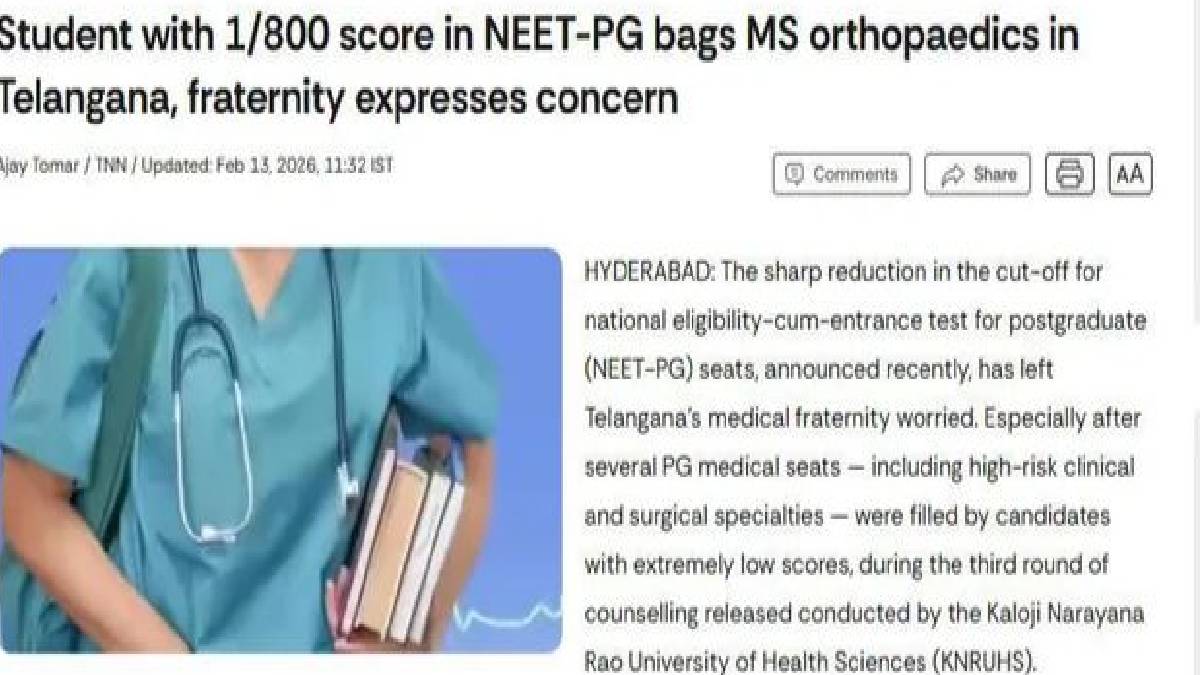
The admission, which took place through the Telangana state counselling process, has reignited debates over the fairness, transparency and quality standards of postgraduate medical admissions in India. Doctors, medical students, education experts and the general public have been shocked at the admission of such low-score candidates into one of the country’s most sought-after surgical specialties.
According to counselling records, the candidate was allocated the seat in the mop-up round under the Competent Authority Quota. Reports say that the candidate belonged to the Scheduled Tribe (ST) category and thus she was eligible in counselling as the qualifying percentile for reserved categories has been reduced.
The controversy stems from the National Medical Commission (NMC) and Medical Counselling Committee (MCC) reducing the qualifying percentile for NEET-PG to the 0th percentile for some categories in order to ensure that vacant postgraduate medical seats across the country could be filled. As a result, virtually every candidate who appeared for the examination became eligible to participate in the counselling process, irrespective of their score.
And although the policy was initiated so that hundreds of valuable postgraduate medical seats would not remain vacant, critics say it has had adverse results. Most believe that allowing poorly trained candidates with low scores into critical clinical specialties to be placed in those professional roles could dilute the quality of specialist training and ultimately hurt patient care.
MS Orthopaedics is widely regarded as one of the most competitive postgraduate medical courses in India. It requires years of intensive surgical training, clinical decision-making and hands-on patient management. In the past, admission into Orthopaedics has been strongly dependent on the NEET-PG score of the aspirants due to intense competition.
The recent allocation has so far become a flashpoint in the debate about the balance of seat use with academic merit.
Medical professionals have different opinions. Some say that once the criteria are formally changed, all eligible candidates are entitled to counselling and take any available seat. They note that counselling was conducted according to the prevailing rules and institutions cannot arbitrarily reject eligible candidates.
Others, however, feel that admission eligibility and professional competence are separate issues. Postgraduate medical education, especially in surgical areas such as Orthopaedics, requires a strong academic foundation, and lowering the threshold too soon would damage public confidence in the health system.
The event has also revived the need for policymakers to re-examine the counselling system that is currently in place. While filling vacant seats is important, experts say, more efficient means of filling them should be considered, but not to the point of leaving medical seats unfilled.
The conflict extends beyond one case of admission. Other candidates with very low NEET-PG scores also were admitted to postgraduate seats in Telangana in counselling after the qualifying percentile was reduced. This has led to calls for more transparency in the admission process and a thorough review of admissions processes.
Neither counselling authorities nor Kamineni Academy of Medical Sciences has indicated any procedural irregularity in the allotment. The admission appeared to have been made in accordance with the eligibility criteria and counselling guidelines at the time.
As the discussion goes on, the case has become a focal point in the wider discussion on merit, reservation policies, seat utilisation and maintaining excellence in India's medical education system. How the existing framework strikes the right balance remains an active public and professional debate.