Prime Minister Narendra Modi has hailed the "Reform Express" - driven by the National Democratic Alliance (NDA) government as a powerful validation of India's growth path. It comes after the First Advance Estimates by the National Statistics Office (NSO) which project India’s Real GDP to grow in FY26 at a robust 7.4%.
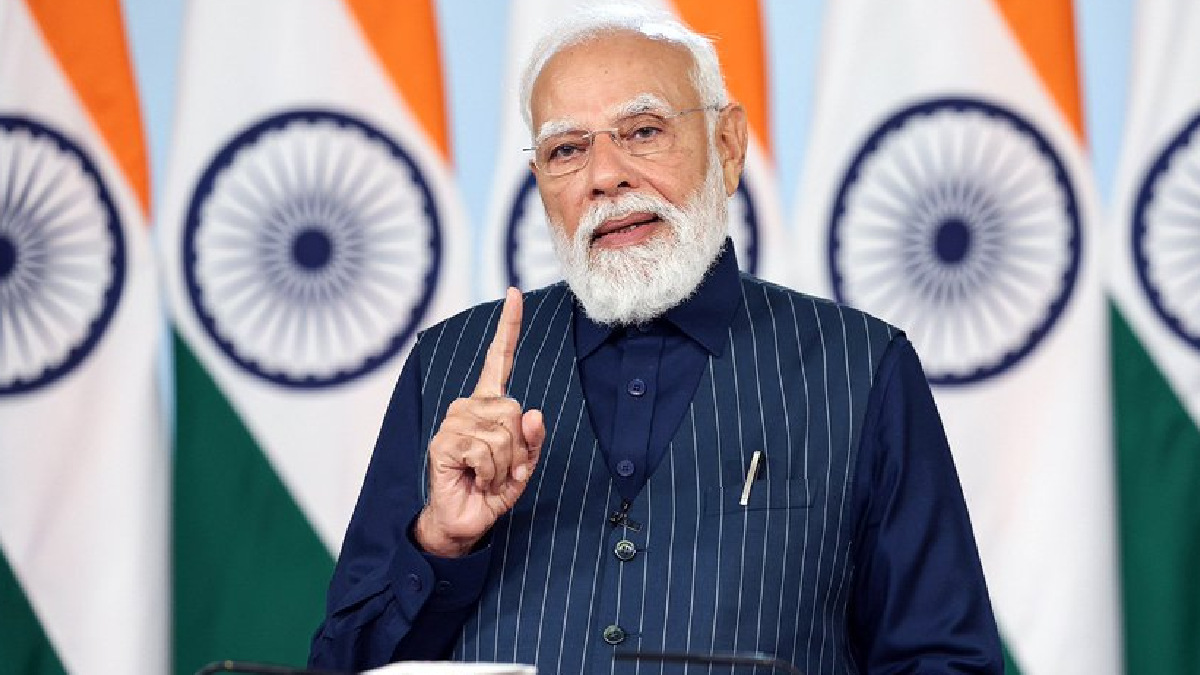
This is a pretty fast track as compared to the 6.5% jump in real growth in FY25, making India the world’s fastest-growing major economy and a leap back onto its feet as the planet’s fastest-growing economy. The Prime Minister took to social media and stressed that this momentum was a direct consequence of both comprehensive investment-led as well as demand-driven policies.
That’s continuing momentum from the Reform Express in India. This is driven by the NDA Government’s holistic investment drive and demand-driven policies. Be it infrastructure, manufacturing incentives, digital public goods or ‘Ease of Doing Business’, we are working for our dream of a prosperous India.’ — Prime Minister Narendra Modi.
Key Drivers of the 7.4% Growth Forecast
The NSO data points to a recovery spanning sectors where the services industry and manufacturing are the main agents of the "Reform Express."
The Services Sector Boom
The tertiary sector continues to provide the backbone of the Indian economy. Financial services, real estate, and professional services are expected to grow at a stellar 9.9%. So, you also have an economy full of growth: Trade, hotels, and transport services will have a 7.5% expansion, meaning that domestic travel and consumption are fully back up.
Manufacturing and Construction Resilience
Supported by PLI schemes in the field, along with "Make in India," the manufacturing sector is set to grow at a rate of 7%. Construction activity also follows with the same projected mark of 7.0% under the aggressive government's capital expenditure (CAPEX) for highways, railways and urban infrastructure.
Investment and Consumption
An important highlight in the FY26 figures is the 7.8% increase in Gross Fixed Capital Formation (GFCF), an indicator of investment. This would suggest that it is only now that the private sector is working with the government to expand capacity. The demand side has suggested that PFCE is expected to increase at 7.0%, with recent relief on income tax and GST rationalizing.
The Global Context:
India Outshining Peers In the global economy, with headwinds. Among them are trade war situations that will not allow India the opportunity to make progress or power production to meet its own needs (purchase in-house products and other industries), the changing cost of energy and various forms of geopolitical crises.
However, India’s internal reforming work represents a protective buffer. India’s rate of 7.4% is still above 5%, far lower than its forecast growth trajectory of China, thus reasserting its position as the world’s “bright spot.” The Nominal GDP projection for this fiscal year ranges at ₹357.14 lakh crore, the total economy is at or around the $4 trillion threshold (estimated at $3.97 trillion). Those figures will be the foundation of the forthcoming Union Budget, which will deliver Finance Minister Nirmala Sitharaman with budget bandwidth to balance welfare spending with sustained infrastructure growth.
We move further along: ‘Viksit Bharat’
The “Reform Express” is not just a political slogan — it is a systematic and systemic shift to a more formalized, digitalized, infrastructure-heavy economy. And given the government continues to polish up the “Ease of Doing Business” and spends on digital public good initiatives like UPI and ONDC, the backdrop looks set for sustained growth of 7%+.
There are challenges ahead, notably to accelerate the agriculture growth rate, which at current sits at a modest 3.1%, but in the end, it feels like there is a glimmer of hope hanging like a fly. If the “Reform Express” continues along as it is, the dream of becoming the world’s third-largest economy by 2030 is attainable.