Bengaluru, the Garden City, Silicon Valley, IT Capital of India, is getting ready to add to its impressive list of achievements. A world-class urban development project called Queen City is set up on the outskirts of Bengaluru, and it will transform Karnataka and make that state one of the world’s leading innovation and investment hubs.
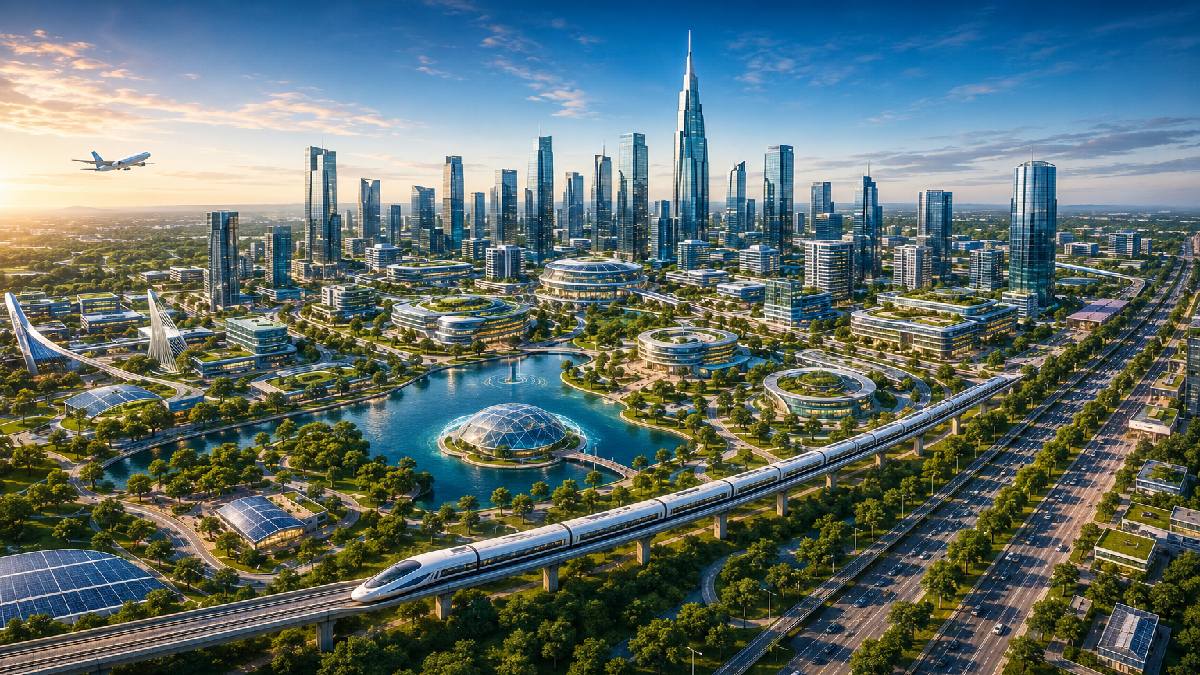
Queen City is expected to be located on around 5,800 acres and attract investments of more than ₹40,000 crore, and will be a futuristic city with a lot of futuristic features inspired by Singapore, Paris and Tokyo. The project is located around 50 km from Bengaluru and is expected to create more than 1 lakh direct and indirect jobs and is one of the most important urban development projects in India.
The project is a next-generation integrated city with technology, education, healthcare, research, manufacturing and sustainable living in one ecosystem. According to officials, Queen City will not just reduce pressure on Bengaluru’s existing infrastructure but also create a new economic growth corridor for Karnataka.
One of Queen City’s greatest attractions is that it is a global education and innovation destination. Plans are being made to bring some of the world’s top universities and research institutions to the city. International educational partnerships can create a knowledge-driven ecosystem and attract students, researchers and innovators from all over the world.
Queen City will be a magnet for emerging technologies to come into play alongside education. Local tech companies in Artificial Intelligence (AI), semiconductors, aerospace, advanced manufacturing, biotechnology and digital innovation are expected to be housed in the city. These industries will play a significant role in India’s technological evolution as well as on the global market.
Healthcare is another major focus area. The city will have world-standard hospitals and medical research facilities, and international healthcare services and medical innovation will be provided. Residents will get state-of-the-art medical infrastructure without going abroad.
The entire 5,800-acre development will be divided into several specialised zones, according to preliminary plans. Education districts, technology parks, industrial and manufacturing hubs, residential townships, healthcare zones, commercial centres, innovation clusters, recreational spaces and green corridors will likely form them. The idea is to develop a self-sustaining city where people can live, work, study and access essential services within a well-planned urban environment.
Sustainability and smart-city technologies will also be the subject of the project. Transport systems, renewable energy integration, digital governance systems and environmentally friendly infrastructure will be at the heart of Queen City's infrastructure, and the city will be the centre of everything. The city should be future-ready and a city with a high quality of life for residents will be the focus of city planners.
The benefits will be huge for Bengaluru residents. It will also create job opportunities, attract foreign investment, develop real estate investment, improve infrastructure connectivity, and establish Karnataka as a world-class innovation center. And it can also alleviate the problem of congestion in Bengaluru through a more convenient place for business and residential growth to occur and to provide a new location to do so in which Bengaluru could be a place of business and residential development.
Queen City, as preparations move forward and agreements with various international institutions and companies are made, is considered a transformational project that will be instrumental in the next chapter of Karnataka’s development story. If executed well, the mega city has the potential to be one of India’s most significant urban and economic landmarks in the next decades.