As of now, more than 10,000 cases still remain in the Supreme Court backlog after more than a decade and 80,660 cases are left pending for more than 30 years in different High Courts. And today the numbers further highlight the magnitude of judicial backlog in India’s legal system and the need for comprehensive judicial reforms, better infrastructure, reliance on technology and better judiciary appointments to make the system more efficient for faster delivery of justice.
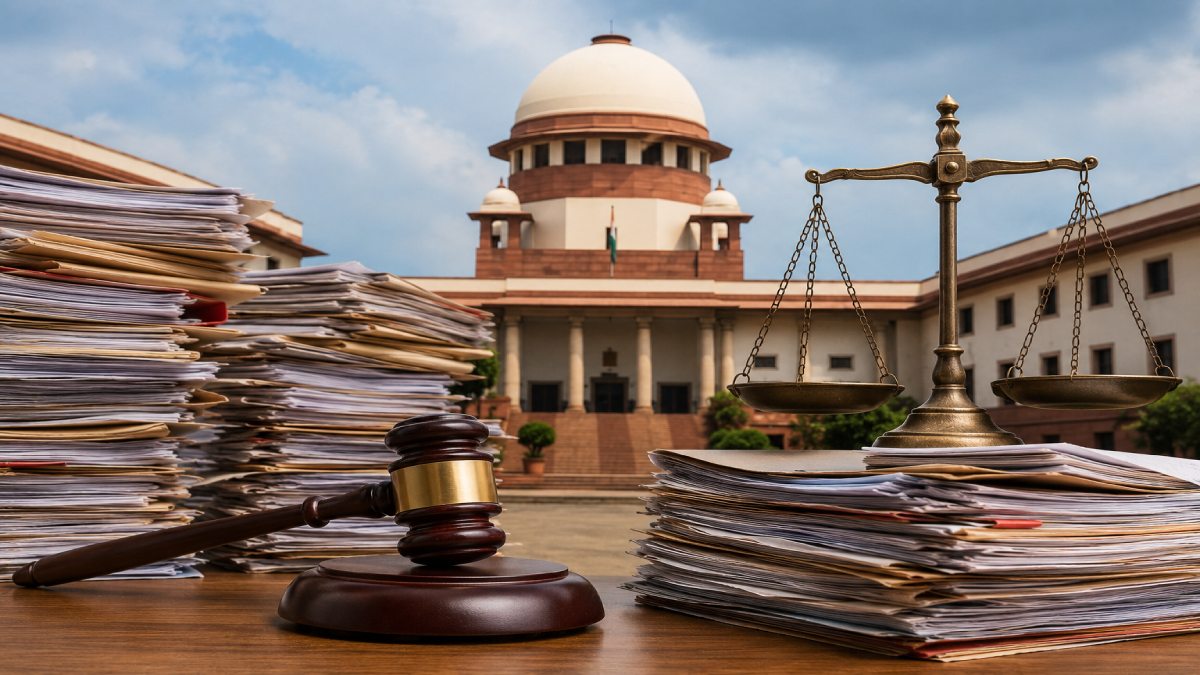
The recent statistics show the mounting burden on courts across the country in which millions of litigants still wait for the resolution of civil, criminal, constitutional, commercial, and public interest matters. The delay in adjudication not only affects people seeking justice but it also affects the business, investment, governance, public confidence in the legal system.
The Supreme Court, India’s highest judicial authority, oversees constitutional interpretation, appeals from High Court, governments’ disputes and public interest matters, and cases with very serious legal issues. While the court routinely dismisses thousands of cases in a year, the accumulation of older matters continues to be a big administrative and judicial challenge.
The situation in the High Court is even more pressing. The cases that have been going on for decades can involve complex civil disputes, land acquisition disputes, property disputes, service-related litigation, taxation disputes, commercial disputes, family disputes and criminal appeals. Long-term litigation often results in multiple generations of families being at the mercy of the courts which delay property settlements, inheritance claims, compensation disputes and contractual enforcement.
And legal experts say that there are several reasons for judicial delays. These include the fact that there are lots of vacancies in the judiciary, courts are overburdened with lawyers, infrastructure is not sufficient to hear cases and adjournments are frequent, procedural problems arise, there is a lack of experienced staff and too many cases are filed annually. In some cases, repeated appeals to multiple courts also take longer to resolve.
The Government of India and the judiciary have introduced several measures to improve the process of case management and reduce pendency in recent years. Digital filing systems, virtual court hearings, e-Courts projects, online case tracking, digitization of court records, artificial intelligence-assisted legal research and video conferencing have significantly modernized judicial administration. Digitalization has made the process of court cases accessible and efficient as the majority of the cases are conducted online in recent years.
The process of appointing judges to constitutional courts is still an important component of the backlog of legal cases. Filling judicial vacancies in a timely manner will help to distribute workloads more effectively and increase disposal rates. Expert opinion includes expanding courtroom infrastructure, strengthening lower courts, appointing more judges, and strengthening administrative support systems.
Alternative dispute resolution (ADR) mechanisms (mediation, arbitration, conciliation and Lok Adalats) are increasingly considered to be efficient means of mitigating pressure on conventional courts. These mechanisms can help to protect judicial resources and deliver quicker outcomes for litigants through the ability to negotiate and resolve suitable disputes outside of lengthy litigation and can also provide a mechanism for finding a resolution.
Business leaders and investors closely monitor judicial efficiency because a quicker dispute resolution is said to be the key to the success of any business. And with an efficient enforcement of contracts and a predictable outcome, investment decisions and economic growth are both highly influential.
Policies are often expensive for ordinary citizens; long-term litigation typically carries emotional, financial and social costs. Long-term legal proceedings can also entail many court appearances, legal costs, and years of uncertainty. For this reason, we believe judicial efficiency is a huge public policy goal that can be improved.
The pendency figures now reflect both the successes and challenges of India's judicial system. Despite the huge number of cases every year filed, the growing number of filings and the accumulation of older ones demand sustained institutional change, technological advancement, adequate judiciary staff and efficient processes.
As the judiciary, legal professionals and stakeholders are still working to improve the justice delivery system, reducing case pendency is a must for timely access to justice. The backlogs of more than 10,000 Supreme Court cases pending for more than a decade and 80,660 High Court cases awaiting disposal for over 30 years are evidence of the need for continued reforms in India to move faster, more efficiently and more quickly for every citizen.