India's rural employment architecture has undergone its most significant overhaul in twenty years. The Viksit Bharat - Guarantee for Rozgar and Ajeevika Mission (Gramin) Act, officially known as G RAM G Act 2025 has replaced the landmark Mahatma Gandhi National Rural Employment Guarantee Act of 2005. Although it is hailed by the government as a visionary reform that matches up with the intent of Viksit Bharat @2047, this has led to fierce political debate. Most recently, the dispute had drawn into the Karnataka State Assembly a constitutional standstill.
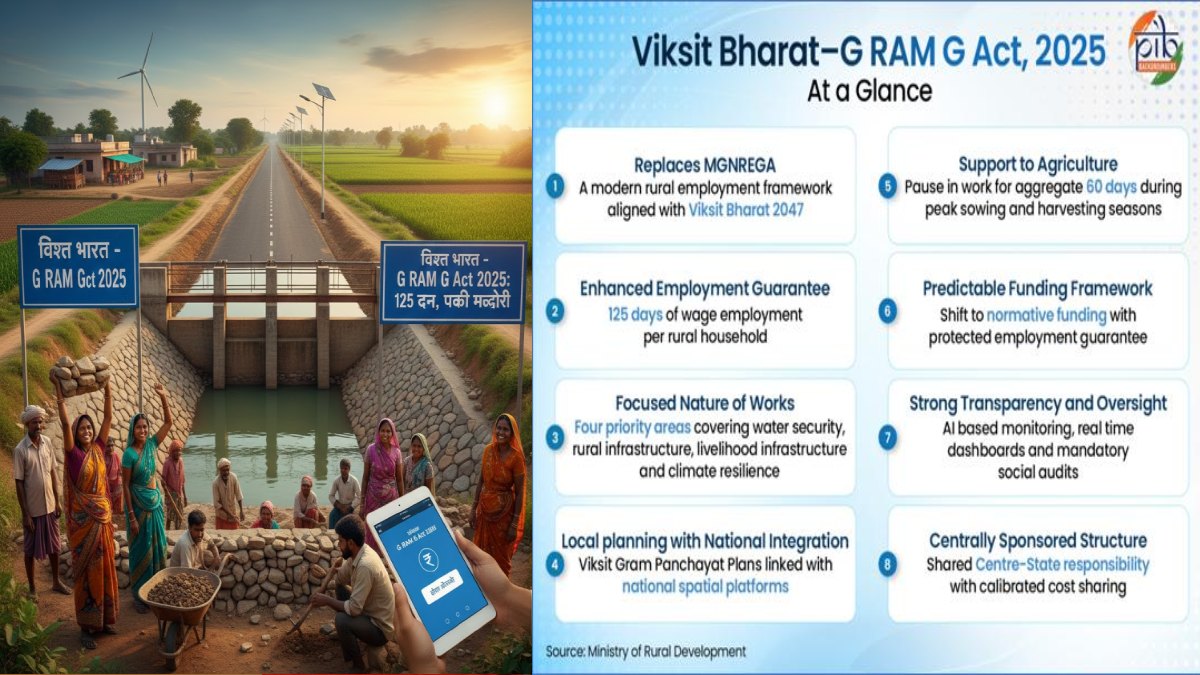
Key features of the G RAM G Act
A number of structural improvements is set out in the new Act for modernizing rural labor and infrastructuring:
The statutory guarantee has been increased from 100 days to 125 days unskilled manual labor per rural household per financial year.
The ‘Agricultural Pause’: During peak farming seasons, States can stop public works for 60 days by issuing a notice. This should ensure that farm labor is on the other side, able to do sowing and harvesting jobs, without competing with any government projects.
Creating durable assets Unlike the generally disdainful image of MGNREGA as a digging and filling hole-focused model, the G RAM G Act has four priority pillars:
- Water Security (Groundwater recharge and conservation).
- Basic rural infrastructure (roads and connectivity).
- Livelihood Infrastructure (Markets and warehouses).
- Climate Resilience (Mitigating the effect of severe weather events).
Weekly Wage payments To combat the problem of late payments, for instance, that seems to plague us all and yet remain persistent, weekly pay-outs have been a legal requirement under the Act. To maintain productivity and thus limit unemployment, each wage being transferred with a strict 15-day upper limit.
The Funding Friction: How States are Protesting
The two most controversial aspects of the G RAM G Act, however, are in its monetary structures. Under MGNREGA, the Central Government covered 100 per cent of the unskilled wage costs. Under G RAM G Act, it has transitioned to a Centrally Sponsored Scheme (CSS):
- 60:40 The Sharing ratio now requires most states to share 40% of wage costs from their own budgets.
- Normative Allocations: The Centre will now impose “pre-defined budget caps” for each state. Any spending above this level has to be completely financed by the State Government, sparking concerns that the “right to work” is being replaced by a “budget-capped” policy.
Political and Social Backlash
Opposition-ruled states, including Karnataka and Tamil Nadu, have levied severe criticism against the Act. Taking “Mahatma Gandhi” out of the name,” critics say, is politically motivated. More substantively, they argue, the 60:40 funding split unfairly offloads more resources onto the poorer states.
The tension came to a head on January 22, 2026, when Karnataka Governor Thaawarchand Gehlot exited the Assembly after he refused to read parts of a speech criticizing the G RAM G Act and saying the state was violating a Parliamentary law.
The G RAM G Act 2025 marks a transition away from a mere "welfare" to a form of "development" agenda. If effectively implemented, the 125-day guarantee and concentration on climate-resilient assets could revolutionize rural productivity. Even so, the efficacy of this mission will rely on the Centre and States working to rectify the 'funding gap' and make certain that this digital-first governance policy does not leave the very workers it set out to shield behind.