The Tamil Nadu government has approached the Supreme Court against a recent Madras High Court order that calls for the government to see that no cow or calf is slaughtered on Bakrid or any other day in Tamil Nadu. The state has argued that the High Court order is a blanket ban that goes against the law and was not stated in the original petition.
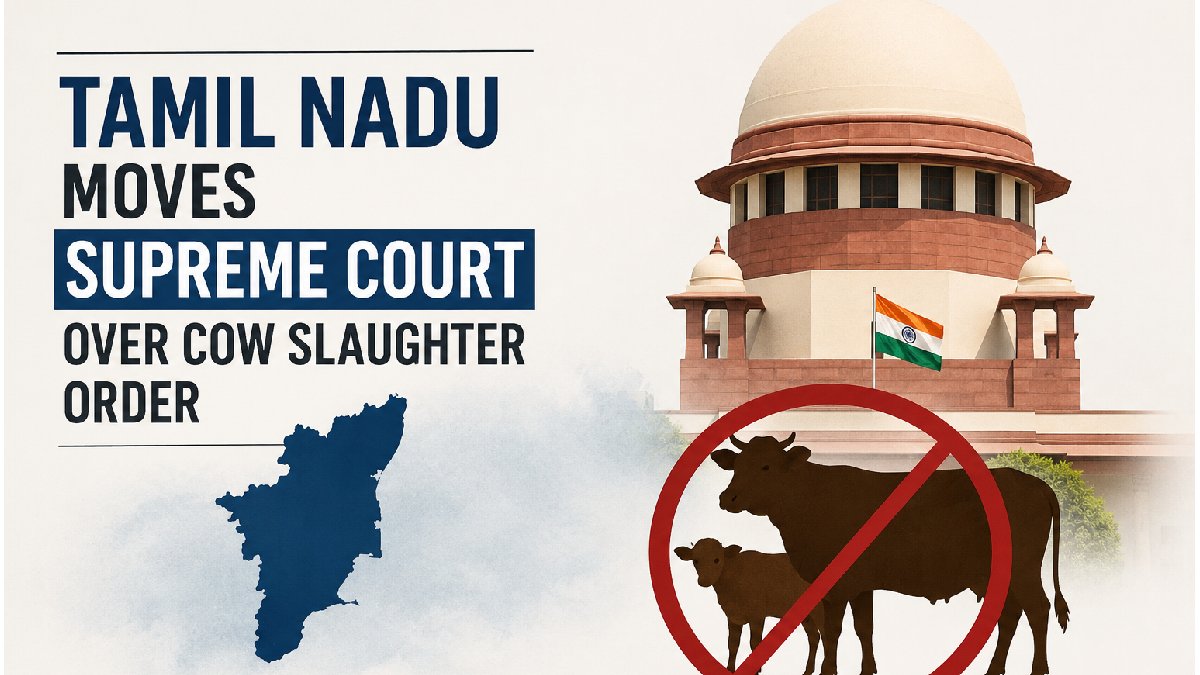
In its appeal, the government claimed that the High Court went much beyond the issue before it and made a new legal restriction by judicial direction.
Petition was limited to Bakrid Slaughter in Public Places
The dispute started with a petition filed by Coimbatore resident K. Surya Prasanth ahead of Bakrid. The petitioner asked the court to prevent the slaughter of cows and calves in public places and non-designated locations during the festival.
However, while hearing the matter, a Division Bench of the Madras High Court directed the Tamil Nadu government to ensure that no cow or calf is slaughtered anywhere in the state—not only during Bakrid but on any day. Senior officials were directed to make the necessary directions to implement the order.
According to the state government, this opened up the case to include a far more detailed case than the original petition.

State Says High Court Granted Relief That Was Never Sought
The Tamil Nadu government has argued before the Supreme Court that the petitioner never sought a statewide or permanent prohibition on cow slaughter.
Instead, the petition focused only on preventing slaughter in public places during Bakrid in Coimbatore. By issuing directions applicable across the entire state and throughout the year, the High Court effectively transformed a limited public-interest petition into a broader policy decision, the government said.
The appeal also states that courts should decide on issues before them and should not grant relief which fundamentally changes the nature of a case.
Government Relies on Tamil Nadu Animal Preservation Act
The state has also maintained that the High Court's order conflicts with the Tamil Nadu Animal Preservation Act, 1958, which already regulates cattle slaughter in the state.
Under the Act, the slaughter of certain cattle is legally allowed after certification by a competent authority. Animals at a certain age (or permanently unfit for breeding or agricultural work) may be slaughtered in accordance with the law.
The government argued that although the Act has restrictions on cattle slaughter, it does not prohibit cattle slaughter entirely. The High Court order, therefore, is a blanket ban that the legislation itself does not provide for.
Government Alleges Judicial Overreach
In its appeal, Tamil Nadu has described the High Court order as an example of judicial overreach.
According to the state, the judiciary interpreted the law in a way that effectively rewrote it by imposing a statewide prohibition not found in the statute. If such a policy change is to be enacted, the government argued, it should come through legislation passed by the Assembly and not through judicial orders.
Supreme Court to Decide the Legal Scope
The Supreme Court will now weigh whether the Madras High Court's order merely enforced existing legal provisions, or did it go beyond its jurisdiction by imposing a new statewide restriction.
The ruling would establish the extent to which judges can intervene in legislation and whether it is possible to extend relief beyond what is given in a petition.
There is a view that the judgment will set a high bar on interpretation of the Tamil Nadu Animal Preservation Act, the separation of powers between the judiciary and legislature, and the extent of judicial power in public policy.