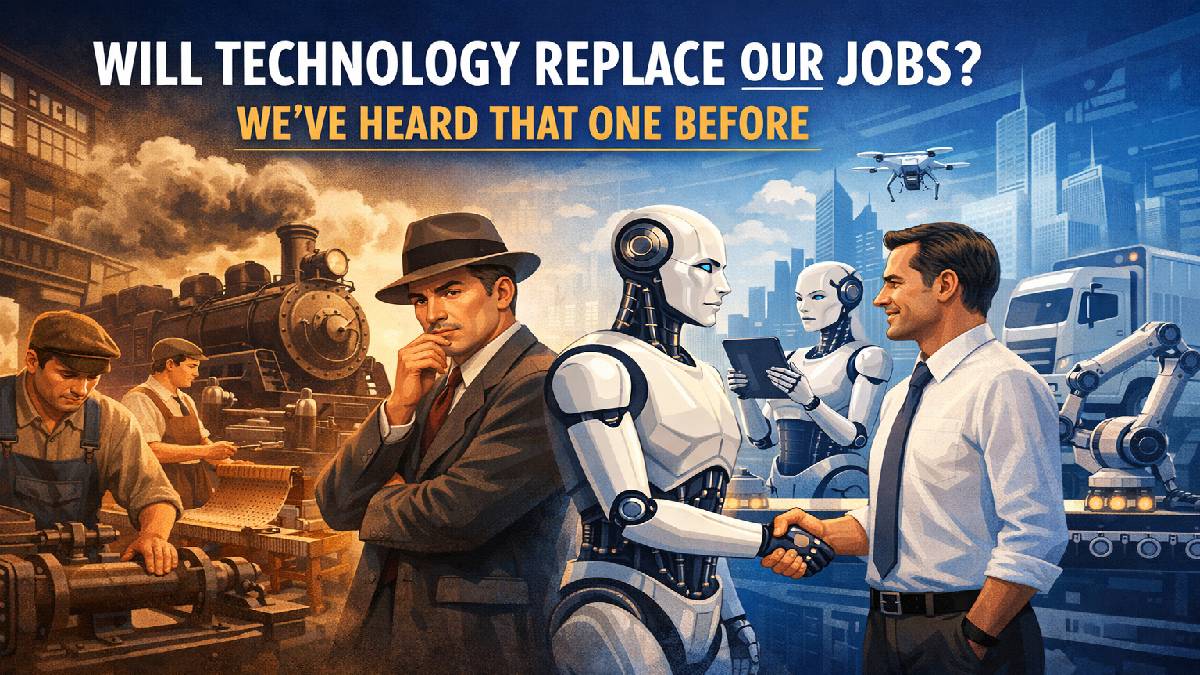
For centuries, every major technological breakthrough has triggered the same fear: This time, machines will replace humans for good. Today, artificial intelligence, automation, robotics, and machine learning have reignited that anxiety. And from factory floors to corporate boardrooms, workers are wondering whether algorithms will render their skills obsolete. But history has a more complex story.
A Fear as Old as Innovation
Textile workers destroyed mechanized looms in the Industrial Revolution, because they feared permanent unemployment. In the early 20th century, assembly lines redefined factory work. In the late 20th century, computers replaced clerical work. Every wave gave rise to widespread alarm over mass job loss. Yet jobs did not disappear. Economies evolved.
Mechanization came to eliminate some manual jobs — but it also invented whole new sectors — railways, manufacturing, logistics, and, later, information technology. The computer age automated paperwork but created new careers in software development, IT services, and digital communications. Technology took away tasks — not work.
The AI Era: What’s New?
Unlike previous waves, today’s AI is disrupting not only manual labor, but cognitive and creative functions, too. AI systems can now:
- Draft legal documents.
- Generate marketing content.
- Analyze medical scans.
- Write and debug software.
- Automate financial analysis.
This kind of knowledge work makes the disruption seem bigger and more personal. White-collar professionals are now experiencing the same uncertainty factory workers did. But technology increasingly supplements workers, not replaces them altogether. AI-based diagnostics from doctors enhance efficiency. Marketers leveraging data tools do become more accurate as a result. Engineers with automation design more intricate systems. The nature of work changes — it doesn’t vanish.
The Economics of Automation
Technological growth historically boosts productivity. More productivity reduces costs, widens markets and creates new opportunities for demand. New demand creates new industries and new jobs. Think of roles that didn’t exist at all 20 years ago: Data scientists. App developers. Cybersecurity analysts. Social media strategists. Cloud infrastructure architects as well.
These occupations have their roots in technological progress. Even organizations such as the World Economic Forum continue to tell us that, whilst automation will put a number of professions out of business, it’s creating entirely new fields of jobs as well — especially in fields like digital services, green energy, AI development, and advanced manufacturing.
The Real Risk: Skill Gaps
The real challenge is not technology but the pace of transition. Workers who struggle to access education, or reskilling programs or digital literacy. If employers continue to neglect workforce development, they risk going into decline. The education systems that do not adapt breed long-term inequality. Adaptability is rewarded with automation.
The competitive advantage in the modern economy is no longer time-tested efficiency, and it’s creativity, emotional intelligence, critical thinking, and technological fluency are the key differentiators.
Replacement to Reinvention
Instead of wondering whether technology will take our jobs, it will best be asked: How will we reshape our work with the help of technology?
History tells you that innovation changes labor markets, but it rarely destroys human performance altogether. Humans are still crucial for leadership, judgment, empathy, strategy, and ethical oversight. Technology changes the way we work. It changes what we work on. But it seldom removes the need for work, or human beings even.
For more than 200 years, the “technology will take our jobs” narrative has resonated. Every time, disruption has been real--but so has reinvention. The challenge here, though, is not to resist innovation. People need to be prepared for it. The future of work belongs not only to machines themselves but also those who learn how to work with them.