A social media controversy erupted after an Instagram user claimed that the performance of women cricketers could be predicted by analysing their menstrual cycle patterns. That claim, which was shared in a viral video, brought into sharp focus athlete privacy, ethics and the use of personal information in sports-related analysis and betting.
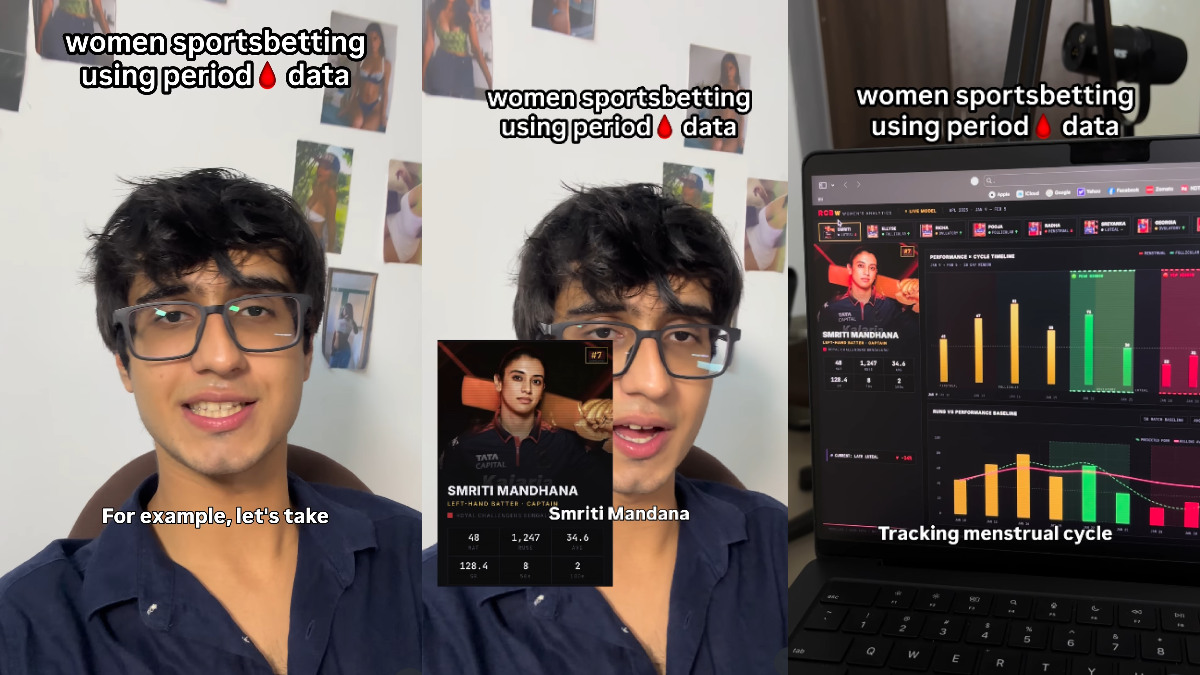
Raj Gomani said he studies historical match statistics as well as menstrual cycle phases of women cricketers. As such, this can give a good indication of when an individual will perform better or worse on the field. The comments on the forum brought about much criticism, and a lot of social media users voiced their doubts about the scientific and ethical implications of that kind of analysis.
The dispute was picked up even further by the user who cited Indian cricket star Smriti Mandhana as an example of how it works. In the video, he had compared past performances with different phases of a menstrual cycle and suggested a few patterns could be observed. He uses these observations to predict future performances in women’s cricket matches and in the Women’s Premier League (WPL).
And when the user said he had done the same for an entire team in the WPL, such claims became even more controversial. “And the video says this information is being used to make betting decisions,” he said. Online, the debate boiled down to whether information about personal preferences should be used in gambling or betting.
One of the main concerns raised by critics is the source of the information. Social media users have repeatedly asked how anyone could accurately obtain or infer such highly personal health-related details about professional athletes. Since menstrual health information is private medical information, many argued that attempting to track or estimate it without consent raises serious ethical questions.
The viral debate has also brought home larger privacy issues in the digital age. Women athletes are subject to a lot of scrutiny, and linking their sporting performance to personal biological information can cross ethical lines. Many users feel athletes need privacy protections like anyone else, especially in the health domain.
Experts and commentators on social media, at the same time, have also pointed out that sports science is increasingly focusing more and more on how much the athletes' performance is affected by sleep, nutrition, recovery, stress and hormonal changes, but judging the performance of a particular athlete from one of the menstrual cycle phases can be difficult for an individual athlete. Sports performance is affected by many factors, and predictions based on one phase can be misleading.
The problem transcends cricket and betting to the wider area of data privacy, consent, and ethics in sports analytics. Questions are now being asked about whether personal biological information should be used for public speculation, performance predictions, or betting activities.
The claims made in the viral video are not verified. There is no independent proof of the accuracy of the alleged data, the methods used to obtain it, or whether any of the assumptions made by the content creator are scientifically sound. The online discussion has been based on the claims themselves and not on any verified evidence.
The debate continues, and many people say the incident serves as a reminder of the growing privacy and personal data challenges that are becoming more pronounced in our sports today. Analytics are increasingly important in professional sport, but the controversy also underscores the need for athlete privacy and for sensitive information to be handled properly and ethically.