Indian business travellers are being put up some difficulty in securing Chinese business visas, and this has caused new concern amongst manufacturers, exporters and industry associations that rely on frequent contact with Chinese suppliers and partners. Rising scrutiny, new documentation and a clear increase in visa rejections are putting India and China at risk.
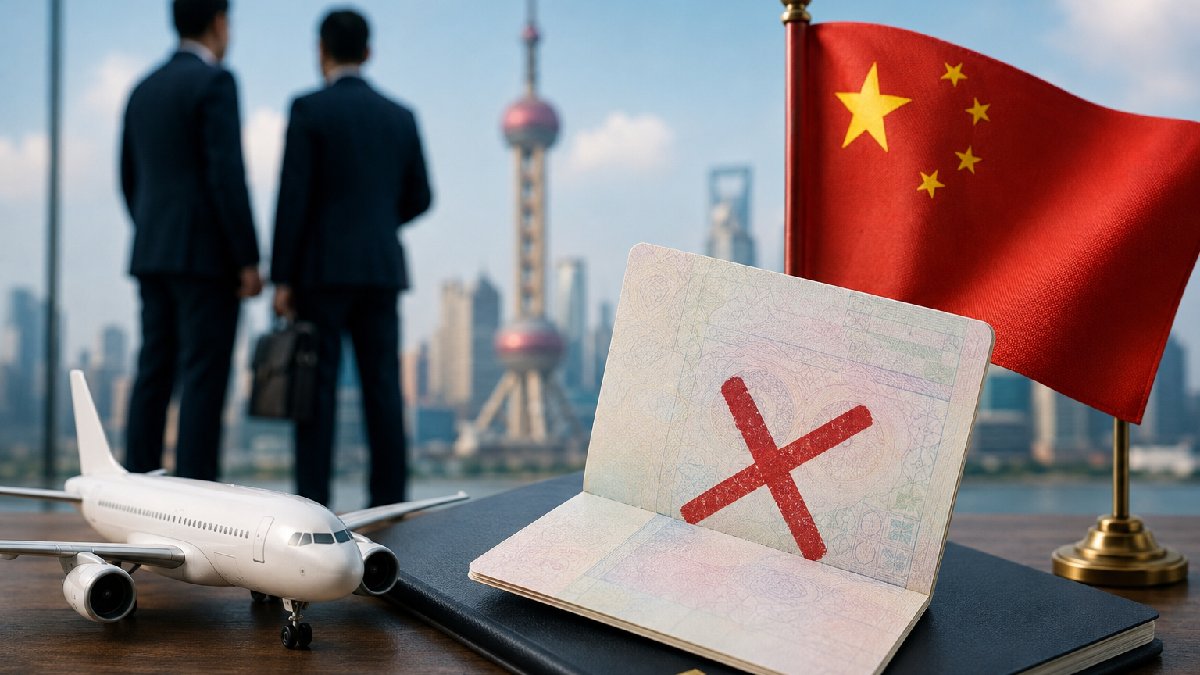
While the Chinese government has not made a public announcement of a shift in visa policy for Indian applicants, several business officers and industry representatives have said that getting business visas has become considerably more difficult in recent months. The problem particularly worries companies that often send executives to China to negotiate contracts, check factories, source raw materials or attend trade exhibitions.
The problems are coming at a time when India and China have maintained strong economic ties despite geopolitical turbulence. China is still India's biggest trading partner in terms of imports, and India is a major importer of medicines, electronics components, industrial machinery, solar equipment and specialty chemicals. Any disruption to business travel may affect a number of manufacturing sectors.
Mitali Nikore, senior economist and founder of Nikore Associates, explained that talks with micro, small and medium enterprises (MSMEs) reveal three main reasons why Indian businesses need to travel to China. Companies look for reliable suppliers for raw materials, explore export opportunities by finding Chinese buyers and study manufacturing practices in China's industrial clusters in order to bring efficiency in their own operations.
Nikore said that many industry associations have informed her organization that business visa rejection rates are now estimated to be between 30 and 40 percent in some cases. She said that some applications may be rejected because of documentation issues or additional paperwork requirements, but there have also been times when applicants were not aware of the reason for the rejection even though they thought that their application was done.
The uncertainty of visa approvals has become a growing concern for industries that rely on frequent contact with Chinese manufacturers. Technical teams and procurement executives often have to travel to the production facility before big purchases or longer-term supply agreements are made in electronics, automobile manufacturing, engineering goods and machinery. If visa requests are delayed, decision-making can be slow, factory inspections delayed and production schedules disrupted.
There are analysts who believe that smaller companies may be especially vulnerable. And unlike large corporations with a vast international network, many MSMEs depend on direct visits to establish trust with suppliers, verify product quality and negotiate commercial terms. The loss of Chinese business travel would increase costs and hurt competitiveness for these companies.
Another factor that has gotten attention is China’s current unilateral visa-free programme, which allows ordinary passport holders from 50 countries to enter China without a visa for up to 30 days for business, tourism and certain other approved purposes. India is not a part of this list and hence Indian business travellers need business visas for official visits.
Jayant Krishna, senior Economist and Senior Fellow at CSIS, believes tighter visa approvals could ultimately work against China’s own economic interests. He explained that China accounts for almost 17 percent of India’s total imports and bilateral trade was more than 155 billion dollars in 2025 and exports are expected to be more than 200 billion dollars in the few years to come if current trends continue.
Krishna also pointed out that China's trade surplus with India in the last year was approximately 116 billion US dollars which represents a significant portion of its overall trade surplus. He said making business travel more difficult for Indian companies would discourage commercial activity and eventually lead to lower Chinese exports to one of its largest overseas markets.
He also claimed that China already has economic problems— domestic growth is weak and external trade pressures are growing. In fact, if India works in China’s favour, business cooperation will be beneficial for both countries as well as creating more barriers to commercial intercourse.
Although digital communication and virtual meetings have become common, many business leaders maintain that most decisions still require face-to-face engagement. Factory visits, quality inspections, equipment demonstrations, and relationships all are still essential in international trade (especially to manufacturing industries where technical specifications and production capabilities must be verified firsthand).
The reported increase in scrutiny over Chinese business visas has thus become more than a travel issue. For Indian companies, especially those that rely on Chinese supply chains, easier mobility is closely related to operational efficiency and business expansion. For China, business relations with Indian companies should not be affected and there is a possibility that if China is able to keep moving forward with its commercial relationship with India, it will be able to sustain export growth in an ever-more competitive international market.
As trade between Asia’s two largest economies continues to expand despite political differences, industry experts believe that predictable and transparent visa processes will be instrumental in keeping the long-term economic cooperation going. The visa difficulties reported in the sector were likely to be temporary administrative difficulties and not permanent or indicative of policy change as a whole, but businesses in both countries will be watching the situation closely in the coming months.