World Rhino Day celebrates one of the world’s most recognizable and endangered species of mammals on September 22. For India, the day also celebrates one of the country’s greatest wildlife conservation stories: the recovery of the greater one-horned rhinoceros.
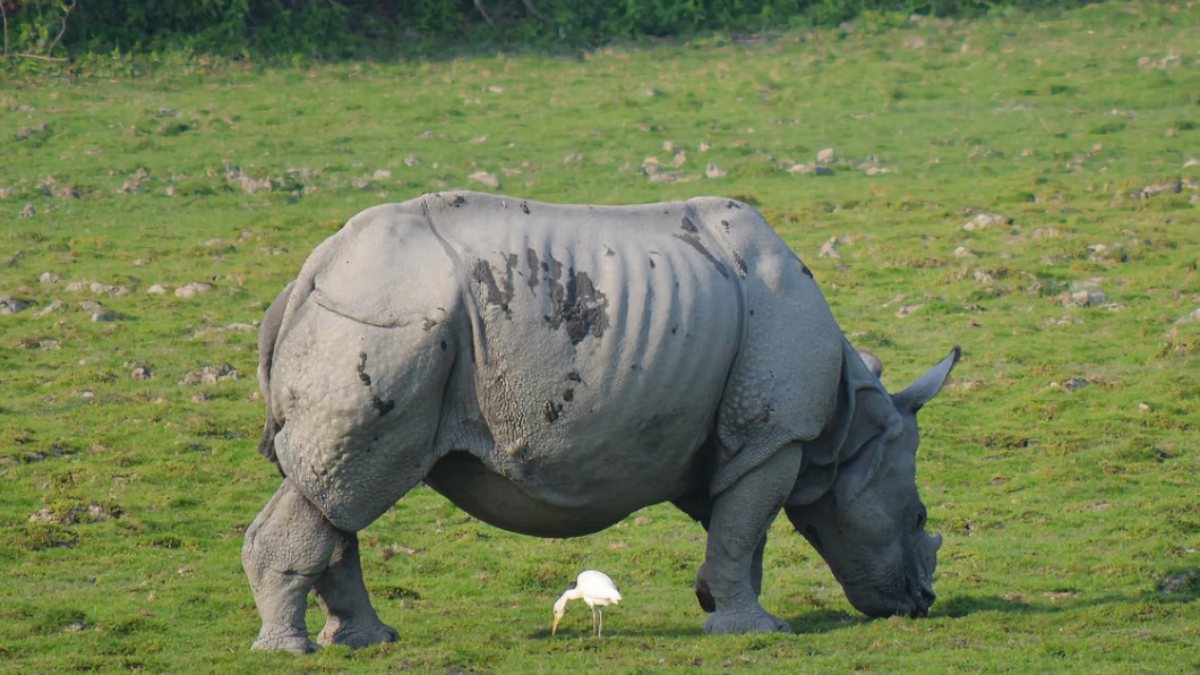
At the center of that story is Assam's Kaziranga National Park.
Kaziranga is situated on the floodplains of the Brahmaputra and is one of the world’s most important habitats for the greater one-horned rhinoceros, scientifically known as Rhinoceros unicornis. The Assam forest department says the park is home to more than 70 percent of the world’s one-horned rhinos.
Kaziranga’s population of more than 2,600 rhinos is now estimated to be more than 2,600, and the park alone accounts for more than two-thirds of the global population of the species.
These numbers are quite remarkable for an animal that was so close to extinction by hunting, poaching, and habitat loss.
Kaziranga's Unique Rhino Habitat
Kaziranga's geography is central to its importance.
The national park covers a vast area of grasslands, wetlands, forests and riverine habitats along the Brahmaputra valley. The Assam government describes it as the largest undivided representative area of the Brahmaputra Valley floodplain grassland.
The area is ideal for the greater one-horned rhino that depends on grasslands and wetlands for food and shelter.
Kaziranga is much more than a rhino habitat. The park houses tigers, elephants, wild buffaloes, swamp deer, leopards, several smaller mammals and hundreds of bird species.
The Assam government says more than 150 perennial water bodies are located in the park and around 480 bird species have been recorded there. The park is home to more than 60 percent of India’s wild buffalo population, according to wildlife information reported by the state’s wildlife department.
Kaziranga is one of India’s most important protected ecosystems in that mix of grasslands, wetlands and forests.
From Just Over 1,500 Rhinos To A Conservation Success
The recovery of the greater one-horned rhino has been gradual.
Historical hunting and poaching severely reduced rhino populations in the Indian subcontinent. Conservation efforts, habitat protection and stronger anti-poaching measures have since helped the species recover.
In 1999, Assam government data showed that Kaziranga had 1,552 rhinos. The number was 1,855 in 2006, 2,048 in 2009 and 2,290 in 2012. The 2018 estimate for Kaziranga population was 2,413.
More recently, the population continues to grow.
The overall recovery is also reflected in India. A recent analysis in The Indian Express found India’s greater one-horned rhino population had grown by almost 170 percent, from around 1,500 animals historically to more than 4,000 by 2024.
Not only have protection measures and conservation programmes been enacted to protect the existing rhinos, but also to expand their range.
The Fight Against Poaching
Conserving such a large population of rhinos is a challenge.
The horn of the rhinoceros has long been a target of illegal wildlife trafficking. Poaching was once a major threat in Assam, and Kaziranga was particularly successful in protecting rhinos from armed poachers.
Conservation has drastically improved in the past few years. Assam had zero rhino poaching cases in 2025, according to reports published earlier this year. The state had also seen a zero-poaching year in 2022, the first since 1977.
And in the long run, poaching has been reduced by better enforcement, increased surveillance, protection by forest personnel and increased wildlife conservation awareness over time.
But conservation does not end when poaching numbers fall. Flooding, habitat changes, disease, climate pressures, and the risks of concentrating a large proportion of a species in one area remain important concerns.
Why is Kaziranga looking beyond its own borders?
Kaziranga’s conservation success has presented an unusual challenge: how to protect a population that has become heavily concentrated in one landscape.
There are reports that Assam is preparing to expand rhino translocation efforts, and Kaziranga could send rhinos to other suitable protected areas. The idea is to create more stable populations across landscapes rather than keeping most of the global population in one place.
The logic is simple. If a population is concentrated in one place, then there can be huge outbreaks of disease, severe floods or other ecological disruptions.
Assam's long-term rhino conservation plan is therefore to strengthen populations in Manas and other suitable habitats.
The state’s own wildlife data shows how conservation has already helped to rebuild populations outside Kaziranga. Manas, for instance, had no rhinos in the 1999 data but had 36 by 2018.
World Rhino Day And The Road Ahead
World Rhino Day is held every September 22 to raise awareness about the conservation of rhinos and the threats facing the world’s five rhino species. India’s greater one-horned rhino is one of them.
Kaziranga’s story illustrates what long-term conservation can achieve. The park has gone from a key refuge for a threatened species to now being home to most of the world’s remaining greater one-horned rhinos.
But a growing population also means that conservation strategies should be changed.
To sustain grasslands and wetlands, maintaining wildlife corridors, controlling poaching, managing human-wildlife interactions, and establishing additional secure populations will continue to be vital.
Visiting Kaziranga for a safari is a chance to see one of the most distinctive mammals in its natural habitat. But conservationists, for all that, see the park as something much bigger: a long-term experiment in whether the preservation of a species and habitat management can help a threatened species back from the brink.
On World Rhino Day 2026, that recovery is worth remembering, but keeping the species safe will take work far beyond Kaziranga.