
A trader in Gujarat was allegedly cheated of ₹40 lakh when fraudsters delivered bundles of fake ₹500 notes with the unusual markings Children Bank of India and Bharatiyan Manoranjan Bank. Two men have been arrested by Ahmedabad Police in connection with the case and more imitation currency was seized during another operation.
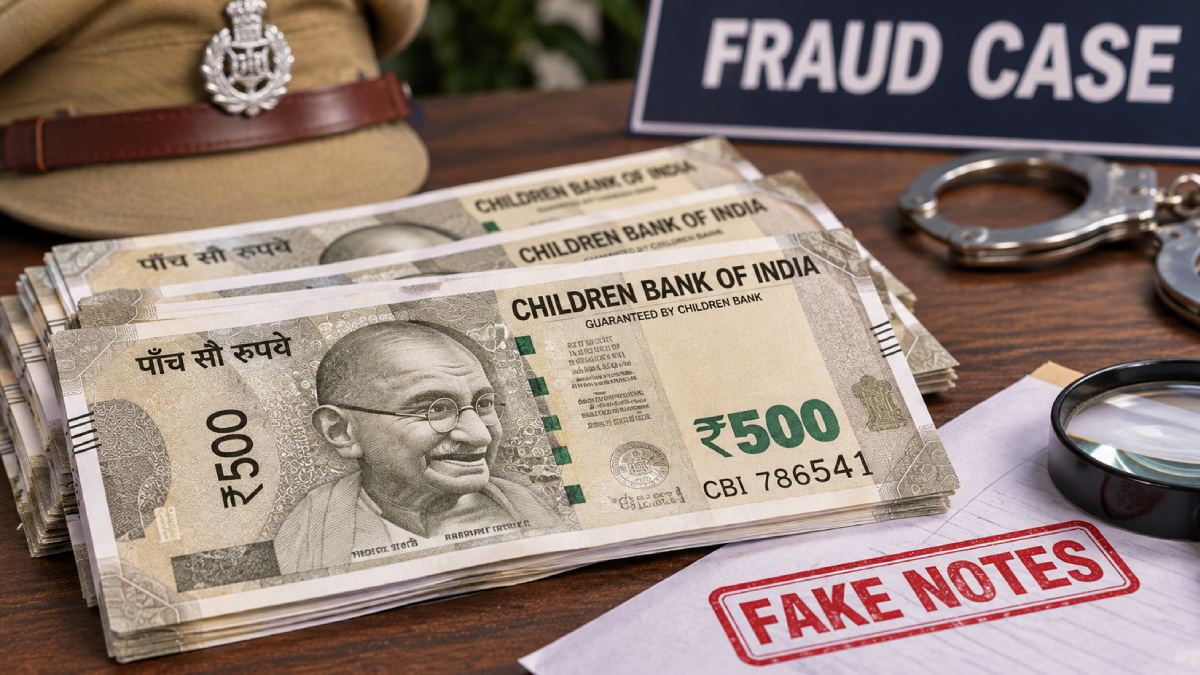
The incident was a traditional cash courier arrangement (angadia service) between businesses in different cities to move money around.
The case came to light when a trading family in Unjha, Mehsana district found that eight bundles given as business payment contained imitation currency instead of real banknotes.
How the Trader Was Cheated of ₹40 Lakh
The FIR said Rohitkumar Patel (cumin and fennel trading business in Unjha under name B.B. Traders) was expecting payment of ₹40 lakh from a business associate in Nagpur Maharashtra.
The transaction was done through an online angadia service.
On 17 November two men allegedly delivered a bag containing eight bundles (each worth ₹5 lakh) wrapped in currency paper bands and labelled with labels similar to ICICI Bank ones.
The packaging made the bundles look real. But when traders’ representatives checked the notes after returning to office they found that the money was fake.
Inscriptions like ‘Children Bank of India’, ‘Bharatiya Manoranjan Bank’ and ‘Five Hundred Coupon’ were used instead of the official Reserve Bank of India markings on the notes.
Family Helps Police Set a Trap
Once the fraud was discovered the complainant’s family decided to work with police to find out who was behind it.
They arranged another cash delivery in Ahmedabad separately. On 19 November someone contacted the family on WhatsApp and said that the payment had come.
Two men then went to Parasnagar petrol pump area in Ahmedabad with bags containing bundles of notes.
The family had already alerted Ghatlodia police who were nearby. When the suspects started showing bundles to them, complainant signalled the police team who entered and arrested both men.
Two Men Arrested, 1,666 Fake Notes Recovered
The arrested suspects were identified as:
- Rahul Singh Thakur, 23, from New Delhi.
- Malchand Sharma (30), Bikaner district, Rajasthan.
Police seized 17 bundles containing 1,666 imitation currency notes from the bag of Thakur in FIR.
Each bundle contained 98 notes in ₹500 denominations. The bundles also had labels that looked like ICICI Bank packaging (allegedly so the counterfeit notes would look real).
The accused were reportedly promised ₹5000 each for delivering the bundles.
Police Suspect a Larger Interstate Network
Sharma allegedly told investigators that his brother Gajanan Sharma (who lives in Noida) had introduced him to a person named Dhanraj.
Dhanraj allegedly told the two arrested men to collect the bundles from Varun near a railway station in Delhi and deliver them to the complainant’s family in Ahmedabad.
Besides the two men arrested, police have registered a case against Gajanan Sharma, Dhanraj and Varun under relevant provisions of BNS.
Investigators are trying to trace the remaining suspects and find out where the imitation currency came from.
What Is an Angadia Service?
Angadia is a traditional courier and money-transfer system used by traders and businesses (particularly in parts of western India).
The network typically consists of intermediaries moving cash, jewellery and other valuables between cities. Businesses use these services for commercial transactions and settlements.
But transactions involving large amounts of cash may be risky if the identity of intermediaries, delivery arrangements and authenticity of the money are not properly verified.
The Gujarat case shows how criminals can take advantage of trust in established business networks by using packaging that looks legitimate and impersonating legitimate payment arrangements.
The investigation is ongoing and police are trying to identify the wider network allegedly behind the fraud.




Comments