In the last week of August, skywatchers around the world are preparing for one of the most spectacular astronomical events of 2027, when a total solar eclipse is expected on August 2, 2027.
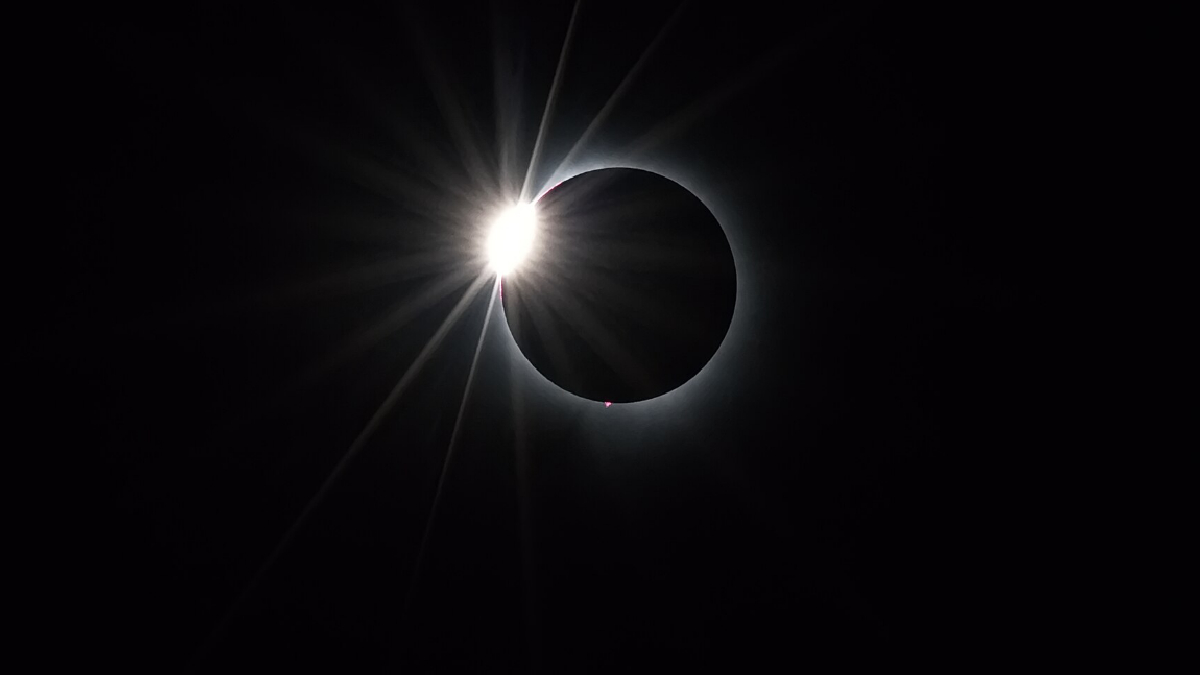
The eclipse has attracted much attention because, at its longest time of totality, the Moon will completely block the Sun and light will give way to darkness and will be bright for a limited time. The longest totality in the 21st century will be about 6 minutes and 23 seconds according to NASA.
A total solar eclipse occurs when the Moon lies directly between the Earth and the Sun and completely fills the Sun's visible disk for the observers in the narrow path of totality. During this brief period the daytime sky can be much darker, while the Sun's outer atmosphere (corona) forms around the Moon's silhouette. The sudden change of light can lead to a twilight atmosphere and in particular, to changes in the surrounding environment.
This Surya Grahan will be especially significant on 2 August 2027 because the path of totality will take us through various countries and regions of southern Europe, North Africa and the Middle East. NASA lists Spain, Morocco, Algeria, Tunisia, Libya, Egypt, Saudi Arabia, Yemen and Somalia as the countries where a total eclipse will be happening.
Europe, Africa, the Middle East and Western and southern Asia will also experience a partial solar eclipse.
Egypt is expected to be one of the most notable eclipse viewing destinations. The area near Luxor is close to where the eclipse is likely to be best in duration. The National Solar Observatory estimates that totality near Luxor could last for 6 minutes and 22 seconds while NASA's calculations suggest 6 minutes and 23 seconds.
The length of the darkness is one of the reasons astronomers and photographers and eclipse tourists are interested in the event.
The eclipse’s path will also pass through Cádiz in Spain, Tangier in Morocco, Benghazi in Libya and Jeddah in Saudi Arabia. But the exact duration of totality will vary greatly from one location to another. Near the centre line of the eclipse path you will experience longer duration of totality and on the edges you will experience shorter duration. Weather will also affect the view of the event.
Will the 2027 Solar Eclipse be visible in India? For Indian skywatchers the August 2 eclipse will be seen as a partial solar eclipse not a total eclipse and the Moon will cover only part of the Sun from India because India lies outside the narrow line of totality.
According to eclipse calculations, the partial eclipse will begin in India at 3:34 pm IST and end around 5:53 pm IST, but the exact times will be different from state to state.
Several Indian states will be able to see at least part of the eclipse. Karnataka, for example, is expected to see the partial eclipse from around 3:51 pm to 5:46 pm IST. In Bengaluru, the eclipse is expected to begin at around 3:58 pm, reach its maximum around 4:53 pm and end around 5:43 pm. The maximum obscuration in Bengaluru is expected to be around 39.12%.
Other major Indian cities will also experience partial eclipse. Mumbai is expected to see the eclipse from 3:47 pm to 5:31 pm, while New Delhi is expected to see it around 3:53 pm to 5:02 pm. Hyderabad is expected to see the event around 3:58 pm to 5:33 pm. The portion of the Sun covered will depend on the observer's location.
Despite the well-known "Sun will disappear for six minutes" statement, this dramatic darkness will not be present in the whole world or even in all the areas where the eclipse is visible. The six-minute-plus totality will only be observed in the central path of totality. In India, we will see only a partial eclipse, so some portion of the sun will be visible.
Important Safety Precautions
If you are going to watch the solar eclipse make sure to take precautions. Looking directly at the Sun during a partial solar eclipse can be dangerous and permanent to the eye. Ordinary sunglasses, camera filters or homemade viewing technology are no substitute for certified solar viewing equipment.
Special solar viewing glasses for the partial phases need to be used, or the correct solar filters.
The August 2, 2027 total solar eclipse is therefore expected to be a major astronomical event for observers across Egypt, North Africa and parts of the Middle East. At its peak with more than six minutes in darkness the eclipse will offer the rare opportunity of seeing the Moon completely cover the Sun and briefly change the light of the day.
For India, the eclipse will be a partial eclipse, but Bengaluru, Mumbai, Hyderabad and New Delhi will still be able to see the celestial event.