If the tailgate is opened down, it opens the air in the truck bed and reduces wind resistance so the truck gets fuel, then why would that benefit the truck? That’s a common automotive theory. But aerodynamic research and real-life testing have shown it is not so.
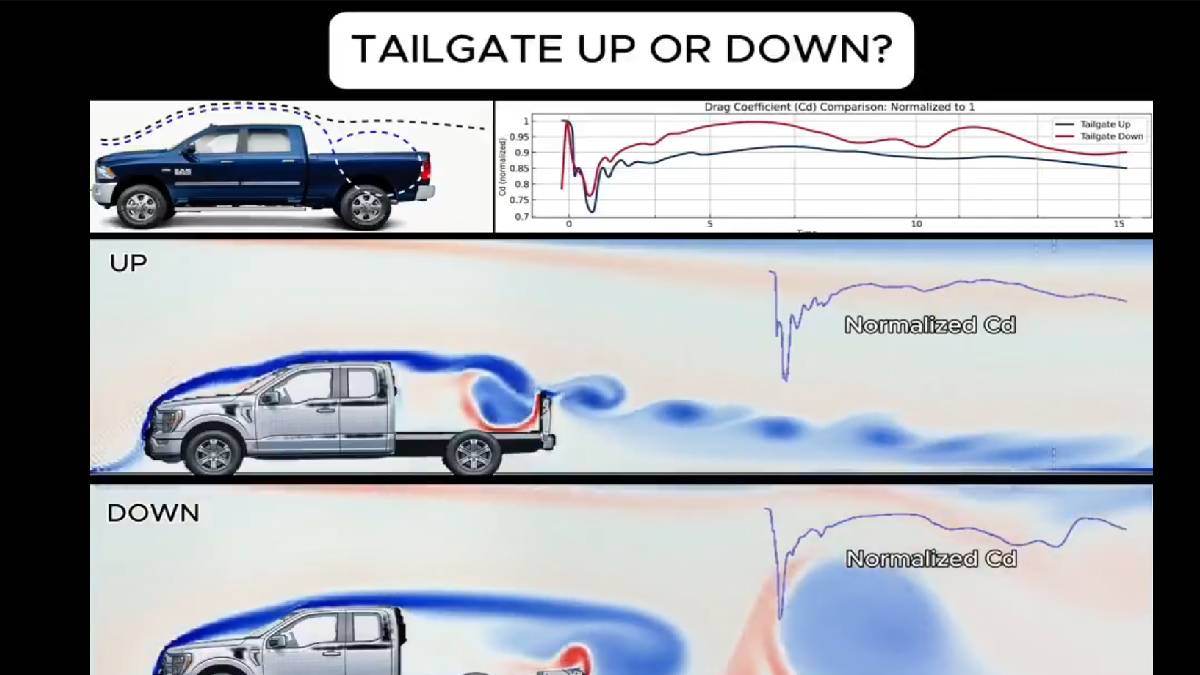
For pickup trucks, automotive engineers, manufacturers, and independent researchers have studied airflow very extensively and believe that keeping the tailgate closed is usually more fuel-saving than driving with it down.
Does dropping a pickup truck's tailgate actually improve fuel efficiency? pic.twitter.com/4VFXIFcPKo
— Science Simplified (@Scivf4) July 16, 2026
Why did the myth rise to the top?
The notion that an open tailgate improves fuel economy dates back decades. The reason is simple: a closed tailgate seems to trap air inside the truck bed, creating resistance; an open tailgate seems to allow air to pass through more easily.
At first sight, this is sound logic. But airflow around a moving vehicle is far more complex than it appears. Air doesn’t just move in a straight line through the truck bed. It behaves in the spirit of aerodynamics.
The Science of truck aerodynamics.
When a pickup truck is driving at highway speed, the air flows over the cab and into the cargo bed. Rather than crashing into the closed tailgate and generating too much drag, the air in the truck bed creates a bubble of air, known as a recirculating vortex.
This trapped pocket of air is like an aerodynamic cushion. The fast-moving air traveling over the truck rides over this air bubble, not into the bed. The airflow is smoother as it moves over the rear of the vehicle, reducing aerodynamic drag.
When the tailgate is dropped, this well-built air cushion disappears. Air is pulled out of the bed into the back of the truck, and turbulence is stronger behind the truck. Higher turbulence means more aerodynamic drag, and more fuel is required by the engine.
What Real-World Tests Show
Several companies, like automotive manufacturers and engineers, have conducted wind tunnel experiments and highway fuel economy tests to analyze the two scenarios.
The results are remarkably consistent:
Tailgate up: It usually has the best fuel economy. Tailgate down: It is often not that much, and it may have some impact on fuel efficiency in a way. The difference is very small but measurable, especially at highway speed, where aerodynamic drag is most significant.
Some initial studies by vehicle manufacturers found that trucks driven with the tailgate closed performed slightly better in fuel economy than identical trucks driven with the tailgate lowered.
Does the design of the vehicle matter?
Yes. Modern pickup trucks are equipped with advanced computer simulations and wind tunnel testing. Engineers carefully shape the cab, roofline, mirrors, underbody, and tailgate to improve airflow.
With these improvements, today’s trucks are much more aerodynamically efficient than older ones. The tailgate is not only a cargo barrier, but it is also the airflow control system of the vehicle.
If trucks were built decades ago, they would have different aerodynamic characteristics, but for most modern pickups, the tailgate should be closed.
What are bed covers?
Many pickup owners install tonneau covers on the cargo bed at the head end of the truck. Tonneau covers provide a smoother surface for air to flow through the truck’s cargo bed.
Most research shows that some hard tonneau covers may bring a small increase in fuel economy by reducing aerodynamic drag. But those savings are usually small—sometimes only a few percentage points—and depend on driving speed, truck model and cover design.
Other factors that affect Fuel Economy.
While tailgate position is certainly of great interest, it has a relatively small impact with regard to other factors affecting fuel consumption.
These include:
Maintaining proper tire pressure, avoiding aggressive acceleration, driving at moderate highway speeds, avoiding excess cargo weight, using the correct engine oil, and keeping wheels properly aligned.
Improving these components of vehicle maintenance and driving habits can generate substantially higher fuel savings than changing the position of the tailgate.
Should you drive your car with the tailgate down?
There are situations when the tailgate has to be lowered: heavy cargo, furniture, motorcycles, construction materials, etc. In those instances, convenience and safety are more important than some minor difference in fuel efficiency.
But if the tailgate is lowered only for saving fuel during normal driving, the evidence is lacking that it is going to be of any value.
The Verdict
The notion that lowering the tailgate of a pickup truck will improve fuel economy is largely a myth. A closed tailgate creates a stable pocket of air that reduces aerodynamic drag, not increases it.
When the tailgate is up, for most modern pickup trucks, they are equally or slightly better off than driving with it down. The fuel savings may not be dramatic, but these are just some of the examples of how modern vehicle aerodynamics are often in question.
Instead of the old automotive myths, drivers who want to improve fuel economy should concentrate on maintenance and driving habits—and reduce unnecessary weight—not on outdated automotive myths. The science is clear: The tailgate is best left closed for fuel efficiency.