
In what is believed to be a shocking cyber fraud case, a private restaurant company in Bengaluru has lost ₹42.49 lakh from its corporate bank account after 11 unauthorised transactions were made within 30 minutes of each other. The incident has shaken confidence in corporate banking systems as the transactions reportedly bypassed the mandatory OTP-based authentication and two-level payment approval mechanism provided by the company.
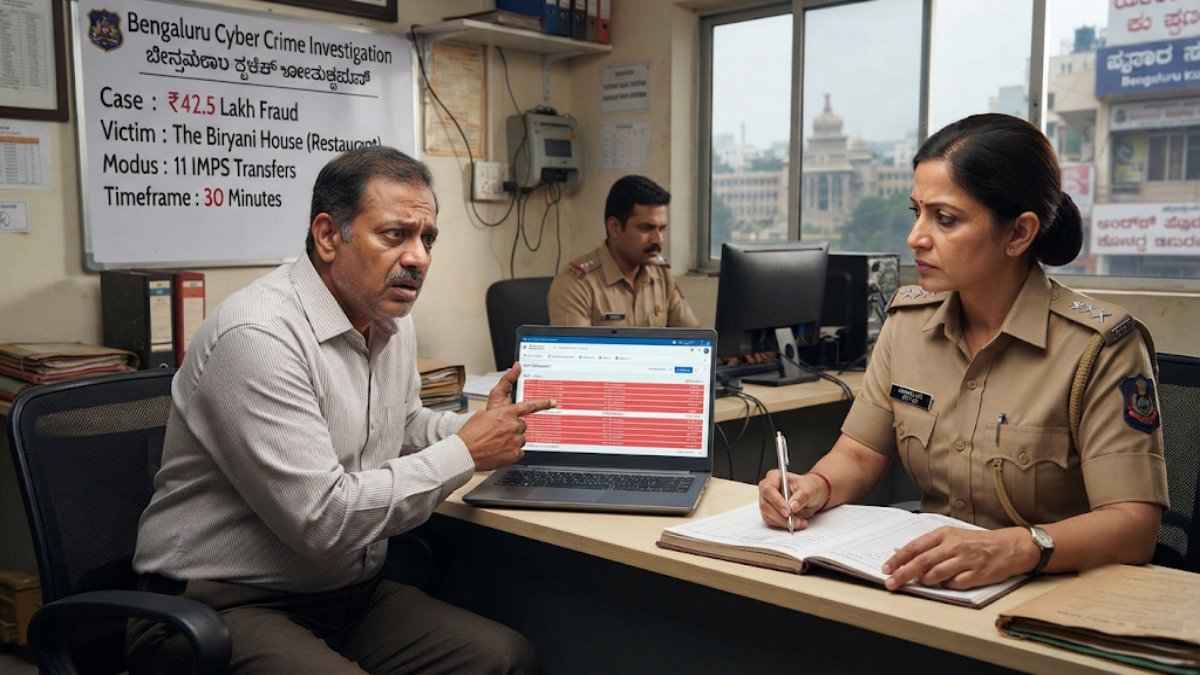
When they noticed suspicious withdrawals and immediately contacted the bank to stop further transactions, the company apparently failed to prevent money from being transferred to multiple unidentified bank accounts. Cybercrime police are now investigating how fraudsters executed multiple transactions without the company’s authorisation.
The accountant of Popo Global Private Limited (restaurant company based in Bengaluru) filed a complaint stating that the company has a current account with the Jayanagar branch of HDFC Bank. It uses its corporate net banking platform to pay vendors and distribute salaries to employees.

Since this is an account used for normal business transactions it follows structured payment approval system so as to prevent unauthorised transfer of funds. According to the complaint, there are two levels of verification: the accounts department requests payments, and the directors of the company approve them before they are processed.
Under the company’s standard payment procedure, employees from the accounts department first log into the corporate banking platform with their credentials and add beneficiaries to whom payments need to be made. Once the beneficiaries are added, payment requests are sent to directors for approval.
Directors then log in to the platform with their own credentials and verify the payment requests. OTP based authentication is also required for authorising transactions. This multi-layered approach is generally done to provide an extra layer of protection against unauthorised transfers (so that money is not moved without proper approval), as well as making sure company funds are not moved unnecessarily.
But security failed when the suspicious transactions started appearing in the company’s bank account. “As soon as we noticed money was being transferred without our permission, we contacted HDFC Bank and asked them to freeze the account and stop any further outgoing transactions,” said one of the officials.
The company tried to prevent more losses by alerting the bank as soon as it realised what had happened, but the fraudsters continued with the unauthorised transfers (11 IMPS transactions in the next 30 minutes). A total of ₹42,49,689 was allegedly transferred from the corporate account to different bank accounts of unidentified beneficiaries.
The incident has caused special concern because the company’s payment system was said to require OTP-based authentication and approval from authorised directors. How the fraudsters bypassed these safeguards and executed multiple IMPS transactions is part of the ongoing investigation.
Investigators are expected to look into whether the company’s corporate net banking credentials were compromised, if any malicious software or phishing activity took place, whether beneficiary addition and payment approval procedures were tampered with, etc. Whether unauthorised access to banking platform occurred as well is being investigated.
After the incident, a case was registered at East CEN Cyber Crime Police Station under the Information Technology Act and Section 318 of BNS. The complainant reportedly gave details of transactions (dates, timings of transfers; names of beneficiaries, bank identification numbers and account numbers to which money was allegedly transferred).
A senior police official said, “The complaint had all relevant transaction details”. Investigators are now expected to coordinate with banks concerned to trace destination accounts and see if the funds can be recovered or not. Whether money moved through multiple accounts could also be checked to find out who was behind the alleged fraud.
Cybersecurity experts have been warning companies for years that corporate banking fraud can happen in several ways: stolen net banking credentials; phishing attacks; malware infection; manipulation of beneficiary registration or payment approval processes; fraudsters trying to get unauthorised access to business computers or mobile devices through suspicious links, fake applications and remote-access software.
Once access has been gained, criminals may try to exploit weaknesses in payment workflows to transfer money without the knowledge of authorised company representatives. The Bengaluru incident demonstrates why businesses need to review their corporate banking security arrangements regularly rather than relying entirely on existing authentication procedures.
Companies that process large financial transactions should put in place additional safeguards to reduce the risk of such incidents. Businesses ideally should have separate devices for initiating and approving payments so a compromised computer does not have access to the entire transaction flow; transaction alerts should be enabled for every debit and beneficiary addition so authorised personnel can spot suspicious activity immediately; daily transaction limits and beneficiary-specific transfer limits should be set so the amount being moved from corporate accounts cannot exceed those limits; a cooling-off period for newly added beneficiaries before large payments are allowed may also be another layer of protection.
Businesses should also limit unauthorised applications and remote access software on computers used for banking operations. Employees shouldn’t share banking credentials, OTPs or authentication details with anyone (even if they believe the request has come from a bank representative).
Security audits, up-to-date antivirus protection and strict access control can also help reduce the possibility of cyberattacks. Companies should have a clear emergency response procedure so suspicious transactions can be reported to the bank and cybercrime authorities immediately.
The alleged ₹42.49 lakh fraud involving Popo Global Private Limited has once again brought to the fore the risks businesses are taking when they use digital banking platforms. Net banking for corporates is convenient for managing salaries, vendor payments and other financial operations, but even a short window of unauthorised access can cost you big.
As Bengaluru cybercrime police probe 11 IMPS transactions, businesses across the city are reminded about stronger digital banking security and continuous monitoring of corporate accounts.





Comments