
Bengaluru's street-begging problem has once more become a topic of discussion on social media after a video of large quantities of groceries collected by people asking for food donations went viral. The video, which was filmed in the Tavarekere area of Bengaluru, shows groceries collected by a group of women who approach people looking for ration supplies.
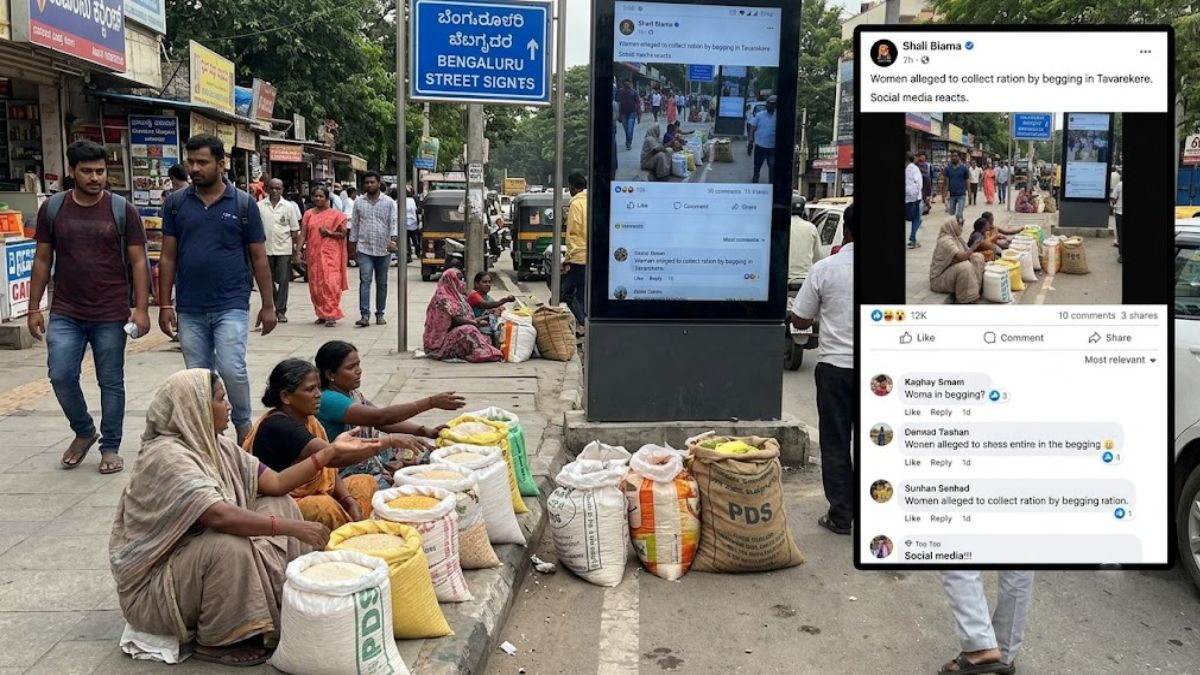
The footage has generated mixed reactions, with some on social media questioning how the food was purchased and others suggesting that the civic authorities and police should take stock of what is happening. The video was posted on an Instagram account named MV Rashii, but the circumstances and the purpose of the groceries are not clear.
In the video, groups of four or five women are often seen moving around with several children and approaching residents or shopkeepers for assistance. They say they don’t have enough ration at home and ask people to give them the basic food such as rice, sugar, pulses and other household stuff, their account said. The women are said to do it weekly if not every single time. The video has raised questions about whether the groceries are household stuff, shared among many families or used for some other purpose.
The footage has generated an avalanche of discussion because people are not used to seeing people ask for food or money outside restaurants, shopping centres, grocery stores, bus stations and railway stations. Some people ask for food or money directly, and others ask for groceries that they can take home.
The viral video has raised our eyes on the latter practice, especially as several people appear to collect supplies in a group. For some viewers, the amount of groceries shown raised questions about how frequently the group collects donations and how those supplies are distributed. But a video alone cannot tell you how many people depend on the food, how long the supplies are intended to last or whether any wrongdoing has been done.
Reactions to the video have been mixed. The video was also seen being posted by Karnataka Minister Krishna Byre Gowda, Bengaluru's civic administration and Bengaluru traffic police who said the matter should be investigated and a suitable action taken if there is a violation.
Some people wondered if the groceries collected would be sold at lower prices and not used to cook. The claims remain conjecture with no actual evidence in place, and the video itself is not enough to establish that the women were in a sort of organised begging racket or the resale of donated goods. A thorough investigation is required to establish the facts before anyone can conclude the people mentioned.
The discussion has also extended to Tavarekere as users say similar groups can be seen in several parts of Bengaluru. In some places, children approach pedestrians and drivers to sell pens, hand towels and other small items and also to fetch money to help with food costs.
In terms of poverty, informal street work, child welfare and the difficulty of distinguishing genuine need from potentially exploitative practices, it is also not easy for authorities to tell people they should be doing so. The presence of children in street activities is particularly concerning because people can be exposed to drivers who might drive too fast, to irregular schooling or to other hazards. It should be said that no one should be made a judgment about someone’s financial situation or the direction of their life just based on their looks or because of the fact that they come to the police.
Some comments on the viral video questioned whether the people involved were from Bangladesh. But the footage and information presented do not establish the nationality or citizenship of the individuals shown. Such claims should not be treated as facts without credible evidence.
People's nationality requires documentation and/or official verification, and speculation on the internet can unfairly target vulnerable communities. The more pressing questions are whether or not they are collecting and distributing the groceries, whether children are in contact with the adults and what laws have been broken.
The video has reignited calls for authorities to investigate the practice of organised begging, possible exploitation of children and the use of public spaces for such activities. Where coercion, trafficking, child exploitation or fraud is found, appropriate authorities should investigate and act under the law.
But people who really need food assistance should also be supported by legitimate community organisations and welfare programmes. But at least in some way the response should address potential exploitation, and not say everyone who begs is dishonest.
The viral footage from Tavarekere has raised some questions but not good answers. The people depicted in the video, the reason for the groceries and the claims of possible resale have not been independently verified from the information available. Any further action will be taken depending on what information is collected by the authorities. As the video is circulating on the internet, there remains to be said for viral content has the potential to educate and raise people’s minds, but allegations about people should also be verified and treated as fact before they are reported as fact.





Comments