
Maybe not so much. A post on X claimed that the Cockroach Janata Party (CJP) is not as popular among southern youth as it is among young people elsewhere, suggesting that young people in the South are being raised with stronger support for the RSS by their parents.
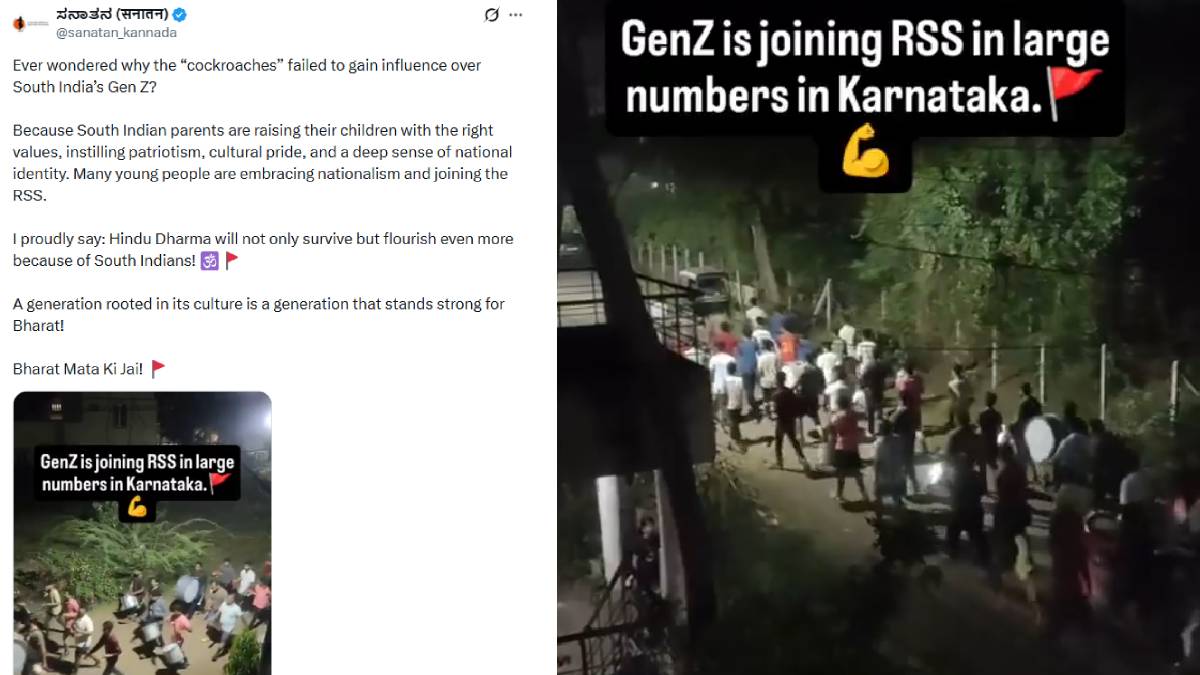
While it is undeniable that the RSS and BJP have been trying to expand their influence across southern India, the claim that CJP's reach among young people is directly linked to the South's supposed rightward shift is a bit of a stretch.
Is CJP lacking in South India?
Yes, CJP is still a relatively new movement, and its long-term grassroots presence across southern India remains limited. However, it has already held protests in Bengaluru, including demonstrations at Freedom Park against the Special Intensive Revision (SIR) of electoral rolls. Its October 2026 protests attracted students, civil society groups and public figures, including actor Prakash Raj.
This suggests that the movement has been able to attract attention in the South, but whether it can build a sustained presence among young people across the region remains to be seen.
Is it because southern youth are becoming more right-wing or RSS-oriented?
Not necessarily. The RSS has a presence in southern India, and the BJP has made electoral gains in parts of the region. However, the political landscape differs significantly across Karnataka, Kerala, Tamil Nadu, Andhra Pradesh and Telangana. It would be misleading to suggest that southern youth as a whole are becoming more right-wing or that they are uniformly moving towards the RSS.
In fact, both the RSS and CJP face a similar challenge as southern India has its own distinct political landscape, shaped by local languages, geography, history and socio-cultural dynamics.
When a movement speaks about issues that do not immediately connect with people's everyday concerns, its message can lose its impact in translation. People may struggle to understand what the movement stands for, how its demands affect them and why they should become involved.
There is also the practical question of distance. For some students in Delhi, travelling to a protest or joining a demonstration in the capital may be relatively straightforward. For students in southern India, travelling to Delhi can be expensive, time-consuming and difficult to manage alongside studies or work.
The memes, language and political culture surrounding movements such as CJP can also be predominantly shaped by northern Indian experiences. This does not mean southern youth cannot relate to them, but it can make the messaging less immediately familiar or engaging.
All of this affects how a movement builds its identity and attracts supporters beyond its original base.
Southern politics also has its own established traditions of social justice, linguistic identity, regional pride and anti-caste movements. In many places, political engagement is shaped by local parties, community organisations and regional issues rather than by the national political narratives that dominate parts of northern India.
Religious polarisation and debates around Muslim identity also play out differently across states. It would be an oversimplification to say that southern India is rarely influenced by the same issues that shape northern politics. Instead, the priorities, political histories and responses of communities differ across the region.
For CJP, the challenge may be less about whether southern youth support the RSS and more about whether the movement can establish meaningful connections with young people through issues they consider important.
Ultimately, it is a question of inclusivity and representation. A movement cannot expect young people to support it simply because it has attracted attention elsewhere. It needs to understand their concerns, communicate in ways that resonate with them and create opportunities for them to participate.
The South is not politically uniform, and neither are its young people. Whether CJP can build a lasting presence in the region will depend on how well it understands these differences rather than treating southern India as an extension of northern political culture.



Comments