
On Twitter, a rift has developed in the minds of people who have too much time on their hands and too little interest in touching grass and seeing the outside world. What started as a post about Hyderabad feeling calmer during Dussehra has taken on another online debate form that makes people’s lives a little more miserable than they’d like, especially for those who come across it.
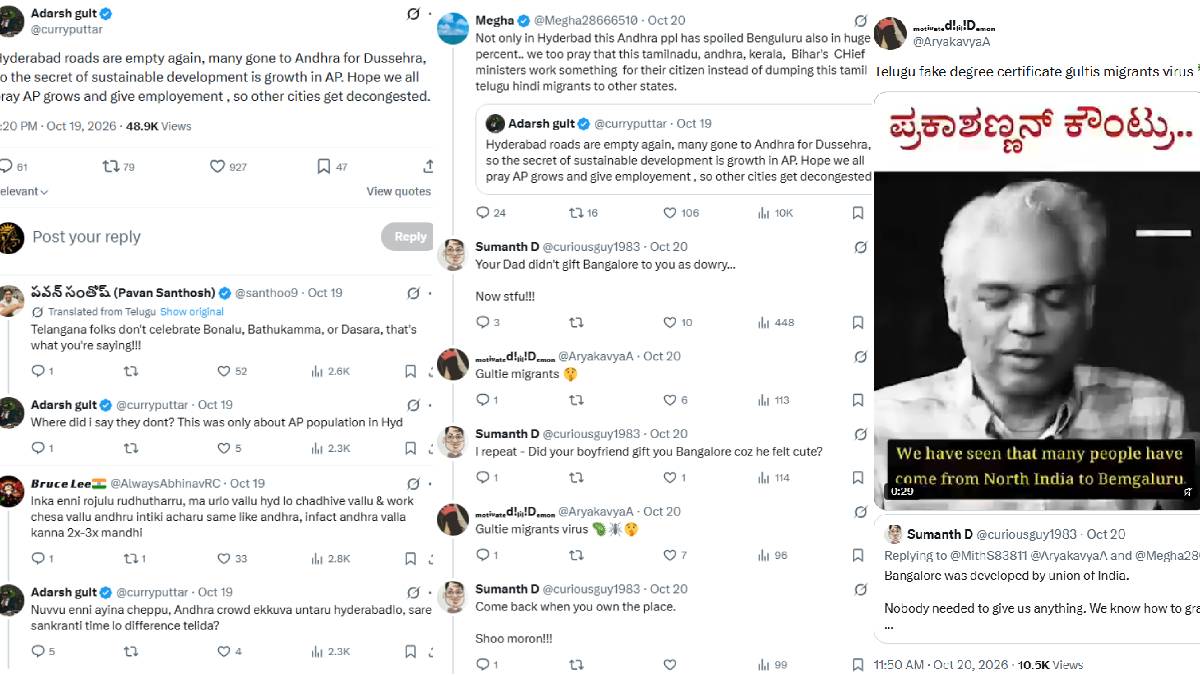
The debate started when a social media user alleged that Hyderabad felt calmer during Dussehra because many people from Andhra Pradesh had returned to their hometowns to celebrate the festival. What an odd thing to say, but perhaps the person did not anticipate the reaction it would trigger. The guy then went on to add that Andhra Pradesh needed to develop further for Hyderabad to feel better, as though Andhra Pradesh had no cities of its own.
And maybe the original poster was just frustrated with noisy neighbours, making a personal observation into a stereotype about an entire region’s population. While the commentors were reminded that DUSSERA is a big festival celebrated by Telangana people as well,
going further, people from Andhra Pradesh and Telangana began pointing out that the comments sounded remarkably similar to things Kannadigas in Bengaluru have said about migrants from other states, including Tamil Nadu and northern India. The familiar arguments about outsiders, overcrowding, employment and who truly belongs in a city were back.
And so began another episode of the Telugu-versus-Kannada-versus-Tamil-versus-North-Indian keyboard wars, with people seemingly eager to explain regional identity and urban development to strangers online.
Who actually built Bengaluru?
As the arguments went on, there was the same old question: who built Bengaluru, and who is to be commended for its economic success?
The factual answer is much less dramatic than the competing claims on social media.
Bengaluru’s foundation was laid long before the IT boom. Investing in education, industry and public institutions in the Mysore Kingdom helped to make an environment which eventually supported industrial and scientific development. Public sector enterprises and research institutions such as Hindustan Aeronautics Limited (HAL), Bharat Electronics Limited (BEL), Indian Telephone Industries (ITI) and Indian Institute of Science (IISc) contributed to the city's industrial and scientific development after independence.
The Karnataka government also had a major role in developing the technology sector. KEONICS was established in 1976 and Electronics City was developed from 1978 onwards as part of efforts to promote electronics industries. Software Technology Parks of India (STPI) and subsequent state IT policies helped to build the infrastructure and business environment needed for the industry to expand.
The IT boom that followed India’s economic liberalisation in 1991 built on this old foundation. Global demand for software services, private investment, local entrepreneurship and skilled workers from across India helped make Bengaluru a major technology hub.
So neither locals nor migrants can reasonably claim exclusive credit for building the entire city. Local talent, state policies, central government investments, private companies and workers from different parts of India all contributed to its growth.
The Migrant versus Local Debate
The same argument applies to migration. Bengaluru has benefited from people coming from various states to study, work, start businesses, and create careers. At the same time, rapid population growth has put pressure on housing, roads, public transport, water supplies and other urban infrastructure.
These are legitimate concerns and should be addressed seriously. But if we blame a whole regional community for every urban issue, then that is neither true nor useful.
India’s constitutional framework guarantees citizens' rights to move freely and live in various parts of the country, but subjected to the law. Qualifications, skills, experience and hiring practices play an important role in employment. The notion that one regional group is more qualified, less qualified, or uniquely responsible for the problems in the job market are stereotypes and not an evidence-based explanation of the job market problems.
The same is true of charges of fake degrees or regional superiority. Without any actual evidence, such accusations do little but promote prejudice.
Another Internet War That Solves Nothing
What is particularly exhausting about these arguments is how quickly an ordinary observation becomes a competition over which language, state or community deserves more respect. People who might otherwise have nothing to say to one another suddenly become experts in economics, history, migration and public policy, armed with screenshots and sweeping generalisations.
Had the original question that Hyderabad was calmer during Dussehra been a simple comment about festival travel and changing city activity, the user had to add a piece which made him sound like he had some resentment towards people from Andhra Pradesh living in Hyderabad.
There is nothing wrong with talking about migration, regional identity, language, employment or local governments’ responsibilities. These are important issues, especially in rapidly growing cities. But they require evidence, context and meaningful solutions instead of competitions over who contributed more to a city’s success.
Bengaluru’s growth is a combination of local foundations, public investment, government policies, private enterprise and talent from all over India. Hyderabad and other major cities have their own story of development, investment and migration.
No city is successful because of one community and no regional group should be reduced to a stereotype because of an individual's social media post. At the same time,e people should respect the culture, language and heritage of the city they live in.
Maybe the most effective response to this latest internet war is to step away from the screen. The cities that are involved have real issues that are really pressing and have more important things to do than spend days defending themselves online against people they don’t know.
Tomorrow there will likely be another regional rivalry on the internet. But whether anyone needs to participate is an entirely different question.






Comments
Leave a Comment