
A young man from Uttarakhand has become a hero for his audacious technological ambitions, inspiring others to have a bright idea that has been turned into something real and workable by being curious and self-learning.
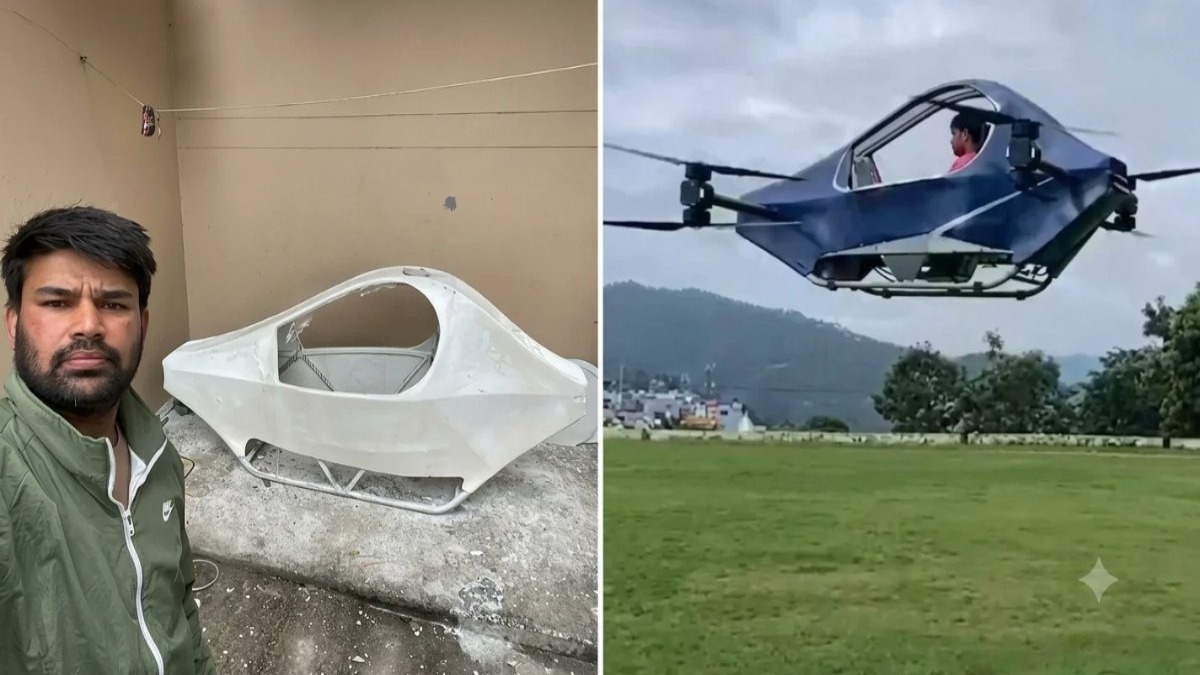
Ravi Tamta, a BA graduate from Almora district, has already created an electric flying vehicle that can travel in a single-seater car, HAPIDA SKYNeX, but he did not have a formal engineering or science degree.
Tamta spent around 13 years learning on his own with the internet for the purpose of learning the technology and designing and working on the concepts and a plan to travel on an air transport plane by himself.
As the world of technology develops, I am interested in his journey because it makes an idea that is now unattainable for people with a special degree or access to top universities.
From a small village in Uttarakhand to an ambitious aviation project
Tamta was born in Kaflikhan, a village near Jageshwar Dham and grew up in Uttarakhand. Living in the mountains, he knew the difficulty people face in the mountainous area and how difficult things are to travel in.
From this experience, Tamta, who was experiencing the difficulty of accessing medical facilities in emergencies, felt that it was time to explore the possibility of using his own air mobility. In mountainous places where road trips can be long and basic services are difficult, a small flying vehicle is very attractive.
In 2015, Tamta started his idea for a flying car and he had a project called HAPIDA Sky Private Limited.
What is the HAPIDA SKYNeX Flying Vehicle?
HAPIDA SKYNeX is a single-seat electric flying vehicle based on vertical take-off and landing technology (VTOL). Unlike traditional aircraft that need a runway for take-off and landing, VTOL aircraft are designed to fly vertically and land without a runway.
The prototype is believed to have multiple electric motors and propellers and is based on multirotor drone technology as well. The proposed design is a lightweight frame with a cockpit and transparent canopy with a battery-powered electric propulsion system.
Electric VTOL technology has attracted growing interest worldwide for its future transport applications, emergency response, and access to spaces where we don't have conventional transport infrastructure.
But building a vehicle that will lift a person safely is far more complex than making a drone. Engineers need to take into account lift, weight distribution, battery performance, structural strength, flight stability, control systems, and emergency procedures.
A successful demonstration or experimental flight does not necessarily prove a vehicle is ready to travel or operate in the real world.
Tamta went to school in a rural village in the first place and is reported to have graduated from a BA college in Nainital. His father, Harish Ram, is a mechanic.
With no major engineering university or a well-equipped research laboratory, Tamta is said to have used the internet as his primary source of learning. Through online resources, technical explanations, and repeated experimentation, he was able to learn things outside of the formal educational environment he had.
The 13-year journey speaks to the persistence required to develop an unknown technology. Designing a flying vehicle involves a lot of technical activities like mechanical design, electrical systems, aerodynamics, and software controls, etc.
Early designs may not be able to deliver the stability, lifting capacity, or endurance needed, and the need for repeated testing and modification is a very important aspect of the prototype development process. Tamta's experience shows the ways in which self-directed learning can help motivated people to start to make sense of technical issues even if they don't follow a traditional course of education.
🚨Ravi Tamta, a Bachelor of Arts graduate from Almora,Uttarakhand has built an electric flying car prototype after 13 years of learning through online resources and hands-on experiments, despite having no formal science or engineering education. https://t.co/LAVWR1eoox
— Indian Infra Report (@Indianinfoguide) October 23, 2026
Prototype flight is only the beginning
According to reports, the HAPIDA SKYNeX prototype conducted a practical flight demonstration in August. But detailed independent verification of the flight, its duration, operating conditions, and performance specifications would be necessary to fully understand the vehicle’s capabilities. There is no information on the maximum flight time, payload capacity, battery range, safety systems, and certification status in the information available here.
A crewed electric flying vehicle used commercially in India needs to comply with all commercial aviation rules and regulations, testing requirements, and safety requirements.
Depending on the final design and classification of the aircraft, it would require approval from aircraft authorities, and such a design would need to be approved and authorized by authorities in the aviation sector. Such requirements are necessary to ensure experimental technology is feasible in the presence of passengers, buildings, roads, and other aircraft.
A story of determination and self-learning
Ravi Tamta's achievement will help motivate students, hobbyists, and aspiring inventors who aspire to do much more than just technical work as well as others who do not have a formal education. His trajectory shows that a bachelor’s degree can be a good foundation (but learning does not end once formal education is complete), as well as online resources, hands-on experimentation, and persistent effort to get good at new things.
At the same time, the development of a flying vehicle demonstrates why ambition must be accompanied by rigorous engineering, independent testing, and regulatory compliance.
If further testing proves it to be both operational and safe, HAPIDA SKYNeX might be one of the best examples of grassroots innovation in the emerging electric aviation sector in India.
For now, Tamta’s story should be viewed as a long-term prototype-development process, rooted in years of self-learning and persistence and a vision that was shaped by the transportation challenges of his home region.
His journey is a powerful message: formal education can open doors, but curiosity and determination can push people to look outside the classroom. But turning an experimental flying vehicle into a reliable transport solution will take more technical proof, safety testing, and regulatory approval.






Comments