
Maintaining financial discipline and adhering to statutory deadlines is crucial for businesses, professionals, and taxpayers in India. Missing key compliance dates can lead to penalties, interest charges, and unnecessary legal complications. As May 2026 approaches, it becomes essential to stay updated with all major deadlines related to GST, TDS, Income Tax, PF, and ESI.
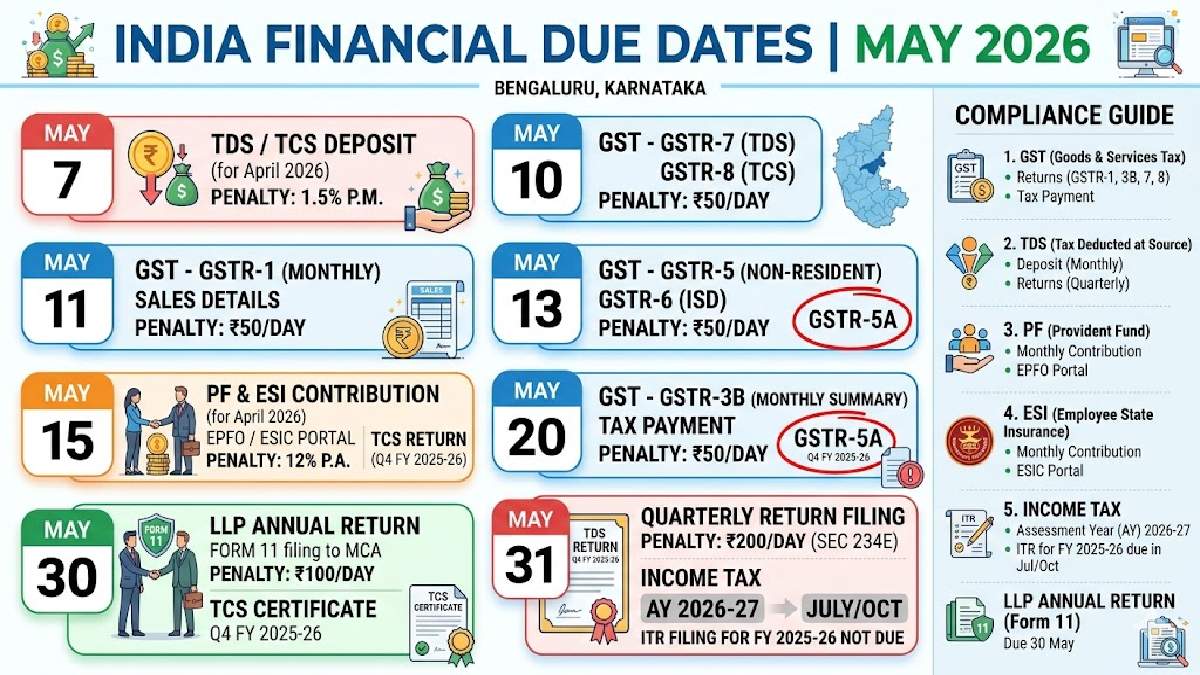
Key Financial Due Dates - May 2026
The month begins with an important obligation on May 7, 2026, which is the due date for depositing Tax Deducted at Source (TDS) and Tax Collected at Source (TCS) for April 2026. Timely payment ensures compliance with income tax laws and avoids interest under relevant provisions.
On May 10, 2026, businesses must file GSTR-7 for GST TDS and GSTR-8 for e-commerce operators who collect TCS. This is followed by GSTR-1 filing on May 11, 2026, which includes details of outward supplies for April.
For taxpayers under the QRMP scheme, GSTR-1 (quarterly) is due on May 13, 2026, covering the January–March quarter.
Mid-month deadlines are equally significant. On May 15, 2026, employers must deposit Provident Fund (PF) and Employee State Insurance (ESI) contributions for April. The same day also marks the due date for submission of Form 24G by government offices.
On May 20, 2026, businesses are required to file GSTR-3B, the monthly summary return under GST. Taxpayers under the QRMP scheme must complete their tax payment via PMT-06 by May 25, 2026.
Toward the end of the month, compliance intensifies. On May 30, 2026, taxpayers must file challan-cum-statements for TDS under sections 194-IA, 194-IB, and 194M. Finally, May 31, 2026, is the deadline for filing quarterly TDS returns for the January–March quarter and submitting relevant reports under the Annual Information Statement, where applicable.
GST Compliance: A Monthly Priority
GST remains one of the most critical areas of compliance. Returns such as GSTR-1, GSTR-3B, GSTR-7, and GSTR-8 must be filed accurately and on time. Delays can result in late fees, interest charges, and even blockage of Input Tax Credit (ITC).
Businesses should ensure regular reconciliation of invoices and maintain accurate records before filing returns to minimise errors.
Income Tax & TDS Responsibilities
Employers, companies, and individuals responsible for TDS must ensure timely deduction, deposit, and filing. Missing deadlines can attract:
- Interest under Section 201(1A)
- Late filing fees under Section 234E
- Additional penalties under Income Tax laws
PF & ESI Contributions
Organisations registered under EPFO and ESIC must deposit contributions by May 15, 2026. Timely compliance helps avoid penalties, interest liabilities, and legal notices.
How to Manage Compliance Efficiently
Staying compliant requires planning and discipline. Here are a few practical steps:
- Maintain a structured compliance calendar or use ERP tools
- Reconcile accounts regularly, including sales, purchases, and payroll
- Keep all documents organised and ready before deadlines
- Consult tax professionals for complex filings or regulatory updates
Conclusion
May 2026 is packed with critical compliance deadlines across GST, TDS, PF, ESI, and Income Tax. Businesses and professionals must stay proactive, maintain proper documentation, and adhere to timelines to avoid penalties.










Comments
Leave a Comment