
The government has revamped its tax-deducted at source (TDS) reporting process in a major way. Form 24Q and Form 26Q are being replaced with Form 138 and Form 140, which makes quarterly TDS filings more easily digestible and accessible.
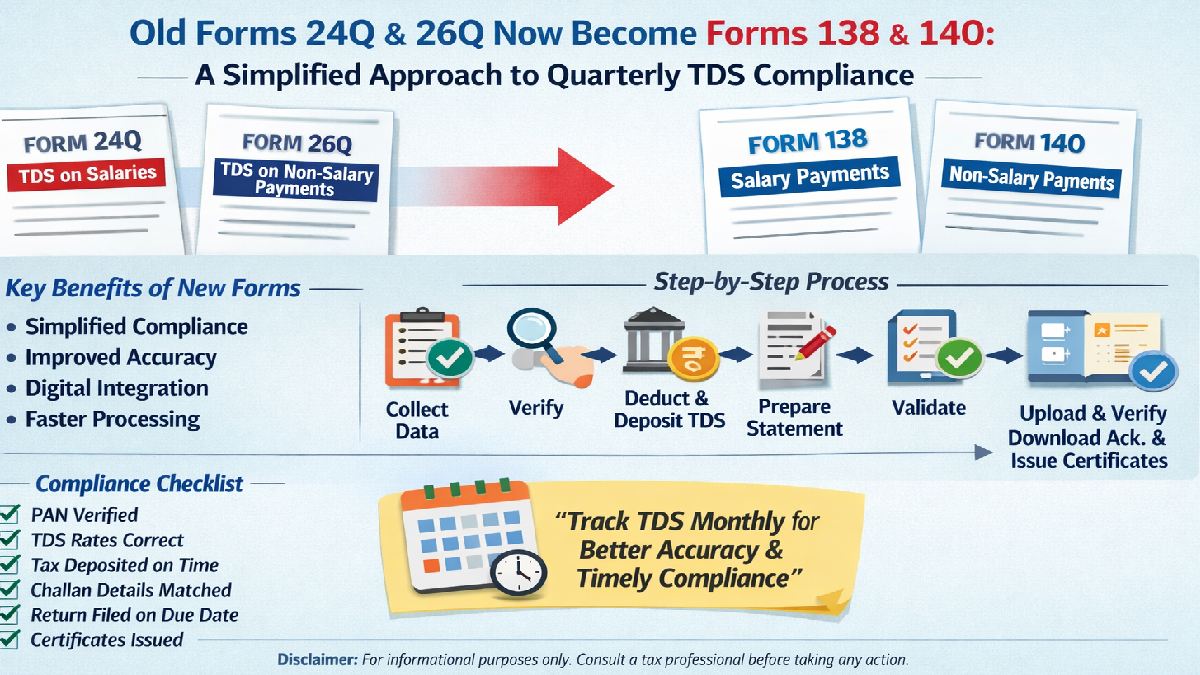
In this transition, we should simplify things, get it right, and get businesses and professionals to be more accurate for compliance.
Understanding the Earlier Forms
Form 24Q – TDS on Salaries
Form 24Q was used for reporting TDS deducted on salary payments under Section 192. Employers were required to file this quarterly, including:


- Employee salary details
- Tax deductions
- PAN information
- Income tax calculations
Form 26Q – TDS on Non-Salary Payments
Form 26Q applied to TDS on payments other than salaries, such as:
- Contractor payments
- Professional fees
- Interest income
- Commission and brokerage
Introduction of New Forms
Form 138 – Salary Payments
Form 138 replaces Form 24Q and is used for reporting TDS on salaries. It offers:
- Simplified employee-level reporting
- Better integration with payroll systems
- Less duplication of information
Form 140 – Non-Salary Payments
Form 140 replaces Form 26Q and is applicable for non-salary TDS reporting. The benefits include:


- Streamlined structure
- Improved classification of payments
- Enhanced validation to minimize errors
Key Benefits of the New System
- Simplified Compliance – Fewer fields and clearer formats reduce filing complexity.
- Improved Accuracy – Built-in validations help avoid common errors.
- Digital Integration – Designed to work with accounting and payroll software.
- Faster Processing – Cleaner data allows for quicker processing by tax authorities.
Step-by-Step Process for Filing TDS (Forms 138 and 140)
- Collect and Verify Data – Get all payment details for the quarter, verify PAN, check TDS rates.
- Deduct and Deposit TDS – Deduct at payment/credit, deposit within due dates.
- Prepare the Statement – Use updated utilities/software, enter deductor, deductee, and challan details.
- Validate the Return – Check for errors in PAN, challan mapping, and amounts.
- File the Return – Upload on the income tax e-filing portal, verify using DSC or EVC.
- Download Acknowledgment – Save acknowledgment for records.
- Issue TDS Certificates – Provide certificates (Form 16 and Form 16A equivalents) to deductees.
Process Flow: Collect Data → Verify → Deduct TDS → Deposit TDS → Prepare Statement → Validate → Upload → Verify → Download Acknowledgment → Issue Certificates
Compliance Checklist
- PAN details verified
- Correct TDS rates applied
- TDS deposited on time
- Challan details matched
- Return filed within due date
- Acknowledgment saved
- TDS certificates issued
Practical Tip
Keeping a monthly TDS tracking system as opposed to quarter-end is helpful in decreasing errors, ensuring timely payments, and streamlining the filing process.
With the change from Forms 24Q and 26Q to Forms 138 and 140, the tax compliance system is becoming more efficient. And while the basics of TDS are still the same, the new formats will be simpler, more accurate, and more in sync with digital processes.
The companies that adapt to these changes will be able to comply with the rules with more certainty and lower risk and hence be more efficient.
Disclaimer
This information is provided for general awareness only and does not constitute professional tax advice. It is advisable to consult a qualified tax professional before taking any action.









Comments