
Knowing the way in which special allowances are taxed can help with a useful framework for salary structuring and tax planning. Under income tax acts 1961, a few of these allowances get exemption, mostly from the former tax system, whereas the new system restricts the number of exemptions to very few exceptions (if any) and allows for much lower slab rates. Here’s a plain old comparison to assist salaried employees make the “must-know” decisions.
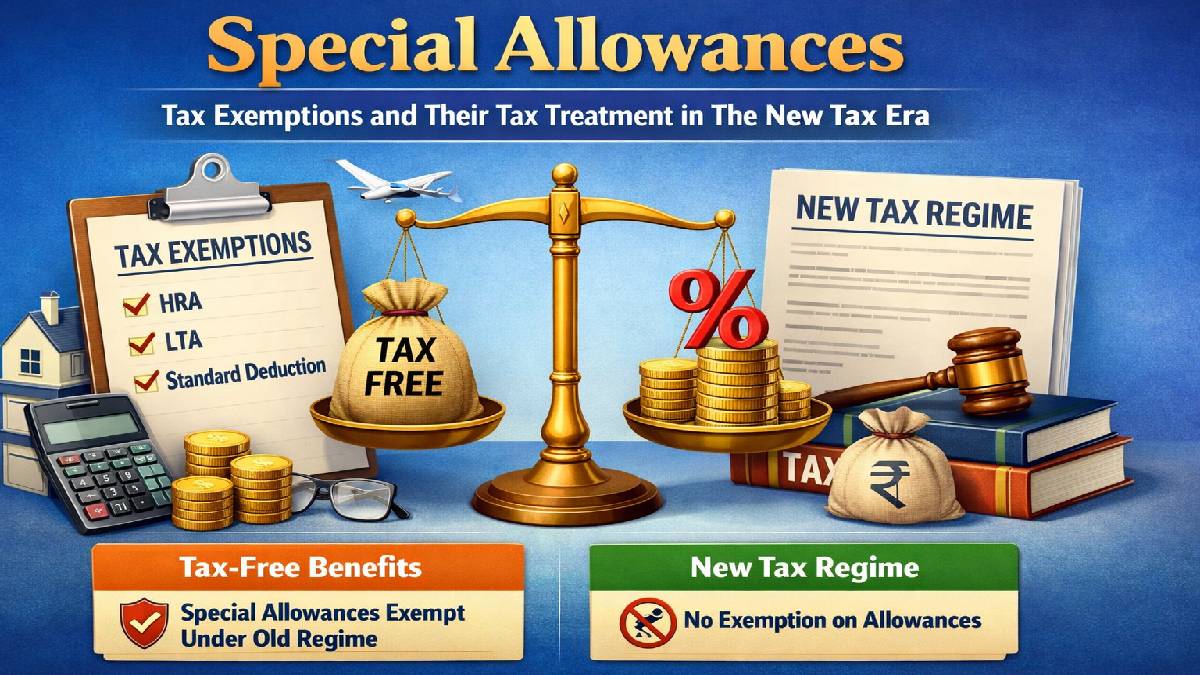
Exempt Allowances under the Old Tax Regime
Allowed for different use of taxpayer’s property. The old tax system allows for multiple exemptions in Section 10 of the Act, which significantly leads to lower taxes on income.
- House Rent Allowance (HRA): exempting the least of: Actual HRA received , 50% of salary (for metro cities) or 40% (in non-metro cities).
Rent paid less than 10% of salary.


- This exemption is advantageous to employees in rented accommodation.
- Children education allowance: ₹100 per child per month. Maximum of 2 children. Total exemption: ₹2,400 per year.
- Hostel expenditure allowance: ₹300 per month per child. Maximum of 2 children. Total exemption: ₹7,200 per year.
- Transport Allowance: ₹1,600 per month. ₹3,200/month for differently-abled employees. (Note: In recent years this has been replaced by the typical deduction for most employees.)
- Special Compensatory Allowance (Hilly Areas): Available for ₹300 to ₹7,000 monthly (location-dependent).
- Border Area Allowance: ₹200 to ₹1,300 per month.
- Tribal Area Allowance: ₹200 per month.
These allowances are location-based and intended to counter difficult living conditions.
Adjustments Under New Tax Regime
And yet the tax regime was also designed to simplify taxation by cutting out most exemptions and exclusions.
What is Not Allowed?
Under the new regime:

- HRA exemption is not available.
- Children’s Education Allowance cannot be exempt.
- Hostel Expenditure Allowance is not exempt.
- Most special allowances are fully taxable.
What You Get Instead:
- Higher standard deduction: ₹75,000.
- Reduced tax slab rates: 0% up to ₹3 lakh , 5% from ₹3–₹6 lakh , 10% from ₹6–₹9 lakh , 15% from ₹9–₹12 lakh , 20% from ₹12–₹15 lakh , 30% above ₹15 lakh.
The aim is to create lower rates that demand a relatively smaller compliance burden.
Old & New Tax Regime: Better?
Choose Old Regime If:
- You are paid a high rent and collect HRA.
- You invest heavily under Section 80C.
- You claim multiple allowances and deductions for several allowances and deductions.
Choose New Regime If:
- You prefer simplicity.
- You have minimal deductions.
- You need lower slab rates and you don’t want documentation snags.
With no business income, salaried taxpayers can change between regimes each financial year on the time their return is filed.
Final Thoughts
Tax planning needs to reflect your income structure and financial objectives. The old regime incentivises disciplined investments and eligible exemptions, while the new regime is straightforward taxation with lower slab rates. Before deciding, calculate your tax liability for these two regimes and decide which option offers the highest savings benefit. Today's tax-planning for tomorrow ensures stronger financial stability. That way our budget does not shrink in proportion as the market goes up and down.









Comments