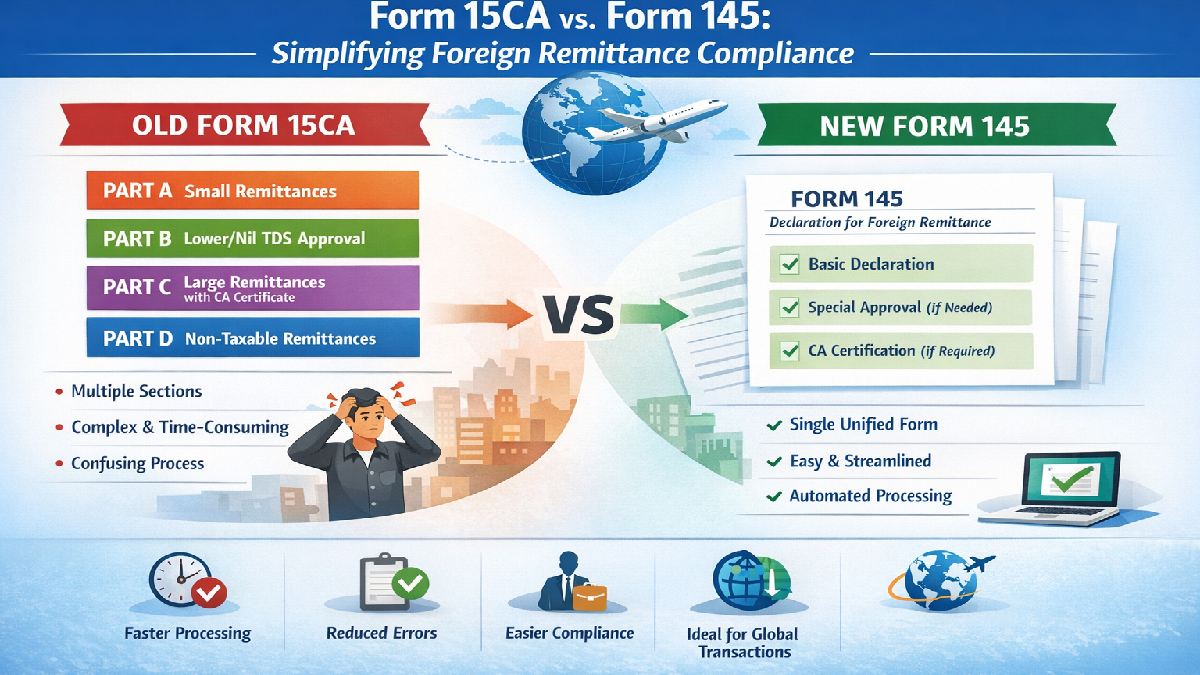
India has made many changes in foreign remittance under the Income Tax Act, 2025. These new rules will be implemented from April 1, 2026 to replace the existing framework in Section 195 of the previous law.

Key Changes
New Forms Introduced
Form 15CB (Accountant’s Certificate) has been replaced by Form 146 and Form 15CA (Remitter’s Declaration) has been replaced by Form 145. These new forms are part of the revised compliance structure, for efficiency and transparency.
New Legal Provision
Foreign remittance compliance will now be governed under Section 393 of the Income Tax Act, 2025. This is a change from the earlier provisions under Section 195.
Practical Implementation Challenges
Mandatory CA Authorization
Taxpayers need to authorize their Chartered Accountant on the income tax portal before filing Form 146. Without this authorization, the filing process cannot proceed.
No Bulk Filing
Unlike in the past, there is no bulk filing in this new system. Each transaction has to be filed separately on the online portal.

Pre‑Remittance Filing Requirement
All relevant forms must be submitted before beginning the foreign remittance. Delays or non‑compliance may result in penalties.
Critical Compliance Points
- The threshold is still ₹5 lakh per financial year.
- Form 146 cannot be edited once submitted.
- Form 146 withdrawal is allowed within 7 days under certain conditions.
- Penalty of up to ₹10,000 per certificate may be levied under Section 463.
Businesses and professionals should do the following:
- Complete the “Add CA” authorization process on the income tax portal.
- Update internal systems and workflows to the new requirements.
- Train finance and compliance teams on the revised procedures.
Objective of the Update
Our first aim in this change is to:
- Increase transparency in presumptive taxation.
- Reduce under‑reporting of income.
- Align ITR information with AIS (Annual Information Statement) and TIS (Taxpayer Information Summary).
Eligibility for Section 44AD
Taxpayers eligible for this scheme are:
- Resident individuals
- Hindu Undivided Families (HUFs)
- Partnership firms (excluding LLPs)
Conditions:
- Turnover up to ₹2 crore.
- Up to ₹3 crore if 95% of transactions are digital.
Not applicable to:
- Professionals (covered under Section 44ADA).
- Commission or brokerage‑based businesses.
- Certain restricted business categories.
Important Dates for AY 2026–27
- 31 July 2026: Salaried individuals and non‑business taxpayers.
- 31 August 2026: Business taxpayers (non‑audit cases, including Section 44AD).
Final Note
The new framework will enhance our ability to comply with foreign remittance laws and be more compliant. But it also adds more procedural requirements and makes the taxpayers and professionals responsible for this. And it will need to be done in a timely manner to be compliant with the new regime.