The Chinese have developed a lifelike underwater robot inspired by the golden arowana, which has caught people's attention with its advanced biomimetic design and underwater observation applications. Known as the BG-5 Golden Dragon Fish, this robotic fish was exhibited at the 2026 China International Fair for Trade in Services (CIFTIS) at Beijing's Shougang Park.
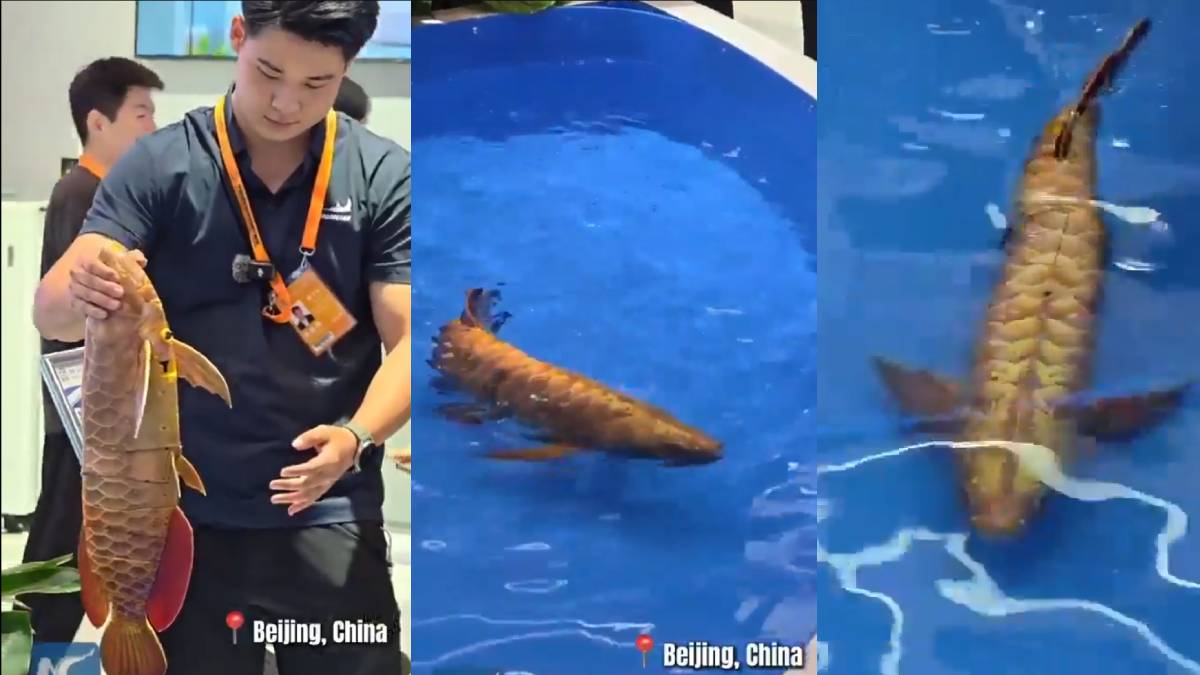
The BG-5 is developed by Boyagongdao Marine Technology Group to deliver the appearance and swimming motion of a true golden arowana. Unlike conventional underwater vehicles that depend on propellers, the robot uses a multi-joint tail to generate propulsion through a wave-like movement.
The robot is estimated to weigh about 3 kilograms and is around 640 mm long. According to the manufacturer's catalogue, it can be used at depths of up to 5 m and with a speed of 0.6 m per second. Its three-joint tail is separated into seven segments, and the machine mimics the movement of a fish swimming.
The BG-5 is able to navigate without a route. Sensors help the robotic fish identify obstacles and manipulate its movements autonomously. This makes the machine so much better in scenarios where underwater conditions can change, and continuous manual control may be difficult.
The fish-like design isn’t just a gimmick. Biomimetic robotics attempts to replicate the processes found in nature to solve engineering problems. Fish can move efficiently through water in a relatively smooth and continuous manner. In replicating that process, the BG-5 can be able to travel without the traditional rotating propulsion system used by many underwater drones.
Look at the quality of this fish drone that China just revealed pic.twitter.com/v24asLP4d1
— The Gulag (@WelcomeTheGulag) September 15, 2026
Its small size and shallow-water operation have also attracted attention. A robot less than a metre in length may be deployed in confined underwater environments where larger unmanned underwater vehicles may be difficult to operate. Possible uses include underwater inspection, observation, environmental monitoring and reconnaissance.
The surveillance angle has attracted particular interest online. The robot’s autonomous navigation, small size and fish-like movement could make it suitable for shallow-water surveillance and reconnaissance, according to some reports. However, that does not in itself establish that the particular BG-5 exhibited at the trade fair is being used for covert spying.
The developer's wider work has added to the discussion. Boyagongdao has been involved with underwater biomimetic robotics projects such as ROBO-SHARK, while the company has also presented work on underwater detection platforms. These connections have led to speculation on the dual use of technologies such as the BG-5.
There is also a more advanced BG-5V version. The reported capabilities are path planning, task assignment, formation control, and cooperation of several underwater robots. These could allow a series of robotic systems to coordinate their actions and tasks and could increase their potential in underwater inspection, search, and reconnaissance.
The presentation has also inspired some lighter responses online. Videos of the robotic fish swimming smoothly in water have been seen as marvelously similar to those of a living fish. Some social media users joked about growing robotic fish, which may eventually become the tool of choice for stealthy underwater missions.
The BG-5 Golden Dragon Fish is unique in that it looks like a real fish. Biomimicry, autonomous navigation, and underwater robotics are converging. China's robotic-fish show has illustrated how machines that can operate naturally in environments where conventional robots are either too obvious or too hard to manoeuvre are rapidly developing.
And for now, the BG-5 is still an impressive underwater biomimetic engineering project. But it is its autonomous movement, shallow-water capability, and fish-like propulsion that is also why such technologies are now attracting attention beyond robotics exhibitions.