A humanoid robot at a technology conference in Beijing had a tantrum-like fit on the floor when its remote control system failed. Video of the incident showed the machine suddenly thrashing around and operators scrambling to intervene and regain control. What had been aimed at showcasing China’s rapidly developing humanoid robotics industry was a moment of viral fame and a funny moment in its own right for viewers.
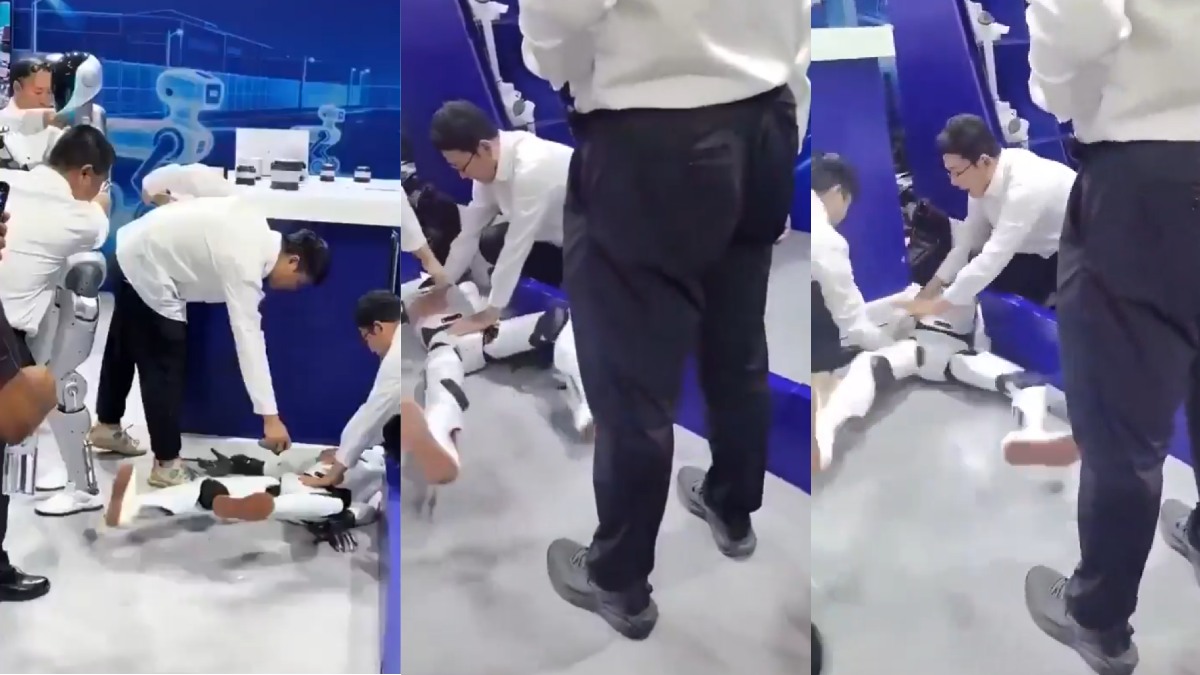
The robot was remotely operated when something went wrong with its control system. The machine didn’t remain upright and didn’t move normally; it just went on the floor. The operators rushed towards the robot and shut it down quickly to stabilize it. But the video showed that powering down wasn’t as fast or simple as expected, creating a chaotic situation around the malfunctioning humanoid.
The strange incident drew extensive attention because the robot's movements resembled what someone might call a tantrum. Its repetitive movements on the floor even made jokes online as some people compared it to a frustrated child. Others joked that sophisticated humanoid robots should have an obvious and easily accessible emergency kill switch that could instantly disable them in a technical disaster.
Though the video was fun to watch, the episode also highlighted a very high-level engineering challenge for the rapidly expanding humanoid robotics industry. With robots increasingly able to walk, balance, lift things, and perform complex tasks, reliable control systems are becoming more important than the mechanical hardware itself. A robot working around people in factories, warehouses, homes, or public places needs to be able to respond predictably even when communication or remote-control systems fail.
The problem was far from unique. Similar glitches in other robots at the conference also pointed to the difficulties in remotely controlling advanced humanoid machines. Such failures demonstrate that robotics companies must account for a wide range of technical problems, including communication interruptions, software errors, sensor failures, and unexpected movements.

China is heavily investing in humanoid robotics as part of its broader push to develop advanced manufacturing and artificial intelligence technologies. Machines for manufacturing, logistics, household assistance, and other purposes are under development by companies and researchers. The technology is increasingly being presented as an answer to repetitive or physically demanding jobs but also as one of the most competitive areas in global technology.
Demonstrations and conferences provide companies with opportunities to show how far their machines have come. Robots are often asked to walk, run, manipulate objects, maintain balance, and perform tasks that show their ability to operate in human environments. But public demonstrations can also expose weaknesses that may not be quite apparent under controlled laboratory conditions.
This is especially significant because the Beijing event is happening at the same time that robot competitions and games are being designed to test humanoid machines on agility, movement, and task-based challenges. Such events are designed to show the potential of robotic mobility and intelligence and to allow developers to test the competence of various machines.
The viral footage provided a new glimpse into the progress and limitations of modern humanoid robotics. A robot’s behavior caused lots of laughter, but engineers will likely look at the situation from an even more practical perspective. A malfunction during a public demonstration is inconvenient, but a similar failure in a factory or home could potentially cause safety problems.
🇨🇳WATCH: ROBOT MALFUNCTIONS AT BEIJING CONFERENCE
— pradhyumn sharma (@pradhyu78651514) August 20, 2026
A #robot at the World Robot Conference in Beijing suddenly ends up on the floor, kicking its legs while operators struggle to shut it down after the remote control reportedly stops working.#beijing #china #viral #funny #Ai pic.twitter.com/RJN8edH2BL
As humanoid robots become more prevalent, developers will need to make them stronger, faster, and smarter but also ensure they can fail safely. Emergency shutdown mechanisms, redundant control systems, and reliable communication protocols could become critical features as these machines move from exhibition halls to real-world environments.
For all our knowledge, the Beijing robot's unexpected performance has provided the internet with an entertaining spectacle. What looked like a robot throwing a tantrum also served as a reminder that even the most advanced humanoid robots are complex systems that can behave unpredictably when their hardware, software, or control mechanisms fail.
The incident might have struck a few as funny, but it is important for the robotics field to consider: impressive demonstrations are only part of the challenge. The real test will be whether humanoid robots can perform safely, reliably, and independently when something inevitably goes wrong.