Oppo is getting into the growing AI hardware market with the new wearable device called the Oppo Heartball. The AI-powered wearable was revealed to developers during its annual developers conference. ColorOS 17 was also launched based on Android 17, though not the main focus of the event.
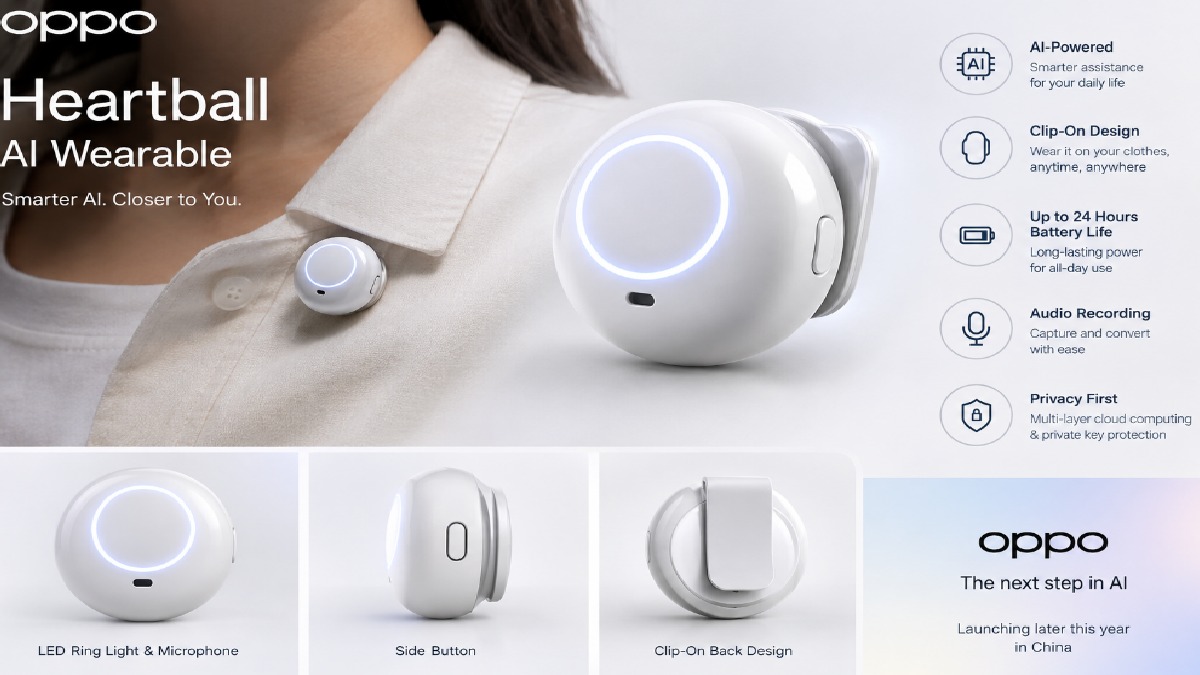
The Oppo Heartball will be introduced in China later this year. However, the company has not yet released a firm date. The device is made for wear on clothing, not on the wrist, and its shape is different than smartwatches and fitness trackers. An Oppo executive showed how the wearable could be clipped onto a user's shirt, the report said.
The wearable is said to be round and ball-shaped. The front part has a white finish and has an LED ring light. There is a cutout below the LED ring that may be connected to the microphone in the device. A button is located on the right side, allowing users to do certain things without having to depend on a connected smartphone.
The Oppo Heartball is very small in size and light in design. The AI wearable weighs about 9.8 grams. It is relatively easy to attach and carry around the day without a lot of bulk like the larger wearable devices.
Battery life is also one critical detail of the upcoming product. The Oppo Heartball is said to have 24 hours of battery life on a single charge. While the actual battery life is dependent on how frequently its recording and AI-related functions are used, the purported endurance indicates that Oppo is positioning the device for daily use.
The Heartball is expected to support live audio recording as well. Low-fidelity recording and simplified recording modes are said to be available. The wearable is capable of processing recorded information and performing text-related tasks, like single-time text parsing and deletion after conversion.
Privacy seems to be another key feature in the device's reported feature set. Oppo is working on multi-layer PCC private cloud computing, and private-key support. These features may indicate that the company is focusing on safeguarding the data collected and user information by AI-driven functions.
The reported compatibility with office software could also make the Heartball useful for workplace-related tasks. Audio recording and text conversion could help users capture meetings, conversations or notes and then process that information digitally. But Oppo has not yet revealed the full list of supported applications or how the AI functions will work in everyday situations.
The Heartball marks a notable expansion of the company’s product portfolio. The company is known for smartphones but has also made products in wireless audio devices and tablets. Entering the AI wearable segment could allow Oppo to try something new in hardware at a time when technology companies are increasingly embedding AI in personal devices.
More information about the Oppo Heartball will emerge soon ahead of its launch in China. Details like pricing, availability outside China, charging specifications, storage capacity, connectivity options and the full set of AI features have yet to be disclosed.
For now, the Oppo Heartball stands out as an unusual clip-on device that is still light, audio-recording, and has a 24-hour battery life. With the device expected to be released later this year, Oppo’s AI wearable could shed light on how the company will marry artificial intelligence and compact everyday hardware.