Artificial intelligence is no longer restricted to chatbots, smartphones and computers. AI is embedded in more and more everyday devices so that they can understand voice commands, recognise surroundings, translate conversations, monitor activities and automate routine tasks.
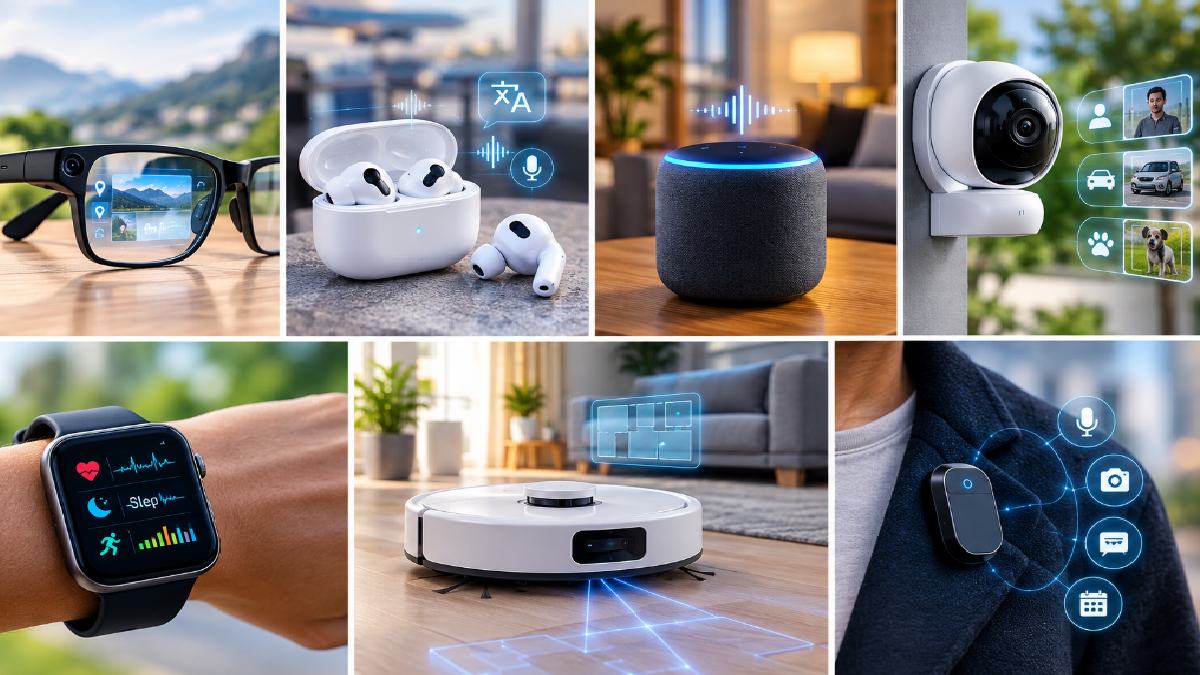
From smart glasses and AI-powered earbuds to home devices and personal assistants, the technology is gradually changing people’s encounter with gadgets.
As AI models become more powerful, manufacturers are developing ways for users to do things that they have never been able to do before without having to go to an app every time they need to; go to it when they need to; and do things to get them to do what they need to do when they need it.
Some of the most interesting developments are about making devices more context-aware, portable and more capable of doing things with fewer inputs.
1. AI smart glasses
Smart glasses with AI are one of the most readily visible examples of artificial intelligence in the real world. Unlike glasses that use cameras, microphones, speakers and AI assistants in combination to communicate with the user's environment, smart glasses are able to do so in a fashion that is entirely new to the scene.
Based on the model and software, AI glasses can answer questions, help identify objects, provide information about places, translate languages and help users take pictures or videos. There are also some devices that support hands-free communication, which will be useful for users when walking, travelling or carrying something.
The technology could eventually take away the need for users to check a smartphone constantly for some information. Users could simply ask their glasses a question and get an audio response.
2. AI-Powered Earbuds.
Wireless earbuds have evolved from being simple music tools to a diverse array of applications, and AI could enhance them. Today’s AI-powered earbuds can marry microphones, voice assistants and smartphone AI services to deliver more than just sound.
Some of the areas of real-time translation would be crucial. AI will be able to process spoken language and translate conversations, helping travellers communicate in foreign countries. AI can also improve voice calls by removing background noise and separating speech from the surrounding sounds.
Earbuds can eventually become personal AI assistants that people could use without having to get on to their phones.
3. AI Smart Home Hubs.
Smart speakers and home hubs are already home hubs that offer voice-controlled automation, but AI is going to make these systems more conversational and context-aware.
Instead of simply responding to fixed commands, AI-based home assistants can understand more natural requests. It would be possible for the user to ask a home hub to change the lighting, manage appliances or reminders, give information or coordinate multiple connected devices in a single conversation.
AI could also help smart homes learn routines while giving users more control over automation. A system might recognize regular patterns and suggest actions instead of waiting for a specific command.
4. AI security cameras.
Home security cameras are also being transformed by artificial intelligence. Traditional cameras continuously record footage, leaving users to search through hours of video when something happens. AI-powered cameras can analyze footage and detect events or objects.
These systems may also distinguish between people, vehicles, animals and other movements. Some may even send notifications when unusual activity is detected to reduce the number of unnecessary notifications.
AI-based analysis could make home security systems more useful because users can receive more specific information instead of simply being told that motion was detected.
5. AI health and fitness wearables.
Smartwatches and fitness trackers already gather information such as heart rate, sleep patterns, activity levels and workouts. AI would make the vast amount of data more understandable.
Instead of making individual measurements and just showing one measurement at a time, AI-enabled wearables could look at patterns over time and provide individualised summaries. Users can then get suggestions for exercise, sleep or activities based on the data they have shown.
But such tools should be used to complement professional medical advice and not to replace doctors and clinical testing, especially when users see unusual health measurements.
6. AI Robots For The Home.
Home robots are another area in which artificial intelligence could make a major difference. While robotic vacuum cleaners are already prevalent, more recent generations of domestic robots are being developed with better vision, navigation and conversational capabilities.
AI, for instance, could help household robots to recognize objects, understand rooms and respond to natural language instructions. Instead of following a programmed cleaning route, the next robots might be given commands for cleaning a particular room or searching for something.
As robotics hardware becomes more powerful, AI may help to transform household robots from single-purpose machines into more versatile assistants.
7. AI Personal Assistants And AI Pins
Wearable AI assistants are also being explored as alternatives to traditional smartphone interaction. These products are designed to provide access to AI through voice, cameras and other sensors to help with access to AI in augmented reality without screen use.
An AI assistant worn on clothes or carried as a small dedicated device could answer questions, record information, summarise conversations, provide reminders and interact with other digital services.
The biggest challenge for this category is to balance convenience with privacy. Data capture devices that use microphones and cameras can collect very sensitive information, so data protection, user consent and transparent controls are very important.
How AI Gadgets Could Change Everyday Life In Which sectors will it be most impactful?
The biggest change made by AI gadgets might not be a single futuristic feature but the gradual shift toward more natural interaction with technology. Users could increasingly communicate with devices using ordinary language, not menus and applications.
AI could also make technology more accessible. Voice interaction, automatic translation and visual recognition may help people do tasks that have taken a few applications or complicated interfaces.
AI gadgets at the same time raise questions about privacy, security, accuracy and reliance on automated systems. Users will have to confront the way devices process personal information and the reliability of answers or recommendations from AI.
The next phase in the gadget industry should therefore be not just about adding AI to existing products but about putting AI in everyday use. Smart glasses, earbuds, home assistants, security cameras, wearables, robots and specialist AI devices could all be part of this transformation as technology continues to evolve.