A young Nigerian inventor Khalifa Aminu from Kano is getting attention for making handmade AI-powered smart glasses that can assist blind and visually impaired individuals to better navigate the world around them.
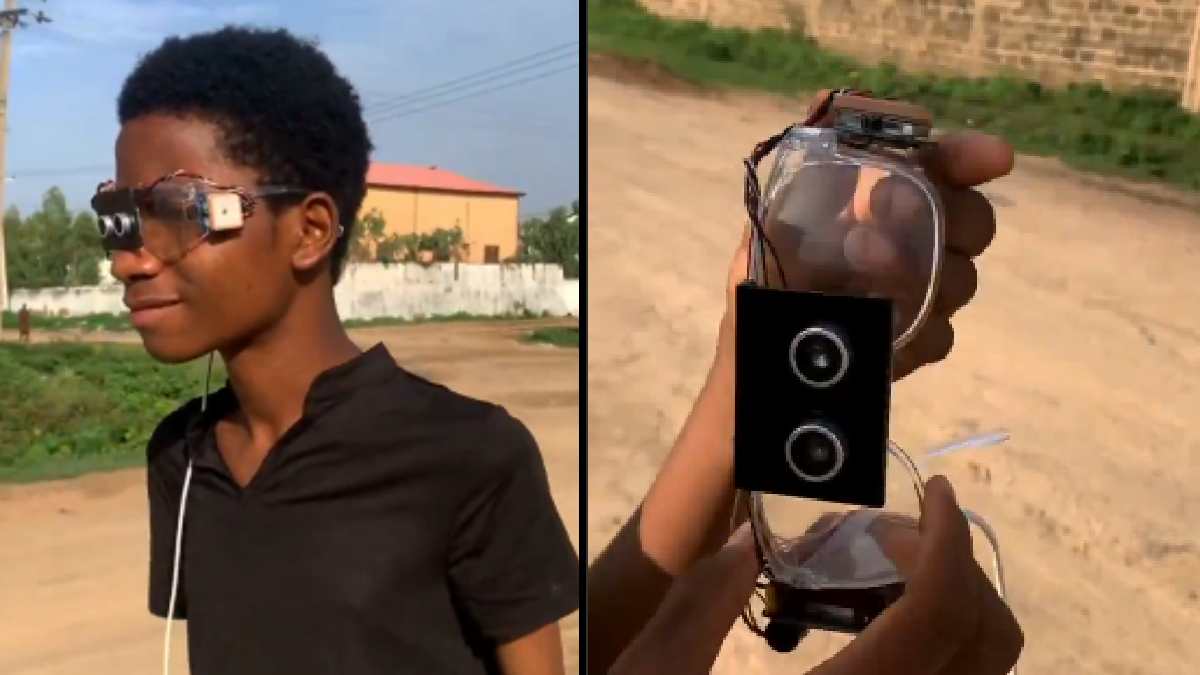
This new device combines a camera, sensors, artificial intelligence and an ESP32 microcontroller to recognize obstacles in real time.
Instead of relying solely on a white cane or a guide dog, the glasses will give the wearer immediate alerts if they detect an object or obstacle in their path.
How the AI Smart Glasses Work
The concept is simple but potentially powerful. A camera and sensors are placed on the glasses to monitor the environment around the wearer. If the system spots an obstacle it can alarm the user with vibrations and an alarm.
These warnings are to give the wearer a bit of time before reaching the object. The system could therefore be especially useful when interacting with an unfamiliar environment i.e., the environment in the interior or the environment outside.
The glasses also come with a GPS chip embedded with GPS tracking, another important safety feature. If the wearer is lost or needs help, the location of the wearer is then shared with a caregiver through WhatsApp or via email.
This will provide families with an additional level of reassurance when a visually impaired person is going to be travelling independently.
Built With an ESP32
Aminu’s project’s most interesting feature was that the device was built with an ESP32 microcontroller. Rather than spending money on an expensive commercial platform, the young inventor created the prototype with accessible electronics and a handmade approach.
The project shows how inexpensive hardware, sensors and AI technologies can be used to create assistive devices that can be used to solve practical problems.
A young Nigerian built AI smart glasses that help blind people walk without a cane or a guide dog.
— Vaibhav Sisinty (@VaibhavSisinty) August 19, 2026
Here's how it works. The glasses use AI, sensors, and a camera to detect obstacles in real time.
If something is in the way, they vibrate and trigger an alarm before the user… pic.twitter.com/lseMZGuZpF
For visually impaired people, technology that can detect obstacles and give feedback in time may complement existing mobility methods and not replace them.
AI Voice Assistance Next Step
Aminu is also working on a more advanced version of the glasses. The next step is adding AI voice capabilities.
If rather than telling the user something is blocking their way, the glasses could explain what is around them. This would allow the device to relay information about objects, surroundings and nearby environments through spoken audio.
Such a system would make the glasses more than an obstacle-detection device. It could be an AI-powered assistant that helps users interpret their surroundings.
Kano’s project shows young innovators are using AI, embedded electronics and sensors to address accessibility challenges.
Though the prototype would need extensive testing, refinement and safety validation before it could be considered a dependable replacement for existing mobility aids, its concept shows the possibilities of affordable assistive technology.