
A civil society group has asked the government not to link access to welfare benefits with a person’s electoral roll status because linking public assistance to voter registration could leave vulnerable citizens without support.
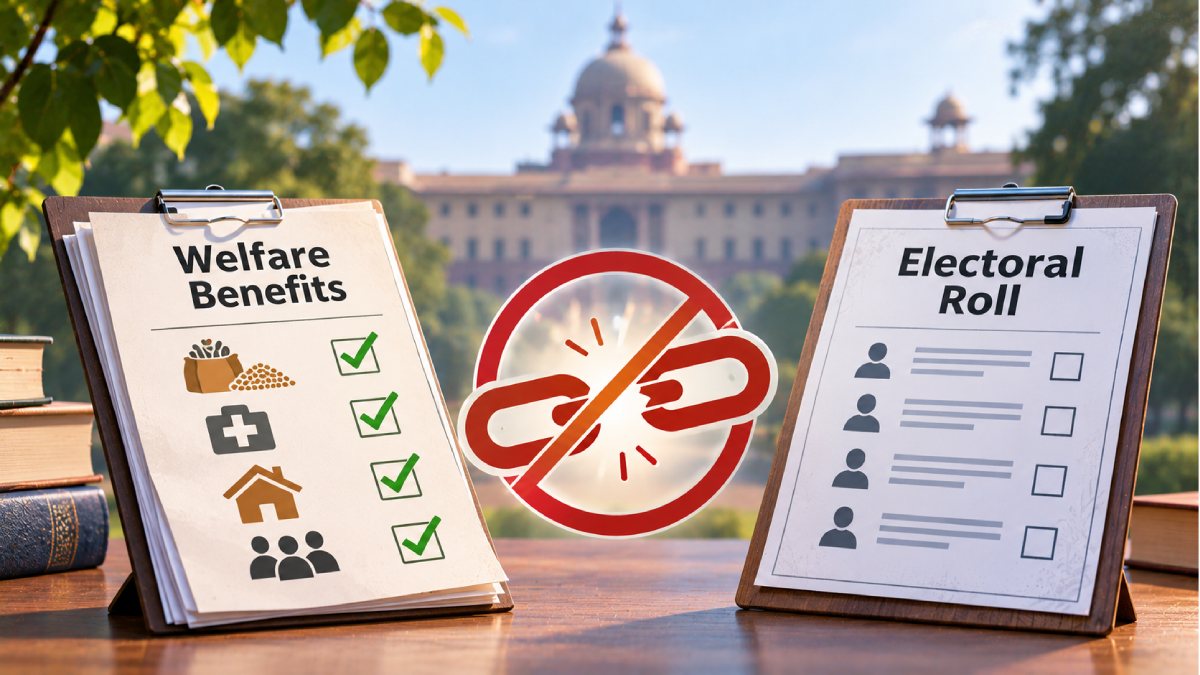
This demand comes in the wake of a wider debate on whether voter identity cards and electoral roll records can be used to identify beneficiaries of government welfare schemes. The issue came into focus after Union Panchayati Raj Minister Rajiv Ranjan Singh said voter ID details along with biometric authentication could be used to identify beneficiaries and process payments under schemes run by his Ministry.
Opposition parties and civil society groups have expressed concern that people whose names are missing from electoral rolls or were removed during voter list revision exercises would be affected by the proposal.
Why Is the Civil Society Group Raising Concerns?
Electoral rolls are created to determine who is eligible to vote in elections. Welfare programmes provide assistance on the basis of eligibility conditions (income, age, disability, employment status and economic vulnerability).
Using electoral roll status as a condition for welfare benefits could cause problems if people are eligible for government assistance but can’t register to vote.
These could be migrant workers, homeless people, old people who move frequently or whose names have been wrongly removed from electoral rolls.
Civil society groups have therefore argued that welfare entitlements should not be determined on the basis of electoral registration.
How Did the Voter ID and Welfare Debate Begin?
The controversy gained momentum when Union Panchayati Raj Minister Rajiv Ranjan Singh (Lalan Singh) said voter identity cards along with biometric authentication would be used to identify beneficiaries and make payments under welfare schemes in his Ministry’s area.
The Minister questioned the validity of Aadhaar as an identification document and said that verification system proposed would help weed out fraudulent beneficiaries and increase transparency in welfare delivery.
His comments came at a time when the Special Intensive Revision (SIR) of electoral rolls was already a political and legal issue.
After the criticism, the government was asked whether people whose names were deleted from electoral rolls would also lose access to welfare.
What Is the Special Intensive Revision of Electoral Rolls?
Special Intensive Revision is an exercise conducted by the Election Commission of India to update electoral rolls and verify voter information.
The process checks voter details, finds duplicate entries and removes names that are no longer eligible to remain on the electoral list.
However, the exercise has been criticised for documentation requirements, verification procedures and whether eligible voters would be wrongly excluded.
Opposition parties and civil society organisations have said people from economically weaker sections, migrant communities and other vulnerable groups may not be able to complete the verification process.
The debate has become particularly sensitive because electoral registration is linked to constitutional right to vote; welfare programmes support eligible individuals and households.
Why Linking Welfare Benefits to Electoral Rolls Could Be Problematic
There are some concerns about making electoral registration a condition for receiving government assistance.
- Risk of exclusion: eligible beneficiaries may lose access to welfare programmes if their names are missing from electoral rolls or removed because of administrative errors.
- Impact on migrant workers: People who move frequently between cities and states may have difficulty keeping updated voter registration records.
- Administrative errors: Mistakes in voter databases could add more barriers for people seeking pensions, financial assistance or other government benefits.
- Different eligibility requirements: being eligible to vote and being eligible for a welfare scheme are two separate issues. A voter list cannot establish someone’s economic or social eligibility.
- Dependence on electoral records: If voter registration is used as a basis for welfare access people may be dependent on changes or errors in electoral databases.
The issue here is that an administrative problem with voter registration shouldn’t automatically deny someone access to basic public services.
What has the Supreme Court said about Electoral Roll deletions?
The debate also asks whether there is a legal distinction between electoral registration and welfare benefits.
In its judgment of May 27, 2026 in the Special Intensive Revision in Bihar the Supreme Court made it clear that the scope of the role of Election Commission in checking citizenship for electoral registration was limited.
The Court said that action arising from the verification of electoral rolls must be limited to electoral consequences. (That is, removal from an electoral roll affects a person’s position on that roll and right to vote but does not automatically determine entitlement to unrelated government benefits).
This distinction is important because welfare programmes operate under their own legal and administrative eligibility frameworks.
It has also highlighted the need for safeguards against wrongful exclusion of eligible beneficiaries from public assistance.
Why Welfare Eligibility and Voter Registration Should Remain Separate
Welfare programmes and electoral registration have different purposes. Electoral rolls are used to administer democratic elections whereas welfare databases are intended to identify people who qualify for particular forms of government assistance.
A person’s eligibility for a pension, food assistance, housing support or employment benefit should be determined by the rules of the scheme concerned.
Experts and civil society groups have said government departments need reliable verification and grievance-redressal systems so that genuine beneficiaries are not denied assistance because errors in one database cause them to be omitted.
The government also needs to ensure that any new identity verification mechanism does not add unnecessary documentation barriers for people who rely on public welfare programmes.
Conclusion
The demand to delink welfare benefits from electoral roll status has brought attention to an important question about democracy and social security in India.
Improving beneficiary verification and preventing fraudulent claims are valid administrative goals but shouldn’t create barriers for eligible citizens.
Electoral registration and welfare eligibility need to be assessed through their legal frameworks. People shouldn’t lose out on essential assistance because of voter list errors; social security needs to be protected and vulnerable communities excluded from it won’t happen.


Comments