
Central Government has amended passport and visa requirements for certain categories of foreigners residing in India (e.g., some Pakistani nationals, minority refugees from neighbouring countries, registered Sri Lankan Tamils and Tibetans).
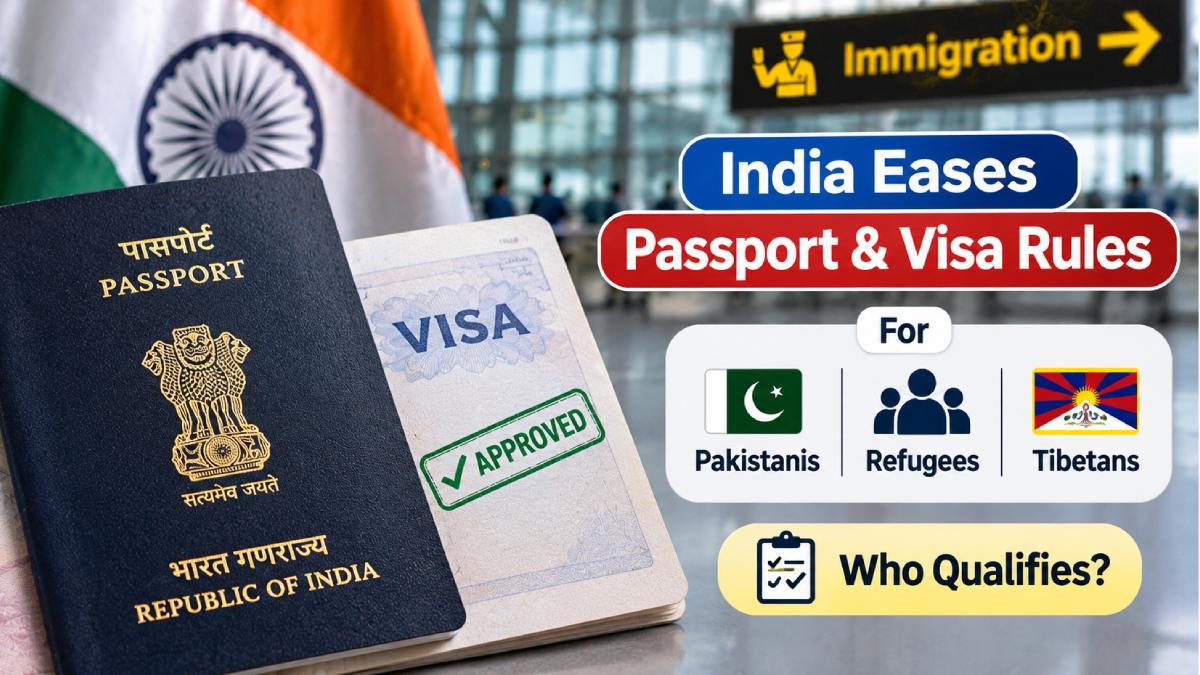
The changes were made through Immigration and Foreigners (Exemption) (Amendment) Order, 2026 issued by Union Ministry of Home Affairs. The amendment was published in Official Gazette on November 5, 2026 and amends provisions of the Immigration and Foreigners (Exemption) Order, 2025.
The new rules exempt certain passport, travel document and visa requirements on the basis of nationality, community, date of entry into India and other eligibility conditions.
The notification also specifies changes in travel documentation requirements for Indian, Nepalese and Bhutanese citizens travelling between the three neighbouring countries.
Of course these exemptions don’t apply to every foreign national in the communities listed above. Some categories have conditions to be met and some still need a visa for staying in India after that period (i.e. they need an appropriate visa).
1. Pakistani Nationals Who Entered India Before 31 Dec 2009
With the amended provisions certain Pakistani nationals who entered India on or before December 31, 2009 with a view to settle permanently in India will be exempted from holding valid passport or travel document for continued stay in India.
The provision covers people who entered India on a passport issued by the Pakistani government but have not been able to renew it because they don’t have CNIC issued by Pakistan.
However, this is a limited exemption and does not automatically grant Indian citizenship or permanent residency.
Eligible people need an appropriate category of visa for continued stay in India. The exemption is specific to difficulty renewing their Pakistani passports.
2. Minority Refugees From Pakistan, Bangladesh And Afghanistan
The amendment also applies to members of six religious minority communities from Pakistan, Bangladesh and Afghanistan who entered India after being compelled to seek shelter because of religious persecution or fear of religious persecution.
The communities included are:
- Hindu
- Sikh
- Buddhist
- Jain
- Parsi
- Christian
To qualify, people had to have entered India by December 31st 2024.
The exemption applies to people who entered India without valid passports or other travel documents, as well as those whose previously valid documents have expired.
However the notification states that eligible persons must apply for an appropriate visa category after entering India so as to continue stay in India.
It is important to make this distinction because the amendment relieves specified passport and travel document requirements but not all immigration-related requirements.
3. Registered Sri Lankan Tamil Nationals
Registered Sri Lankan Tamil nationals who took shelter in India on or before 9 January 2015 are also covered under the amended provisions.
The order exempts this category from the general requirements of valid passports, other travel documents and visas for entry into, stay in and exit from India.
The notification also defines what registration is. Individuals have to be registered with an officer (either Central Government or State Government) designated for this purpose.
The exemption therefore only applies to registered individuals who meet the date requirement. It should not be taken as a general exemption for every Sri Lankan national living in India.
4. Tibetans Who Entered India Under Specific Permits
The new order also exempts certain Tibetan nationals who entered India through certain routes and permits issued by the Indian Embassy in Kathmandu.
Two categories are covered:
- Tibetans who entered India after 1959 but before May 30, 2003 on an Entry Permit issued by the Indian Embassy in Kathmandu.
- Tibetans who entered India after May 30, 2003 using a Special Entry Permit issued by Indian Embassy in Kathmandu through an immigration post on the India-Nepal border designated by Central Government.
For those who entered after May 30, 2003 the notification states specifically that registration with the concerned Registration Officer and issue of Certificate of Registration under Rule 13 of the relevant rules.
Eligible persons are exempted from passport, travel document and visa requirements for entry into and stay in India.
The provision is based on the manner of entry and permits relevant to that entry, not all Tibetan nationals without distinction.
5. Special Exemption for Certain People of Indian Origin From Malaysia and Singapore.
The amendment also applies to certain Indians who got Malaysian or Singaporean citizenship and then returned to India.
They had to return to India on or before December 31, 2009 with a valid passport issued by Malaysia or Singapore. The passport must have expired and cannot be renewed because the person does not meet the conditions of passport renewal in that country.
They must also provide documentary proof of their Indian origin.
For the purposes of this provision a person of Indian origin is defined in the notification as foreign citizen who held an Indian passport previously or whose parents, grandparents or great-grandparents were born in and permanently resident in territories which formed part of India under Government of India Act 1935 or territories which became part of India subsequently.
The definition excludes citizens of Pakistan, Bangladesh, Sri Lanka, Afghanistan, Bhutan, Nepal and China.
Eligible persons are not required to show valid passport or travel document for their stay in India but need an appropriate category of visa for continued stay.
6. Special provision was made for certain Indian-origin Muslim men who returned from Pakistan.
Another category covered by the amendment is some male members of the Muslim community who were originally Indian citizens and moved to Pakistan after Partition.
This provision applies to persons who travelled to Pakistan between 15 August 1947 and 31 December 1965 leaving family members in India behind and returned to India on or before 31 December 2009.
They must have settled in the state of Kerala (Keralam) as mentioned in the notification.
The amendment also lays down several conditions:
- The person must not have married while living in Pakistan.
- They could not have acquired immovable property in Pakistan.
- They must have left family members who are Indian citizens behind when they travelled to Pakistan.
- They must undertake not to return to Pakistan.
- They must not have any adverse report from the police or security agencies.
Their Pakistani passport must have expired or been lost. Eligible persons are exempt from the passport or travel document requirement for their continued stay but must get a visa of the appropriate category.
7. Travel Rules for Indian Nepalese and Bhutanese Citizens
Apart from exemptions for foreign nationals living in India the amendment also amends travel documentation requirements for citizens of India, Nepal and Bhutan.
Indian citizens travelling directly to Nepal or Bhutan (or coming back from either country by land or air) can use any one of the identity documents listed in the government’s Visa Manual instead of a passport.
Similar provisions apply to Nepalese and Bhutanese citizens entering or leaving India by land or air.
However, certain restrictions remain in place.
Indian citizens travelling to or returning from countries other than Nepal and Bhutan through India-Nepal or India-Bhutan borders must carry valid passport and use immigration posts.
Nepalese and Bhutanese nationals also need a valid passport if they enter or leave India while travelling to/from a country other than Nepal or Bhutan. If one has arrived at (or transited through) China, Macau, Hong Kong or Pakistan then both passport and visa must be valid.
8. Military personnel are exempt and foreign military vessel crew.
The amended order also makes specific exemptions for members of India’s naval, military and air forces.
Personnel entering or leaving India on official duty are exempted from passport, travel document and visa requirements. The exemption also applies to family members accompanying them when travelling by government transport.
Foreign crew members of foreign military vessels visiting India for repairs are also covered under the amendment.
They must have military identification documents and get a Military Ship Repair Permit from Immigration Officer at the relevant immigration post.
The notification defines foreign military vessels as warships and other government ships operated for non-commercial purposes by the armed forces of another country.
What the New Passport and Visa Rules Mean
The Immigration and Foreigners (Exemption) (Amendment) Order, 2026 introduces targeted changes to the immigration regime in India. It deals with foreign nationals who have not been able to renew their travel documents; persons who entered India after religious persecution; communities which took shelter in the country under certain conditions.
But the amendment does not give blanket exemption from passport and visa requirements to all Pakistani citizens, refugees, Sri Lankan Tamils or Tibetans.
Eligibility is determined by the conditions stated for each category (nationality, community, date of entry, registration status and documentary evidence).
Covered persons should refer to the official notification and contact immigration authorities concerned to know documentation and visa requirements under their circumstances.




Comments