
India could be the world’s largest economy by the end of 21st century and have nearly twice China’s population, noted American economist Jeffrey D. Sachs said.
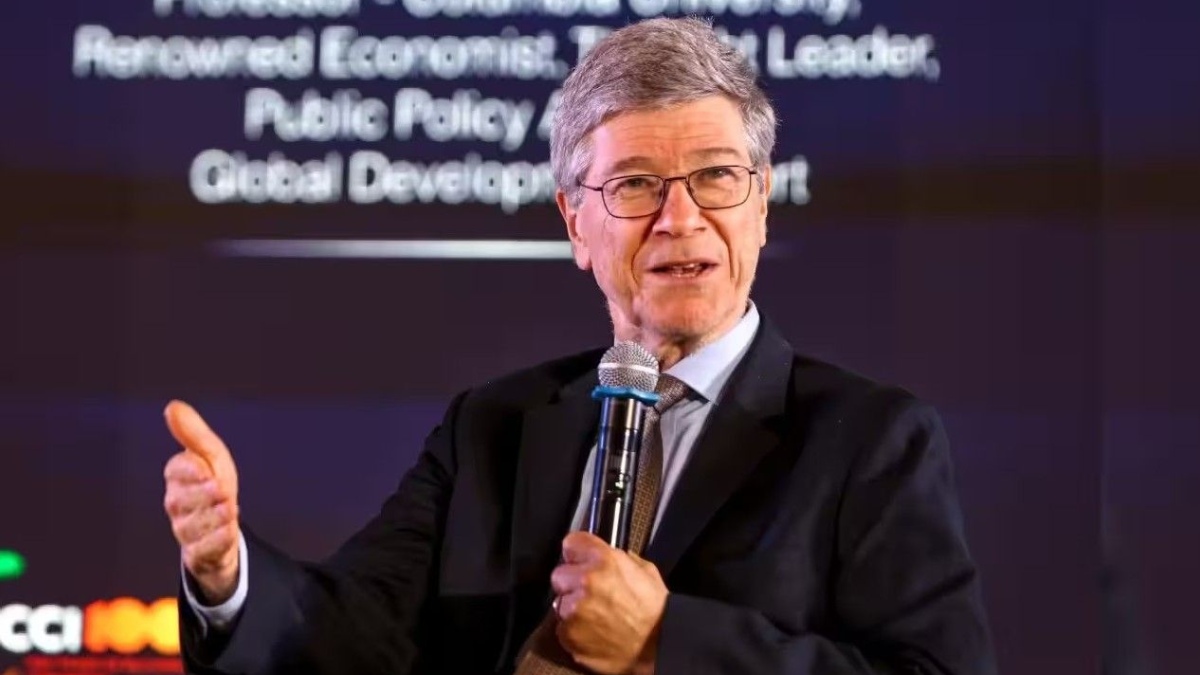
Jeffrey prediction has renewed debate on India’s long-term economic potential, demographic advantage and growing clout in global affairs.
At the World Symposium on “Ancient Wisdom for Modern Challenges” held in Varanasi Sachs said the balance of economic and political power in the world was shifting towards Asia and Africa
In coming decades international order would be reshaped India may well lead by 2100. He also said there might be a future where no country or region dominates the world.
Jeffrey Sachs made the prediction when talking about long term demographic change and multipolar global order emerging India’s population could be twice as big as China’s by the end of the century creating a huge demographic shift between two Asian giants.
He called it an extraordinary development and said India could become the single largest economy in the world by 2100. His comments have been noticed because India and China are already two of the most important economies in Asia and their future economic trajectories will have enormous impact on global trade, investment and geopolitics.
Sachs explained his outlook in terms of population patterns changing across the world. By 2100 almost three-quarters of the world’s population could be in Asia and Africa Sachs said; Africa’s share of the global population could increase substantially while Asia is expected to remain a major centre of economic activity.
China’s declining population was also an important factor that might influence its long term economic position, he said (India’s population could reach about 1.5 billion by the end of the century under demographic projections Sachs talked about but China’s population could fall to around 630 million if the projection he referred to comes true).
So India’s population would be more than twice as big as China’s under that projection.
🚨 "India will become the world's largest economy and possess twice China's population by the end of the 21st century." - Economist Jeffrey D. Sachs https://t.co/AW694PnDnj
— Indian Tech & Infra (@IndianTechGuide) November 3, 2026
That demographic edge could have economic consequences too. A bigger population can give a country a large workforce, a growing consumer market and more domestic demand for goods and services.
India’s relatively young population growth, expanding urban centres and digital technology adoption could provide opportunities across many industries manufacturing, IT, financial services, renewable energy, healthcare, infrastructure and consumer goods to name a few.
But population alone doesn’t guarantee leadership in economics. Quality education, productive employment creation, healthcare improvement and workforce participation will determine how well India converts its demographic advantage into economic growth.
Sachs also stressed the need to understand how India and China are changing their relationship. “Don’t just see them as competitors,” he said; “cooperation can help create a more balanced international system. Both countries have big populations, growing economies and influence across Asia.
Trade, investment, technology, infrastructure and regional development all have opportunities for both economies if they cooperate stronger.” He also said China should support India’s rising role in the international arena (including its bid for permanent membership of the United Nations Security Council).
Another major theme of Sachs’ remarks was that we were moving towards a multipolar world. For many decades the US and European countries dominated global economic and political institutions; but Asian economies are becoming more important and African economies are expected to expand so gradually this balance could change. No country would be able to dominate the international system in future, Sachs said countries would have to understand different civilisations, histories and political interests while cooperating on common challenges.
For India the prediction is both an opportunity and a responsibility. To become world’s largest economy it would take sustained growth over several decades, better infrastructure, higher productivity and stronger manufacturing ecosystem; it would also need to address issues like income inequality, unemployment, urban congestion, environmental pressures and differences in access to education and healthcare.
Creating enough quality jobs for large working-age population will be key here. Investment in research, advanced technology, logistics, clean energy and skill development could help India compete more effectively in global economy.
It is also important to remember that Sachs’ statement is a long-term economic prediction not a guarantee. Economic rankings can change (productivity, technological progress, political stability, investment, trade conditions and demographic development).
So population numbers alone cannot be used as an indicator of the future. India’s ability to maintain strong economic growth and raise living standards will therefore be more important than population numbers.
Nevertheless Sachs’ comments add to the international conversation about where India will be in the global economy in the coming decades. If it does combine its demographic potential with technological development, industrial expansion and human capital investment then it could become one of the most powerful economic powers of the century (the prediction that India will be world’s largest economy by 2100 may still be decades away but decisions made today could decide whether or not that is the case).



Comments