
Three works of India’s literary, historical and intellectual heritage have been internationally recognised after being included in UNESCO’s Memory of the World Asia-Pacific Regional Register. The works are Kalhana’s Rajatarangini (the Mahabharata), Kautilya’s Arthashastra and the Mahabharata.
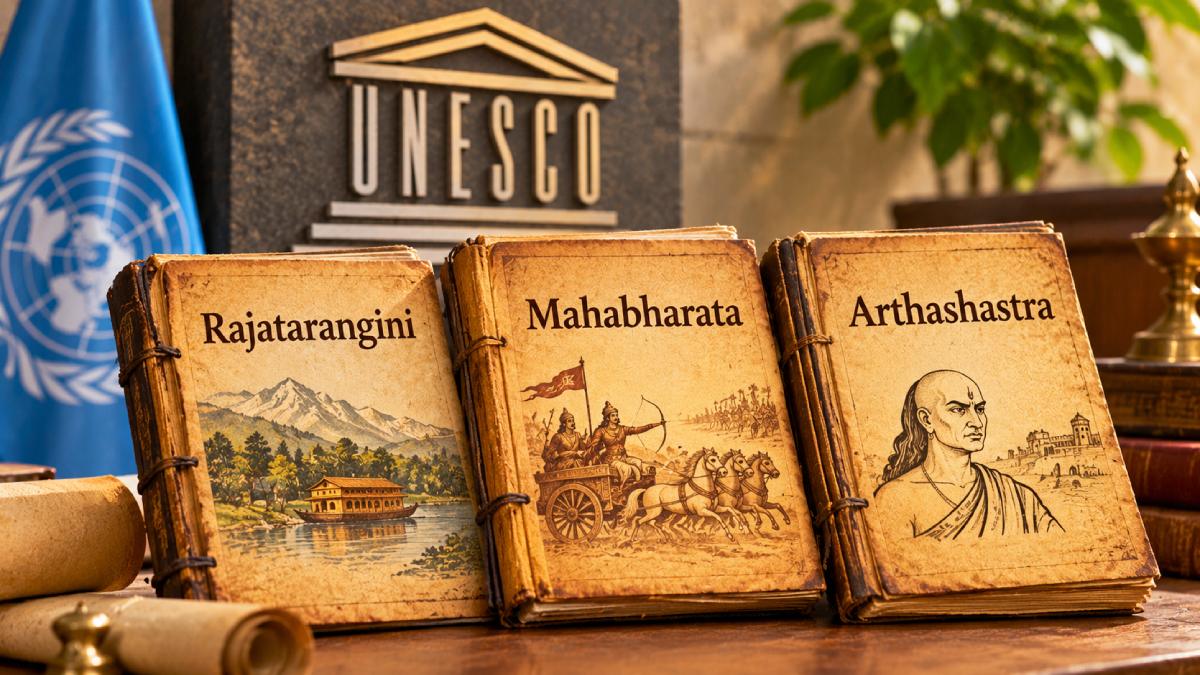
The decision was taken at the 11th Session of MOWCAP (Memory of the World Committee for Asia and the Pacific) held in Jakarta, Indonesia on November 5, 2026. The announcement was made on November 5, 2026 and welcomed by Union Culture Minister Gajendra Singh Shekhawat.
The three works represent different aspects of India’s knowledge traditions. Rajatarangini is an important history of Kashmir; Mahabharata has philosophical, ethical and spiritual questions; Arthashastra is a large ancient treatise on governance, administration, economics and statecraft.
The Indira Gandhi National Centre for the Arts (IGNCA) had an important role to play in preparing nomination dossiers for all three works.
With these new entries India’s total number of inscriptions in UNESCO’s Memory of the World Asia-Pacific Regional Register is now six.
What Is UNESCO's Memory of the World Programme?
UNESCO established the Memory of the World Programme in 1992 to protect and preserve documentary heritage of historical, cultural and intellectual value.
The programme recognises records that help preserve the collective memory and knowledge of societies (manuscripts, historical documents, archives, photographs, films, books and other documentary material).
Its main aim is to protect valuable records from deterioration, damage, destruction and loss. It also facilitates better access to documentary heritage through preservation, research and digitisation.
Memory of the World initiative has different levels of recognition (international, regional and national registers). The latest Indian additions have been included in Asia-Pacific Regional Register which recognises documentary heritage of significance to region.
This is different from UNESCO’s World Heritage List (which covers mainly cultural and natural sites) and its Intangible Cultural Heritage List (living traditions and practices).
Rajatarangini: An Important Historical Record of Kashmir
The first of the three recognised works is Rajatarangini (historical chronicle) by the 12th century Kashmiri historian Kalhana.
Written in Sanskrit around 1148–1149 CE, it records the history of Kashmir’s rulers and royal families. It also contains accounts of political developments, social conditions, cultural practices and events of importance to the region.
The name Rajatarangini is usually translated as ‘River of Kings’. The chronicle is in eight books (Tarangas) and has about 7,826 verses.
One of its salient features is Kalhana’s approach to historical writing. He used earlier accounts, inscriptions, records and other sources to construct a chronological narrative of Kashmir’s past.
The manuscript recognised by UNESCO is a rare birch-bark document written in Sharada script. It is preserved at Oriental Research Library in Srinagar.
Its presence in the register emphasises the need to record early historical records and acknowledges Kashmir’s place in India’s literary and historical tradition.
Mahabharata: India's Epic of Philosophy, Dharma and Human Values
The Mahabharata is one of two major Sanskrit epics of India and among the longest epic compositions in world literature. Traditionally ascribed to Maharishi Ved Vyasa it tells the story of the Pandavas vs Kauravas conflict and raises difficult questions about duty, morality, justice, relationships and responsibilities of individuals.
Although the central theme is a family feud in the Kuru family, the epic goes much beyond the story of war. Dharma, leadership ethics human behaviour and consequences of individual decisions are discussed extensively.
One of its most influential sections is the Bhagavad Gita where Lord Krishna has a philosophical conversation with Arjuna on the battlefield of Kurukshetra. Discussions on Karma Yoga, Bhakti Yoga, Jnana Yoga and performing one’s duties have been influencing Indian philosophical and spiritual traditions for centuries.
The manuscript recognized by UNESCO is a birch-bark manuscript associated with the older Kashmiri version of Mahabharata and preserved at Bhandarkar Oriental Research Institute, Pune.
The award recognises the manuscript’s documentary and historical value as well as the epic’s influence on literature, philosophy and cultural traditions in South Asia.
Arthashastra: Ancient India's Treatise on Governance and Statecraft
The third recognised work is Kautilya’s Arthashastra an important ancient Sanskrit treatise on political administration, economics diplomacy and statecraft.
Traditionally attributed to Kautilya (also Chanakya or Vishnugupta), the text discusses how a state should be governed and how a ruler should manage its resources, administration and security.
Arthashastra covers several areas of governance (taxation, agriculture, trade, public finance, law enforcement, intelligence networks, diplomacy and military strategy).
It also talks about the duties of rulers and administrators, the necessity of political stability and relations with neighbouring kingdoms.
The work is especially important for its systematic approach to state administration and economic management. Ideas in it are still studied by researchers in ancient Indian political thought, economics, public administration and international relations.
The manuscript recognized by UNESCO is an ancient palm-leaf manuscript in Grantha script. It is preserved at Oriental Research Institute, Mysuru.
Its inclusion shows how India contributed to the history of political and administrative thought.
India's Total Inscriptions in the Regional Register Rise to Six
The latest recognition brings India’s total number of inscriptions in UNESCO’s Memory of the World Asia-Pacific Regional Register to six.
Three other Indian documentary heritage works had already been awarded in 2024:
These are the only three Indian documentary heritage works that have been awarded so far in 2024.
- Ramcharitmanas: Illustrated manuscripts with miniature paintings and preserving the work of Tulsidas.
- Panchatantra: A rare 15th century manuscript containing animal fables and moral stories.
- Sahrdayaloka-Locana: An important work in Indian poetics and literary theory.
Taken together the six inscriptions represent different aspects of India’s literary, philosophical, historical and intellectual traditions.
These additions reinforce the value of original manuscripts and making historically important documents available to researchers and future generations.
Role of IGNCA in Preserving India's Documentary Heritage
The Indira Gandhi National Centre for the Arts (IGNCA) prepared nomination dossiers for the three newly recognised works.
The institution works towards the preservation, documentation and promotion of India’s artistic and cultural heritage; research; manuscript documentation; conservation initiatives and promotion of traditional knowledge systems.
When preparing a UNESCO nomination you document the historical importance, authenticity, condition and significance of the material being nominated for recognition.
Such efforts are necessary because many ancient manuscripts are susceptible to deterioration due to humidity, temperature changes, insects and ageing. Birch bark and palm leaves need special preservation methods.
Digitisation and systematic documentation can also be used to study these records without repeatedly handling fragile original manuscripts.
Why This UNESCO Recognition Matters for India
The Rajatarangini, Mahabharata and Arthashastra being included in UNESCO’s regional register is important because the three works cover different but interrelated areas of India’s intellectual history.
The Rajatarangini tells the story of Kashmir’s history and politics. The Mahabharata preserves philosophical and ethical discussions which have affected generations of readers. Arthashastra presents ancient approaches to administration, economics and diplomacy.
Their recognition also makes us see the value of original manuscripts as historical documents instead of seeing them only through literary or philosophical content.
The development can be used to stimulate further research, conservation and international collaboration in documentary heritage.
It also reminds us that fragile manuscripts need to be protected; that their documentation needs to be improved and made accessible so future generations can access them.


Comments