
Violence and physical attacks on court premises have renewed concerns about law and order and human rights protection in Bangladesh.
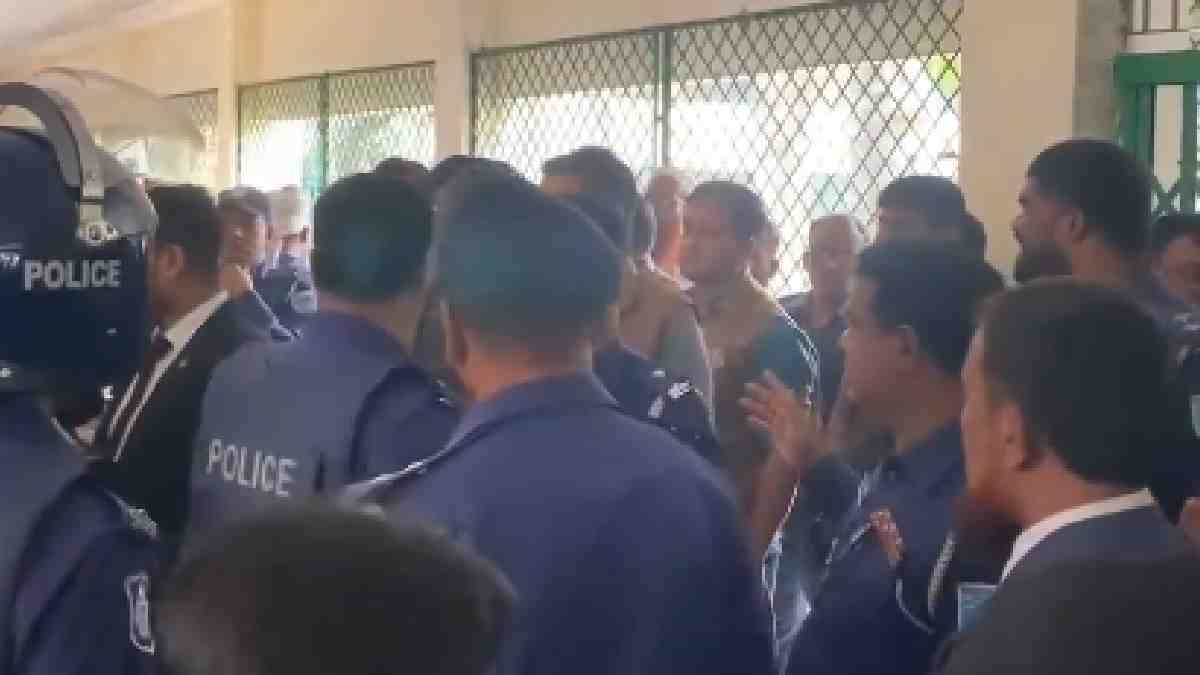
Allegations of political activists targeting people inside judicial complexes have brought up serious questions over the safety of prisoners, independence of judiciary and responsibility of law enforcement authorities.
A court is supposed to be a place where justice is delivered regardless of the political affiliation or background of an individual. Clashes, intimidation and alleged physical assaults in court premises have raised questions about whether judicial spaces are being protected enough.
On 4 October 2026, lawyers of BNP and Jamaat-e-Islami clashed inside Dhaka Chief Metropolitan Magistrate Court during bail hearing of former lawmaker Major (Retd.) Akhtaruzzaman.
Media reports said the two groups argued with each other inside and outside court room and pushed each other. Police later intervened to control the situation.
More recently JusticeMakers Bangladesh in France alerted about attacks, harassment and detention of four lawyers in Dhaka, Chattogram and Cox’s Bazar between November 10 to 14; a statement issued on November 16 alleged that BNP and affiliated organisations were behind some of them. Accountability and protection for lawyers was demanded from the authorities.
These incidents have again raised questions about how security is maintained inside court complexes. If people can be threatened or attacked while attending judicial proceedings then fundamental rights are not protected.
The issue also highlights the constitutional principles of justice in Bangladesh. Article 31 of the Constitution guarantees protection of law and Article 35 has important safeguards for criminal proceedings (protection against torture and cruel, inhuman or degrading punishment).
🚨Brutal Failure!!! This is the state of Current law and order Under Pakistani Agent @trahmanbnp Jamaat govt in Bangladesh. Inside court area with presence of Police the BNP Jamaat caders are attacking the prisoners?? False cases, Mass Arrests, No bail, getting attacked in Court area!! Is there any human rights exist?? Can this be termed as legal human rights? @UN @ohchr @hrw @amnesty?? #Bangladesh #TariqueMustGo
— Sagarsufian (@Sagarsufian2) November 16, 2026
Every accused person has the right to legal representation, a fair trial and treatment in accordance with law. Political differences or allegations against an individual cannot be used as grounds for physical violence intimidation or punishment outside of the judicial process.
Questions about arrests, criminal cases, bail applications and political targeting also need to be asked. Every arrest must have a lawful basis; every allegation must be investigated impartially; bail decisions by courts must be made in accordance with the law (see above).
It is the authorities and law enforcement agencies that have to ensure security inside court premises. Police presence should protect everyone prisoners, lawyers, witnesses and members of public too. Any failure to prevent violence should be investigated independently.
The bigger question is whether Bangladesh can give equal protection under the law regardless of political identity. Human rights cannot depend on which political party is in power or which group an accused person belongs to.
Authorities must investigate impartially, protect courtrooms and hold those who commit violence accountable. Justice can’t be determined by politics or mob pressure only evidence and law.A court should be a place where justice is protected, not where people fear being attacked.




Comments