
France has reported the first human infection with Shamonda virus, a pathogen previously associated with livestock. The case has attracted international attention because the virus had circulated among animals for decades without a confirmed human infection that has been reported.
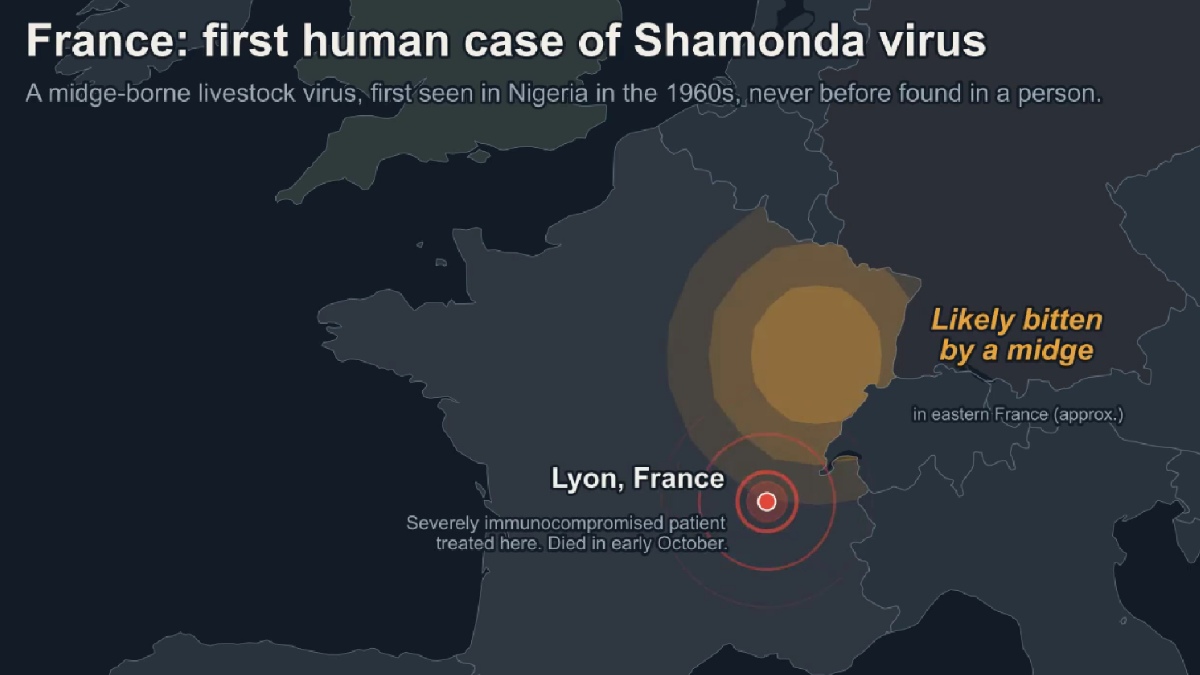
The patient, a man in his 60s from the Lyon region, was severely immunocompromised and had been treated for a serious illness. He died in early October 2026. French authorities said the neurological complications he had before his death were very likely linked to the infection but investigations are ongoing.
🇫🇷 A virus only ever seen in animals has infected a human for the first time, in France. The patient is dead. France said on Thursday that a severely immunocompromised man treated in Lyon had Shamonda virus, likely from a midge bite, and died in early October. Whether it killed him is still under investigation. So should Europe worry?
— Monte Cristo (@Ferm0s) October 22, 2026
The World Health Organization (WHO) has described the case as isolated. French authorities have said that, based on currently available information, no health risk to the general population has been identified.
What is Shamonda Virus?
Shamonda virus is an insect-borne virus belonging to the Orthobunyavirus family and the Simbu serogroup. It was first identified in cattle in Nigeria in the 1960s and has since been reported sporadically in Africa and Japan.
The virus mainly affects animals, especially cattle. It has also been detected in sheep, goats, horses, and alpacas. It was detected for the first time in Europe in 2026 after problems were reported in livestock.
Shamonda is related to other viruses that may affect livestock, like Schmallenberg virus. However, related viruses do not necessarily behave identically and scientists are still studying the characteristics of the Shamonda variants circulating in Europe.
How does Shamonda Virus spread?
Shamonda virus is known to spread mainly through the bites of infected Culicoides midges, tiny biting insects which can transmit pathogens between animals.
French authorities believe the patient acquired the infection through a midge bite in eastern France, where the virus had been spreading among animals. The exact route of transmission in this case has not been definitively established and the species of midge involved in the European outbreak is still unknown.
There is also no evidence that Shamonda virus spreads easily from one person to another. The information is limited because this is the first documented human case.
What Symptoms Does it Cause in Animals?
In livestock, the virus has been associated with many symptoms. These may include:
- Fever, weakness and reduced appetite
- Diarrhoea
- Reduced milk production in dairy cattle
- Reproductive problems in pregnant animals
- Abortions, stillbirths and developmental abnormalities in affected offspring
Some reports from Europe have also described neurological problems in horses. The severity and long-term effects of the European variants are not yet fully understood.
Researchers in Japan have reported birth defects in calves infected before birth. Such results indicate the virus’s prevalence on animal health and livestock farming.
There is currently no commercially available vaccine specifically for Shamonda virus, according to the World Organisation for Animal Health.
What do we know about the first human case?
The reported patient was severely immunocompromised, meaning that his immune system was severely weakened while he was receiving treatment for a serious illness.
French health officials said the neurological complications seen before his death were very likely linked to the infection, based on preliminary investigations. But the exact role of the virus in the patient's death remains under investigation.
It was a particular case, and Shamonda virus had not been detected in humans before, though it had been detected in animals for decades. Scientists now need more evidence to understand whether this was an exceptionally rare event or whether infections in people might have gone unnoticed in the past.
The European Centre for Disease Prevention and Control is working with French authorities, and also other partners, to investigate the possibility of public health implications and to improve testing capacity.
Should the general public be worried?
At present, health authorities have not identified a wider public health risk from the reported case. The infection appears to be isolated and is unlikely to lead to wider spread based on current knowledge of the virus and related pathogens, the WHO said.
However, one confirmed human infection is not enough to establish how frequently the virus could infect people, what symptoms it might cause in different individuals or whether people with weak immune systems are at greater risk.
The patient’s severe immunocompromised condition is a crucial detail, but it does not show that Shamonda virus can cause serious illness only for people with weakened immunity.
The discovery also does not mean that the virus is spreading between people. In this case, officials suspect an insect-borne route but also the source of infection is being investigated.
Why are scientists monitoring the virus?
The first human detection makes surveillance of the virus more critical for animal and human health. Tracking livestock infections, studying unusual neurological illnesses, and improving laboratory testing can help researchers determine if more cases occur.
Shamonda virus has been detected in livestock throughout several European countries in 2026. However, the extent of its spread and its long-term impact remain uncertain, partly because surveillance and reporting systems differ between countries.
The case is one of the reasons health professionals use a One Health approach to treat human and animal health and the environment. The infection of animals and how insects spread from one animal infection through its vectors can help the authorities to determine if there are threats before they become widespread.
For now, Shamonda virus is mostly a livestock disease and the first reported human infection is being treated as an exceptional case. Additional investigations and surveillance are needed to determine if the virus poses a broader threat to humans.






Comments
Leave a Comment