
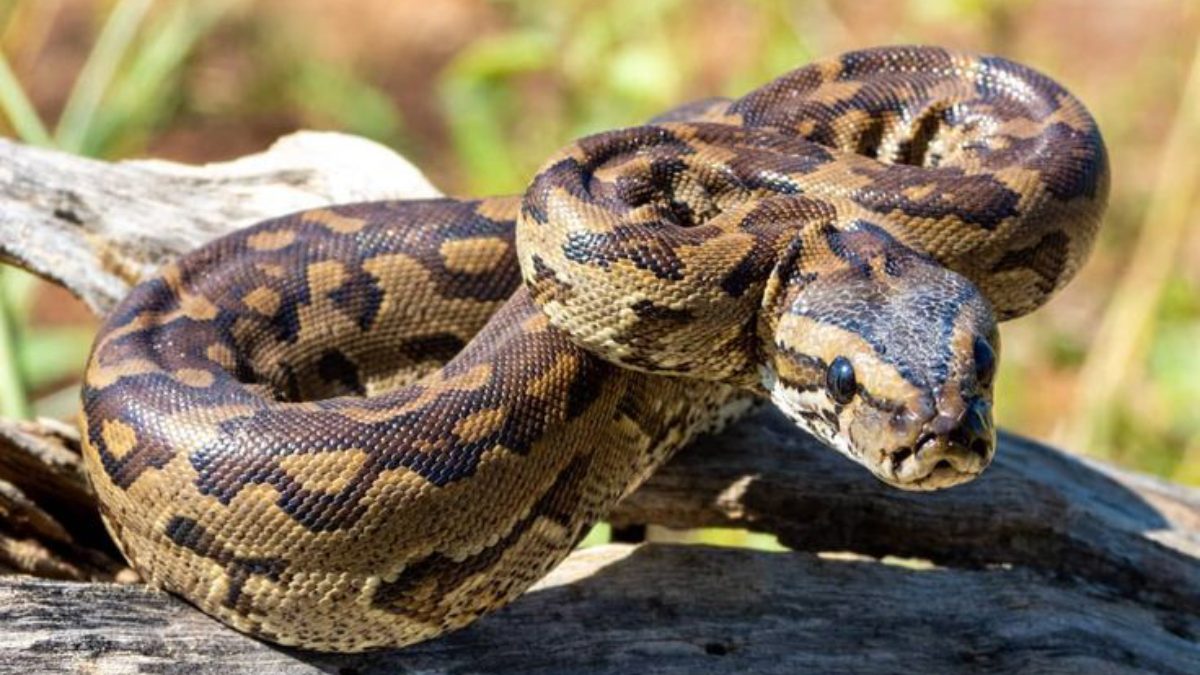
Scientists have now described a previously unrecorded hunting behaviour in Southern African pythons. The large snakes may use their tails to lure prey because caudal luring (moving the tip of the tail so it looks like something attractive to nearby animals) is known to work.
The finding came from research that combined historical scientific records with photos and videos posted on social media. It gives us new information about feeding habits and hunting tactics of Southern African pythons as well as showing how online observations can be used in wildlife research.
What Is Caudal Luring In Southern African Pythons?
Caudal luring is a hunting strategy in which the snake moves its tail to imitate something that may attract prey. The snake does not move its whole body; it remains relatively still and uses the tip of the tail to draw an animal closer.
Kirsty J Kyle and Colleen T Downs at the University of KwaZulu-Natal in South Africa observed this behaviour in a Southern African python (Python natalensis).
The python was medium sized (1.5 to 2 metres). The snake was temporarily housed in a large glass enclosure but domestic chickens were moving around nearby.
The python took an ambush position and moved repeatedly the visibly marked end of its tail in a wave-like manner. One chicken saw this movement and came to the tail several metres away from it.
The glass enclosure prevented the chicken from being prey, but researchers saw the behaviour as a likely attempt to attract the bird.
This was the first documented evidence of caudal luring in Southern African pythons.
Why Does The Python Move Its Tail?
The researchers said Southern African pythons have markings near the end of their tails.
The upper surface of the tail has a camouflage pattern similar to that on the rest of the body but its underside is marked with black and white.
This contrast in colour might make the tail tip stand out more when exposed and moved. Researchers thought that colour and movement would draw animals close enough for the python to strike.
Caudal luring is known in several other snake species but the study only documented this particular hunting behaviour in Southern African pythons for the first time.
Interestingly, snakes used to use their tails in defense. Photos and videos posted online showed individuals using their tails when they were threatened by predators.
The new observation shows that the distinctive tail features may serve more than one behavioural function.
How Social Media Videos Helped Scientists
The research shows how social media and citizen science are becoming more important in wildlife studies.
Kyle and Downs reviewed historical scientific literature as well as observations from Facebook, YouTube, Instagram and iNaturalist. They looked for photos or videos of Southern African pythons feeding on potential prey or interacting with potential prey.
The researchers gathered social media records posted up to May 1, 2024 and manually checked the material to identify snakes and prey.
The study made 238 feeding observations. Of these, 219 could be identified to species level.
Facebook had the biggest share of records (84.5 per cent of social media observations), YouTube (6.3 per cent) and Instagram and iNaturalist (the remaining records).
These observations expanded the information available about the species’ diet and feeding behaviour.
What Do Southern African Pythons Eat?
The study lists 104 vertebrate prey species consumed by Southern African pythons (mammals, birds and reptiles) plus additional records from historical sources.
Researchers also saw a change in prey type as the snakes grew larger.
Smaller pythons were more commonly found feeding on birds and larger ones mammals.
Of all feeding incidents involving pythons shorter than 1.5 metres, 89 per cent were birds; birds only made up 6.1 per cent of the records of feeding by the largest snakes (more than three metres).
Impala were among the most frequently recorded mammalian prey (44 incidents in total).
So the findings suggest that size of a python determines what kind of animals it can catch and eat.
Pythons May Return To The Same Hunting Locations
The study also reported observations that Southern African pythons can repeatedly use places where prey animals congregate.
One python that was monitored with a live webcam caught different birds from the same branch of a dead tree on nine occasions.
Another one visited the same tree in a residential area for seven months and fed on six different species of birds.
These observations suggest that the snakes might take advantage of places where prey is regularly found (rather than just chance encounters).
Why This Discovery Matters For Wildlife Research
Southern African pythons are large reptiles whose feeding habits and hunting strategies are relatively little known.
The research shows how well-verified photographs and videos taken by the public can be used to document behaviours scientists might not otherwise be able to see in the wild.
It also shows that social media can be a valuable source of research material if observations are checked and combined with established scientific records.
The discovery of caudal luring gives another dimension to how these snakes hunt and interact with their environment but also demonstrates how citizen participation is needed in documenting wildlife behaviour.





Comments