AI, automation and digital technologies are transforming our workplaces worldwide at an instant pace. A new employment projection from the United States has reignited the debate about the future of work, pointing out that it will be the job that most traditional jobs will disappear in the next decade. And AI will not only make job opportunities in new fields more imminent, but it is also eliminating jobs that are repetitive, predictable and easily automated.
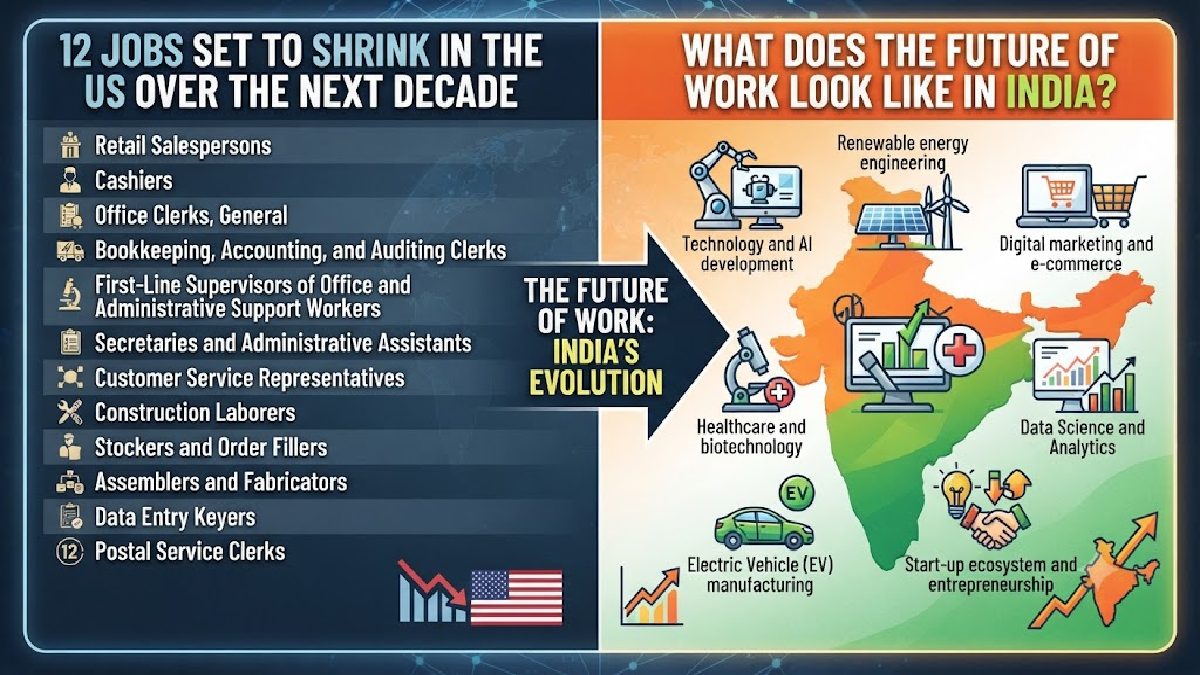
According to the data, the U.S. Bureau of Labour Statistics (BLS) has predicted that a number of jobs will suffer substantial decreases from 2025 to 2035. The jobs most vulnerable to shrinkage are word processors and typists, order clerks, switchboard operators, telemarketers, telephone operators, mining roof bolters, foundry mould makers and a few manufacturing jobs. Automation, AI-powered software, digital communication systems and advanced production technologies are among the reasons for the potential decline.
The 12 Jobs Expected to Shrink
The occupations projected to decline the most will be:
- Word Processors and Typists
- Order Clerks
- Switchboard Operators
- Telephone Operators
- Telemarketers
- Mining Roof Bolters
- Foundry Mould and Coremakers
- Metal and Plastic Patternmakers
- Various Machine Setters and Operators
- Data Entry-related roles
- Certain administrative support positions
- Clerical Processing jobs
Many of these jobs are routine jobs that AI systems, automation software or advanced machines can be used for. For instance, word processors and typists will see the sharpest declines in terms of jobs since AI-powered writing and transcription tools have taken more bite out of them. Telemarketing jobs are also under pressure from digital advertising, online marketing platforms and rules on unsolicited calls.
AI Is Changing Jobs, Not Eliminating Work
Experts warn against assuming that AI will eradicate employment opportunities. The latest BLS projections indicate that while some jobs are going to shrink in the United States over the next decade, the overall job market is expected to grow by millions of jobs. Healthcare, social assistance, technology and renewable energy are the largest job creators.
In fact, several AI-related and technology-oriented professions are likely to see significant growth. Data scientists, computer and information research scientists, AI engineers, cybersecurity specialists and cloud computing professionals are among the professions in the highest demand. AI's growth has created new jobs that did not exist even a decade ago, and the growth of AI itself is creating new roles.
What Will It Mean for India?
The implications for India are important because India is home to one of the world’s largest workforces and a rapidly growing technology sector in the country. For jobs in repetitive and routine jobs that are already under pressure from automation, there is also a great demand for skilled professionals in AI, machine learning, cloud computing, cybersecurity, data analytics and software engineering.
Large technology companies, global capability centres (GCCs) and multinational companies are hiring professionals with knowledge of advanced technologies. According to industry estimates, India currently has over one lakh technology-related jobs, particularly in AI-driven sectors, which means that the nature of work is changing and there are still opportunities for those with knowledge to get a job.
Skills Will Matter More Than Degrees
One of the most important lessons to learn from the changing employment landscape is that skills are more valuable than ever. Employers find job-matching candidates who are able to apply new technologies to complex problems and work with AI tools.
Companies that continue to upgrade their skills are going to continue to be competitive as automation takes hold. Certifications in AI, machine learning, cloud platforms, cybersecurity and data science are becoming key differentiators in the job market.
The Future Workforce
The future workplace is not about replacing humans entirely but merging human intelligence with artificial intelligence. Jobs that require creativity, critical thinking, emotional intelligence, leadership and complex decision-making are likely to remain resilient. On the other hand, routine administrative and clerical tasks will continue to be automated.
The message is clear for students and professionals in preparation for careers: adaptability and lifelong learning will be imperative. The jobs that disappear over the next decade could be replaced with entirely new jobs that are based on technology and innovation.
Although the prediction of 12 shrinking occupations in the United States illustrates the disruptive power of AI, it also shows a more general picture. The future of work is not just job losses; it is change. Even in countries with a young workforce and a growing digital economy, like India, workers will be able to benefit from the transition if they are prepared to take upskilling and technological change in their jobs.