Artificial intelligence is changing how we work for this world. From customer service and software development to banking, marketing, healthcare and manufacturing, AI-powered tools are increasingly being used to carry out tasks that were once very much human labor. While all of the talk about AI taking over jobs has made workers nervous, the more important thing is that artificial intelligence is transforming jobs rather than simply eliminating every human role.
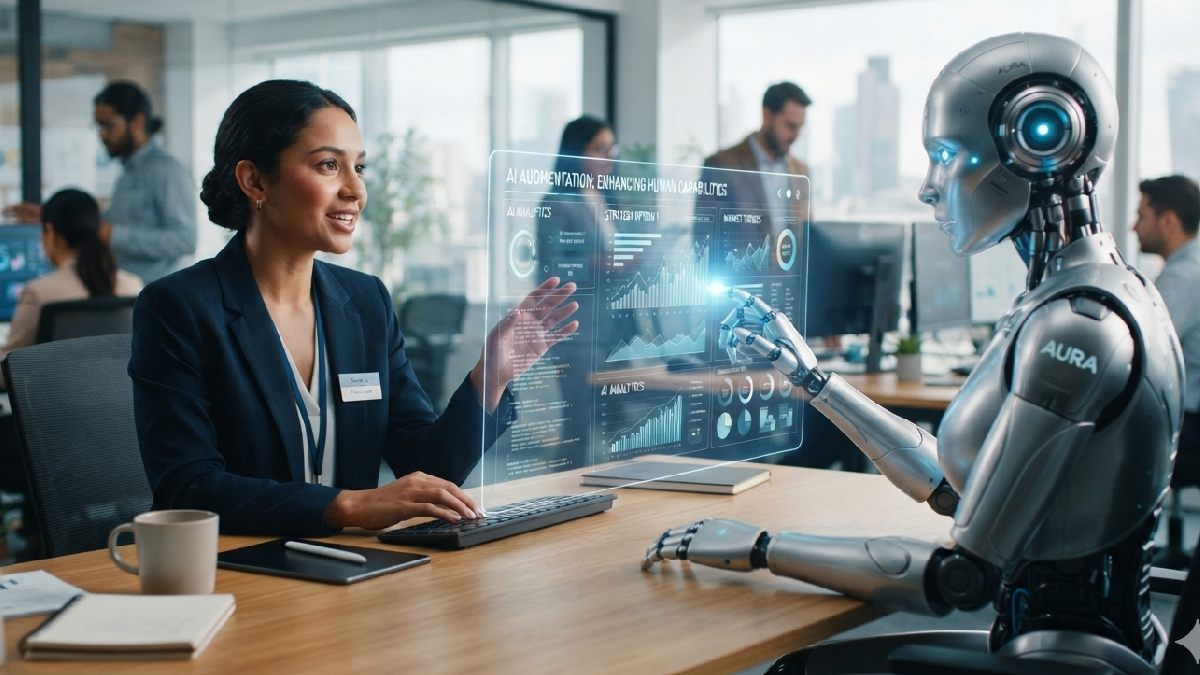
AI has been a prime reason companies are moving forward with AI because AI is good for doing very fast processing of large amounts of data in a business because AI can process big data and data quickly. AI systems can analyze data, find patterns, generate reports and perform repetitive tasks faster than an individual person can process it in less time and work on data, and in less than a person takes.
For businesses, that will add to productivity, cut costs and allow employees to work on more complex tasks and reduce them to do more time on complex tasks.
Repetitive work is one of the most affected areas of automation. The tasks (data entry, basic document processing, scheduling, routine customer queries and some administrative functions) are increasingly automated, which means that in the future software will take care of all of these things. This does not imply that a whole profession will disappear in one day. Some jobs may be automated so that the worker has to work on something that requires judgement, communication and creativity.
Customer service is another area which is rapidly changing. AI chatbots and virtual assistants could answer any question, provide information and assist customers at any time. Human workers are still needed when a situation is about empathy, negotiation and nuanced problem solving or unusual circumstances. So many companies are going to combine AI and human workers rather than one or the other.
Another major industry sector is also undergoing major change. AI tools can assist programmers in developing code, identifying errors, and explaining technical concepts. Designers, writers and marketing people also can use generative AI to get a start of draft, ideas, and content. The use of these new tools can speed up the early stages of creativity, but human intervention in the process is still needed for accuracy, originality, context and decision making.
Artificial intelligence is already a significant factor in healthcare. Such intelligent systems can analyse medical images, organise patient information and aid research. Doctors and other healthcare professionals are still needed because human beings are involved in medical decisions that are complex and professional but also require humans to interact with them. AI support doesn’t replace trained professionals.
Change of the workplace also means a whole new set of new career opportunities are also emerging. Businesses are looking for AI developers who can create these, manage, monitor, and use them wisely in a professional manner. AI engineering, data analysis, cybersecurity, AI governance and technology management positions are increasingly central to AI engineering, data analysis, cybersecurity, AI governance and technology management are all more and more critical roles.
Traditional workers in jobs at the work force might also benefit from receiving a basic knowledge of AI in the domain that their industry needs to know about the use of the technology.
This change will only make reskilling and upskilling more important. If workers can learn to work with AI in a more collaborative way, they will be more likely to adapt to changing industries. We are not competing in the same way with machines with such tasks which software can do faster, or with machines: leadership, critical thinking, creativity, interpersonal communication, strategic judgement and emotional intelligence are hard skills to automate.
Education systems are also under pressure to adapt. Traditional qualifications are not enough in today’s fast-changing labour market. Both students and professionals may have to build technical and human skills. To know how AI works, how to assess its output and to use it responsibly might actually be as important as learning specific software or workplace processes.
There are also legitimate concerns about AI-driven employment changes. Workers in highly repetitive jobs may see more disruption, and companies may have to reorganise departments as automation becomes more capable. The transition may not be equally easy for everyone. So governments, employers and education institutions need to support workers in training, career transitions and policies that are adapted to a changing labour market.
In the end, we may be looking at AI versus humans as a false concept. In many professions, humans will be working with the AI systems of the future. A person who is good at AI will have some advantage over a person who doesn’t want to change much and AI itself is still dependent on the human hand and oversight and accountability.
Artificial intelligence is not expected to transform the world of work in one big leap. Instead, change is happening task by task, industry by industry and profession by profession. Some jobs will shrink, some will change, and entirely new jobs will emerge. And the people who are best able to navigate their way through this transition will not necessarily be those who can compete with AI, but those who know its power and use it effectively, and bring human skills to work.