Computer Science Engineering is the most popular engineering branch for most engineering students in India, while traditional branches like Electrical Engineering and Electronics and Communication Engineering have been drawing relatively fewer students.
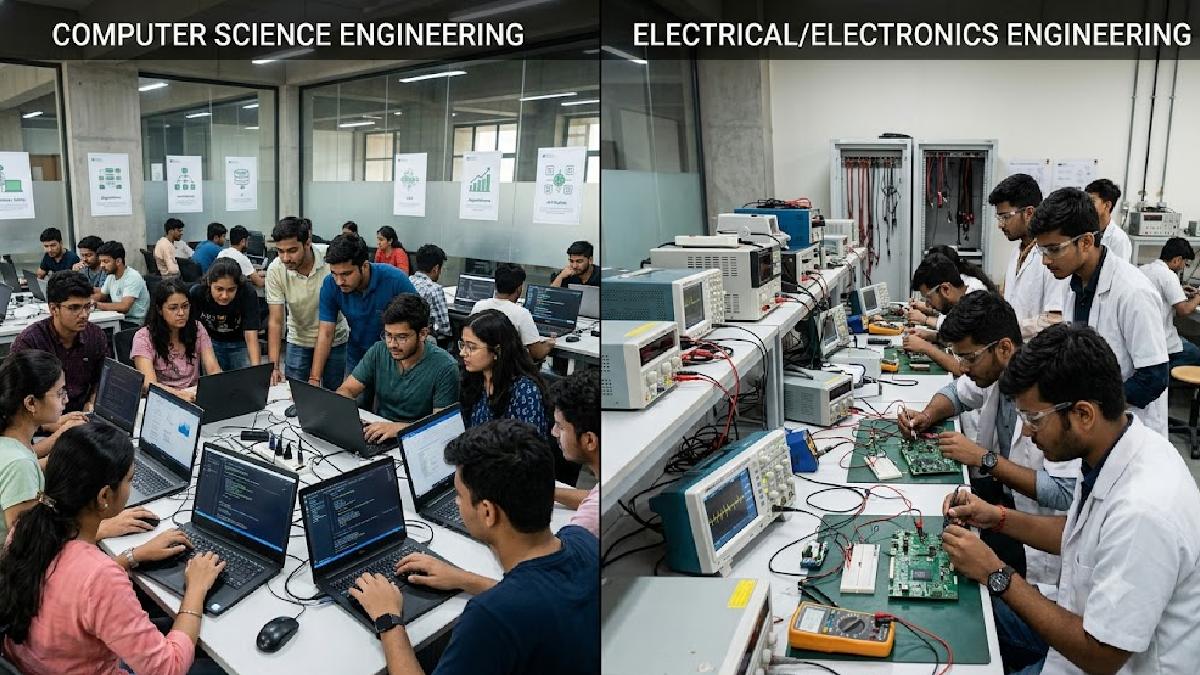
That is because of the increasing demands for jobs and the development in technology and computer-related degrees have a better chance of graduating.
AICTE data for 2024-25 shows the differences in students’ preferences in the field. More than 3,90,245 students were enrolled in Computer Science and Engineering (CSE) compared to 1,60,450 students in ECE and 1,25,902 students in Electrical Engineering.
Electrical Engineering and ECE together account for 2,86,352 students, which is about 1.04 lakh fewer than CSE alone. The numbers illustrate how strong computer science has become for engineering aspirants and how fast computer science has become the most popular field in engineering.
One of the reasons for that is the perception of better career opportunities. CSE is associated with software development, artificial intelligence, data science, cybersecurity, cloud computing, and other technology-driven jobs. Students perceive job opportunities in all sectors as almost everything now relies on software and digital technologies.
Salary expectations also affect branch selection. Technology companies are generally associated with attractive salaries, especially for software engineers and people who are in high-level fields like AI and machine learning. Placement statistics from colleges and social media also support the view that CSE is a pathway to high-paying jobs faster for them.
Electrical and electronics-related branches are usually more challenging for students because they involve mathematics, physics, circuits, etc.
Electrical Engineering involves electrical machines, power systems, control systems, and electrical networks; ECE includes electronics, communication systems, semiconductor technology, and signal processing. Students who are programming-oriented might find computer-related subjects more attractive.
The growing popularity of specialized computer branches has also changed the way students view engineering. Artificial Intelligence, Machine Learning, Data Science, and Cybersecurity courses are now considered as future careers. And a lot of students are taking them even though they have not studied traditional engineering in depth.
Peer influence is also a factor. Students often discuss college branches with classmates, seniors, relatives, and coaching institutes before they make their decision.
Once CSE is repeatedly indicated as the most promising branch, students may feel that choosing another discipline could limit their career options.
But lower enrolment does not mean that Electrical Engineering or ECE has become less important. India is expanding its electric vehicle ecosystem, renewable energy capacity, semiconductor industry, electronics manufacturing, automation, and smart-grid infrastructure. These industries require engineers with good knowledge of electrical and electronic systems.
The real problem could be less about lack of opportunities than awareness. Students who choose an engineering branch should look for opportunities and career options as a career choice and not only be propelled by enrolment trends.
CSE may still dominate the preference chart, but Electrical Engineering and ECE are still essential to the development of India's technology and industrial sectors.
Ultimately, the right engineering branch will rely on what students want to do and not just the branch with the largest number of students.