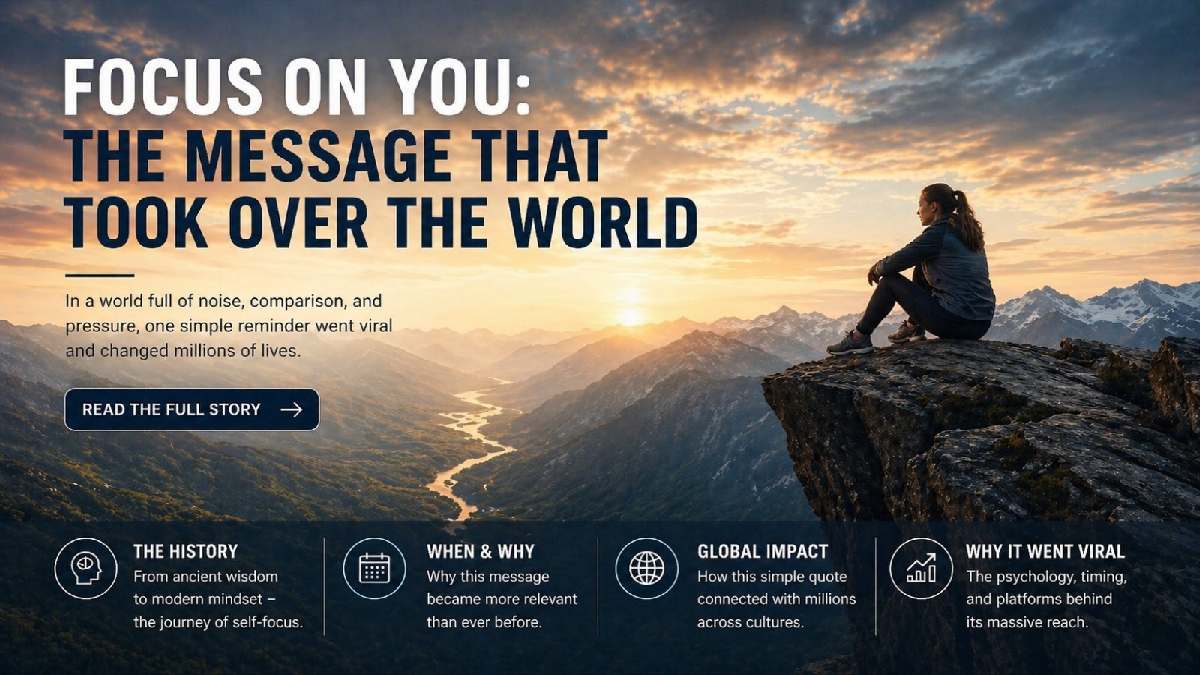
Amidst a global marketplace that won’t stop asking for more, maybe one little message can burst into the noise: “Sometimes you just need to focus on you… and that’s ok.” What appears to be a mundane bit of phrase on a dramatic mountain background is a potent global movement shared, saved and searched by a lot of thousands of people every day.
But why has this thought gone viral? The answer is the way modern life works. From their numerous notifications to social expectations, individuals today are easily pulled in all directions. Be it career pressure, caring families or the comparison culture of social media, human thinking seldom fails to take a break.
That’s where this message lands differently; it gives permission. Permission to pause. Permission to breathe. Permission to choose yourself. Prioritising oneself was often regarded as selfish historically. Cultures around the world, including that of India, prized sacrifice and group identity over individuality. But over the years, there has been a real change, especially with the development of mental health awareness in the 21st century.
Self-care, emotional balance and the practice of mindfulness have become no longer luxuries but necessities--no longer optional but indispensable. Search trends demonstrate this paradigm shift. When it comes to key keywords like “self-love,” “focus on yourself”, and “mental wellness,” these are among the most frequently searched.
Viral posts with similar messages tend to overwhelm sites like Instagram and Pinterest, in many cases outperforming more sophisticated motivational statements. Why? Since simplicity resonates faster. This message looks human in comparison to traditional motivational quotes that encourage hustle and productivity. It doesn’t pressurise, it comforts. There’s no need for success; it brings balance.
That emotional relatability is precisely what allows it to rank high and be replicated worldwide. The visual component is also very important. The strong, isolated mountain represents strength, isolation, and clarity, the perfect counterpart to the notion of self-focus. It brings powerful imagery together with a soft message, with the scroll stopping you from receiving engagement and shares.
Such content is effective for websites that also hope to reach a large global audience, as it is easily cross-boundary. It delivers the message that a student in Bangalore, a professional in New York, and a traveller throughout Europe should hear. Ultimately, this article isn't only a quote; it's an exhortation for which the world should take some heed. It is the one truth that will continue to sweep through life, even as everything else goes on as it is:
In terms of looking out after oneself, self-care isn't selfish; it's survival.