Life and death have always been humanity's greatest mysteries. While life is often celebrated as a journey filled with dreams, ambitions, and achievements, death quietly reminds us of a truth that many of us spend our lives trying to ignore: nothing lasts forever. Yet, rather than being something to fear, death can become life's greatest teacher.
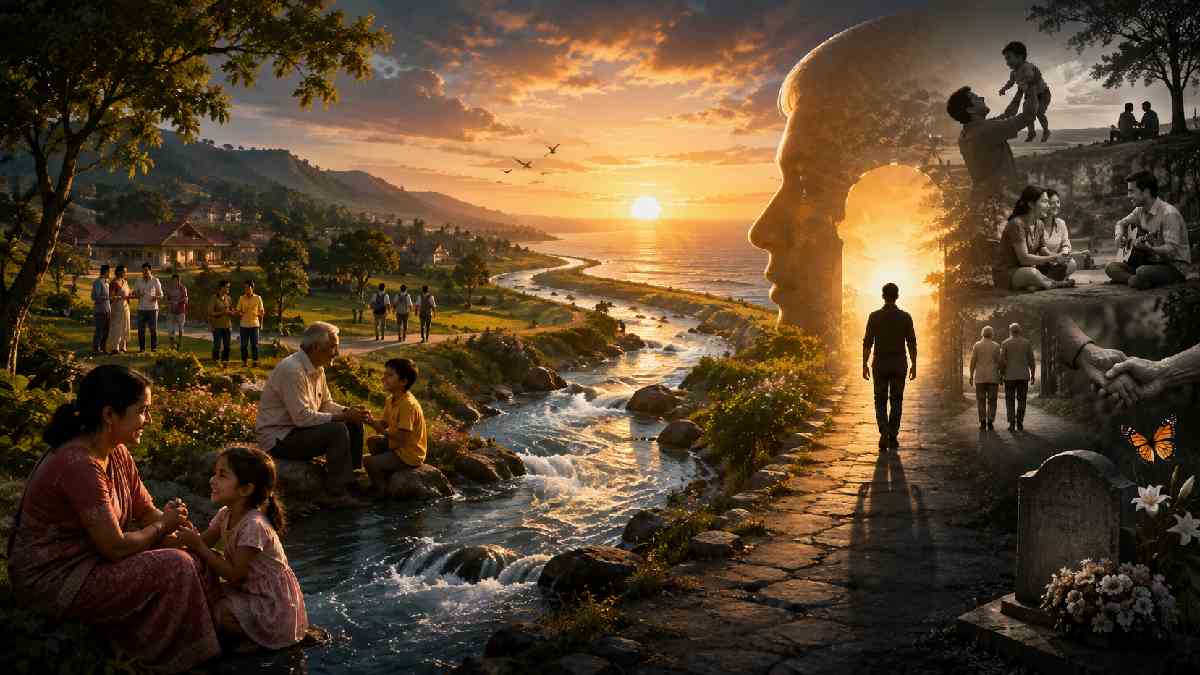
Imagine life as a flowing river. It begins at the source of birth and ultimately finds its way to the vast ocean of eternity. Along its course, the river never resists its destination. It flows through mountains, valleys, and forests, nourishing everything in its path. It does not stop because it knows the ocean awaits. Instead, it embraces every twist and obstacle as part of its purpose.
Human beings, however, often behave differently. We cling to possessions, titles, achievements, and even pain as though they will remain with us forever. We spend years accumulating wealth, chasing recognition and worrying about tomorrow, forgetting that the true value of life lies not in what we own, but in how we live today.
Death strips away every illusion of permanence. It reminds us that our homes, bank accounts, awards and social status eventually lose their significance. What remains are the memories we created, the kindness we showed, and the lives we touched.
People rarely remember someone for the size of their house or the balance in their bank account. Instead, they remember the friend who stood beside them during difficult times, the stranger who offered unexpected kindness, the parent who sacrificed everything for their children, or the teacher who inspired confidence in a struggling student.
In many ways, our lives are measured not by the passing of years but by the moments that leave lasting impressions. Ten minutes spent comforting a loved one can carry more meaning than years spent pursuing material success. A heartfelt apology can heal wounds that money never could. A genuine smile offered at the right time can become unforgettable for someone silently battling life's hardships.
Nature teaches this lesson every day. Trees let go of their leaves without fear. Rivers continue flowing. The sun sets every evening only to rise again the next morning. Nothing in nature clings to what must eventually pass. Yet people often struggle to release anger, pride, regret, and grief.
Perhaps one of life's greatest tragedies is not death itself, but the emotions left unspoken before it arrives. Too many expressions of love remain unsaid. Too many words of gratitude are delayed. Too many apologies are postponed until there is no longer an opportunity to offer them.
Death reminds us that tomorrow is never guaranteed
Every conversation may be our last. Every embrace may become a cherished memory. Every sunrise offers another opportunity to become kinder than we were yesterday.
One of the most powerful images of human existence can be found on a gravestone. It carries two dates—the day of birth and the day of death. Between those dates lies a simple dash. That tiny mark represents an entire lifetime.
For everyone, the dash occupies the same amount of space.
Its meaning, however, is entirely different
- Some fill that dash with selfishness, greed, and pride.
- Others fill it with generosity, compassion and service.
- The length of life is never fully within our control, but its meaning always is.
Modern society has achieved remarkable technological progress. Humanity has explored space, built artificial intelligence, and connected billions of people through digital communication. Yet many people struggle to truly connect with those sitting beside them.
We know global headlines but fail to notice the sadness in our parents' eyes.
We scroll endlessly through strangers' lives while overlooking the people who love us most.
Progress has transformed our world, but true humanity is still measured by empathy rather than innovation.
Ultimately, death asks each of us one simple question:
- "If you had just one more day to live, would you spend it the same way?"
- For many, that question is deeply uncomfortable because it exposes the gap between how we are living and how we truly wish to live.
- The greatest legacy we can leave is not financial wealth or material possessions.
- It is the love we shared, the hope we inspired, and the kindness we offered without expecting anything in return.
A person who plants a tree may never sit beneath its shade, but future generations will benefit from the decision. In the same way, every compassionate act creates ripples that extend far beyond our own lifetime.
Life's ultimate victory over death is not found in living forever. It is found in leaving behind a light that continues to shine in the hearts of others.
Because, in the end, we are remembered not for how many years we lived, but for how many lives became better simply because we were here.