Niladri Bije is one of the most cherished rituals of the annual Rath Yatra, and the festival is the finale of the big festival at Shree Jagannath Temple in Puri, Odisha. It is celebrated on Asadha Shukla Paksha Trayodashi and is a welcome homecoming of Lord Jagannath, Lord Balabhadra, Devi Subhadra and Lord Sudarshan after their annual visit to the Gundicha Temple.
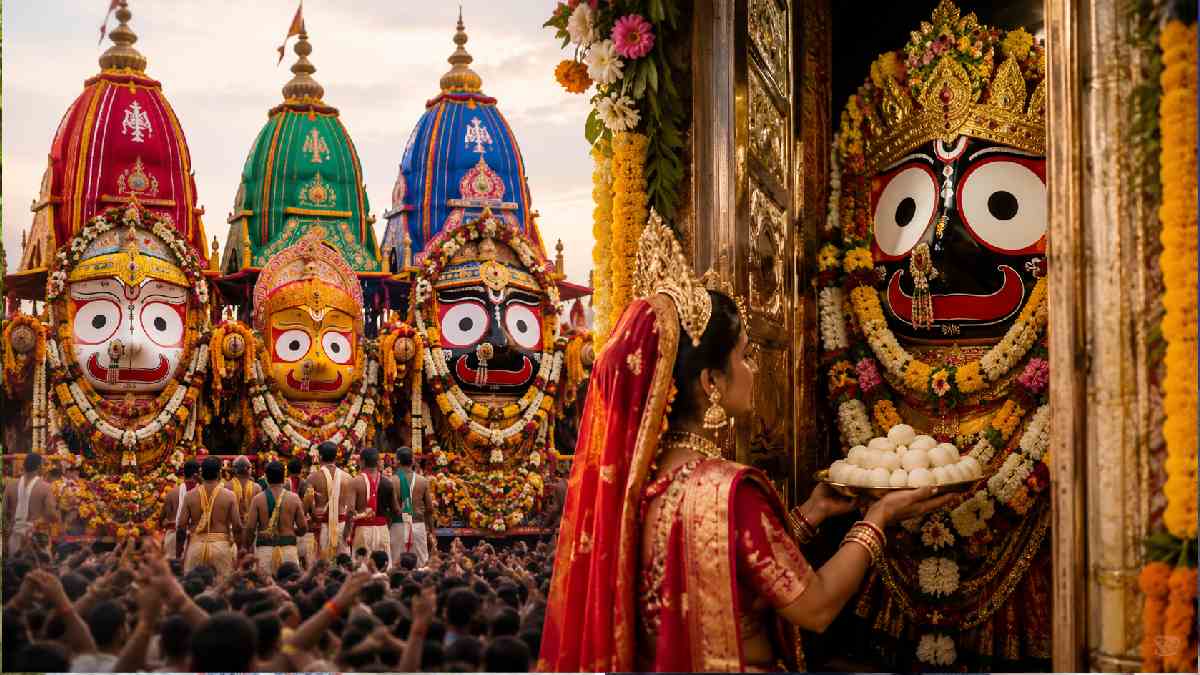
In 2026, the Rath Yatra started on 16th July and Niladri Bije is held on 27th July, bringing the sacred celebrations to a close with devotion, joy and centuries-old traditions.
What Does Niladri Bije Mean?
The word Niladri refers to the sacred Blue Mountain, the hill on which the Jagannath Temple stands in Puri. Bije means entering or taking one's rightful seat.
Together, Niladri Bije symbolizes Lord Jagannath’s ceremonial return to the temple and restoration to the Ratna Singhasana (Jeweled Throne), which ends the annual Rath Yatra.
God of the People: Lord Jagannath and Goddess Lakshmi
One of Niladri Bije’s most cherished traditions is the symbolic interaction between Lord Jagannath and Goddess Lakshmi.
According to temple tradition, after Lord Jagannath leaves for the Gundicha Temple with his siblings, Goddess Lakshmi feels disappointed because she was not taken along on the journey.
When Lord Jagannath returns, Goddess Lakshmi symbolically closes the temple doors and refuses him entry.
The temple servitors engage in a playful conversation between the divine couple. To seek forgiveness, Lord Jagannath gives rasagola (rasgulla) to Goddess Lakshmi as a gesture of apology.
Pleased with the offer, Goddess Lakshmi forgives him and lets him enter the temple. This touching ritual is love, mutual respect, forgiveness, and reconciliation in relationships.
The tradition has also inspired Rasagolla Dibasa, celebrated in Odisha on Niladri Bije each year.
Major Rituals of Niladri Bije
The closing ceremony includes several rituals.
Lord Jagannath, Lord Balabhadra and Devi Subhadra are taken down from their chariots. The deities enter the Jagannath Temple through the Jay Vijay Dwara in the traditional Goti Pahandi procession. The priests conduct Vedic chanting, sacred rituals, and special prayers. The symbolic reunion between Lord Jagannath and Goddess Lakshmi is carried out before the devotees. Rasagola and other traditional offerings are handed over to the deities. The deities are restored to Ratna Singhasana, marking the formal conclusion of Rath Yatra.
Niladri Bije is more than the last ritual of Rath Yatra—it has deep spiritual and moral values
The ceremony tells us that humility, forgiveness, compassion and mutual respect are the foundation of a good relationship. Lord Jagannath’s apology and Goddess Lakshmi’s gracious acceptance of the apology are all truths that remain relevant and relevant to the world today.
Niladri Bije is also a celebration of the Lord's return home for the devotees; that is, a holy journey is finished and the divine harmony restored.
We have thousands of pilgrims in Puri every year to witness this unique tradition, and Niladri Bije is one of the most emotional and spiritually uplifting events in Jagannath tradition.